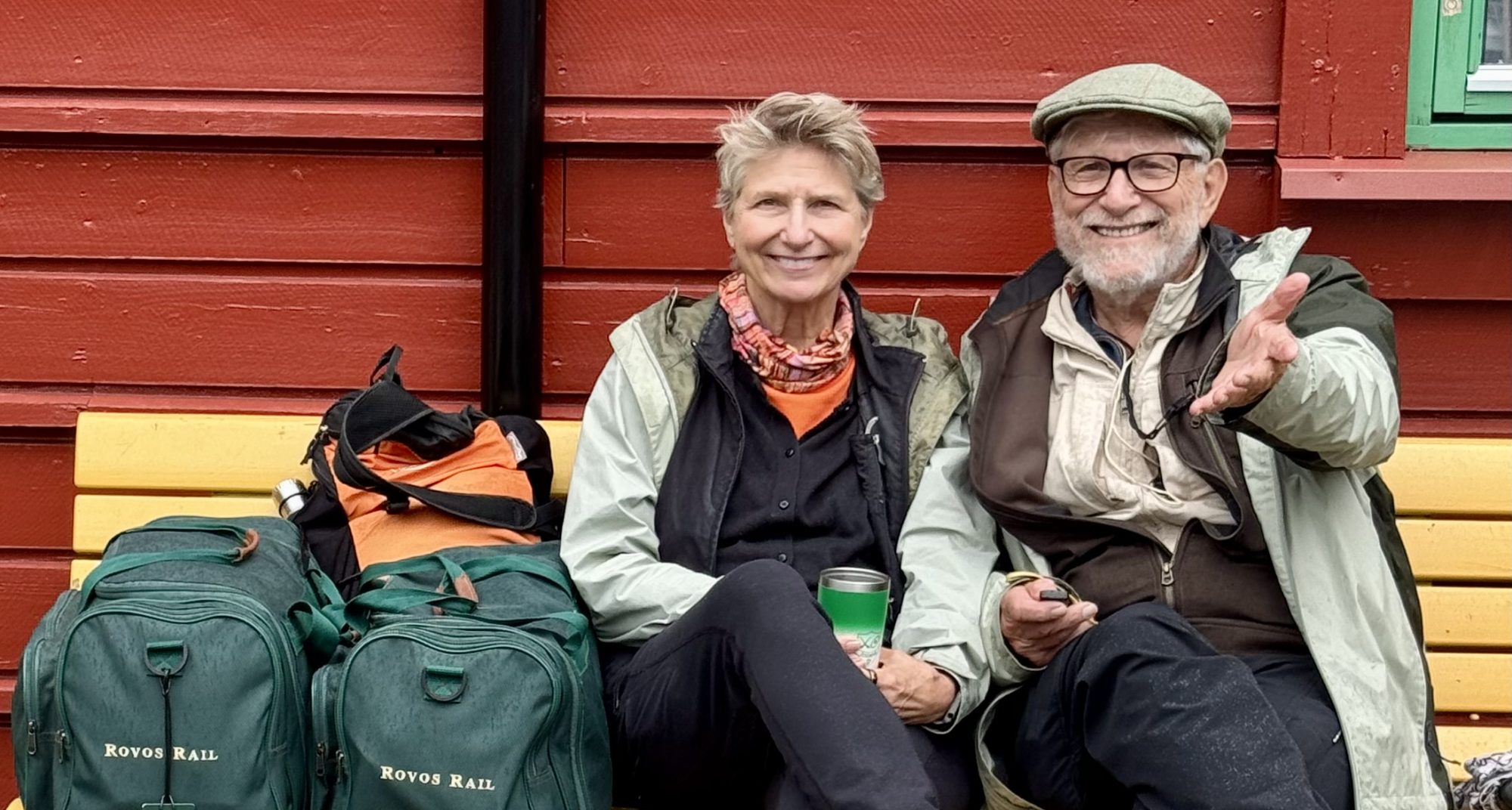
9 November – North Pacific Ocean
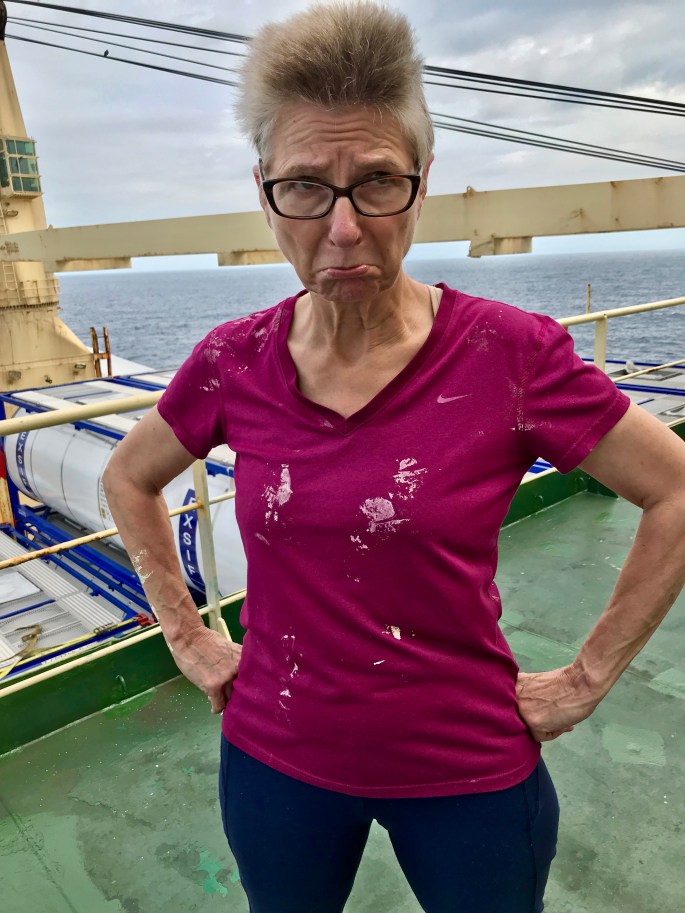
The crew has been scraping the rusty places on decks and railings and priming them with paint. They do not, however, feel the need to mark the freshly-painted spots, so the unwary passenger can and of course does get smeared.
The steward was very excited last night – he saw three splashes and a “big fish” off the starboard deck outside the galley…. maybe a whale! Oh, phooey – we missed it.
But then this afternoon, during a perambulation around the deck….. off to port appear a ripple and a shadow. A quick rush to the railing; the giant rolls over to show his tummy – a slick expanse of grey – and comes up again shortly after to expel a mushroom cloud of air from his blow hole!
It is so easy to forget the phenomenal quantity and variety of life that exists just beneath our feet…. and how vast that area is. The earth’s surface is something like 70 percent water, with an average depth of 5 kilometers, just over three miles. Unbelievable! Even at the greatest depths are exceedingly strange life forms of which scientists until recently were completely unaware.
But back on the surface, the officer on the bridge did not see the whale; as we describe the sighting to him, an area a bit larger than a full basketball court near the bow of the boat starts to shimmer……and suddenly a host of dolphins bursts from the water. There are easily a hundred of them in the group, executing smooth leaps and dives, one after another. An amazing display – they stay within a fairly consistent distance from each other, moving as a group further off to port. We follow their progress for a minute or two, then their number starts to dwindle until only one or two heads pop up, and then they are gone. It’s the finest moment at sea so far.
Several more viewings this afternoon – none quite so dazzling. A group of 3 or 4 dolphins play together, executing pirouettes in which they leap up, twist in the air, then hit the water flat on their backs. The loud “thwack” of the impact from each maneuver is audible on the deck. A couple of others rise up on their tails and seem to “surf” the wave that comes off the bow. And a mystery – twice “something” emerges from the water, shaped like a black and white triangle – almost like a ray had popped up. The captain guesses that it may have been a whale fin….
Wowie – today’s show was really worth the price of admission.
10 November – off the coast of Costa Rica
A few isolated dolphin sightings today, but very few. We must have sailed beyond their turf.
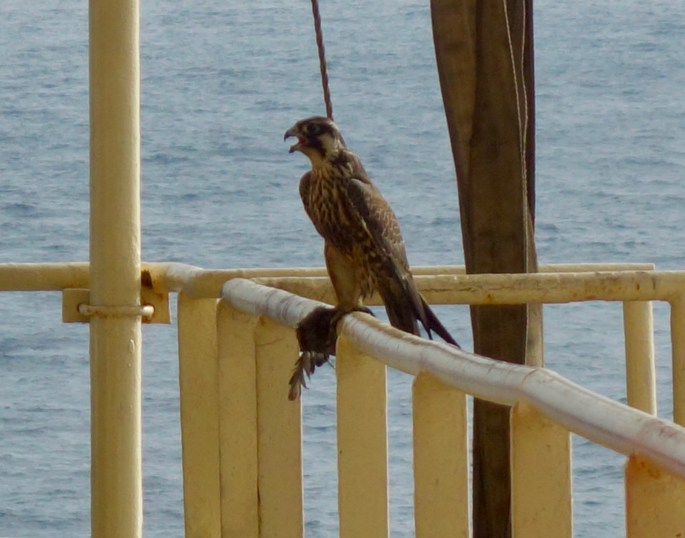
Two peregrine falcons – Wanda and Wes – join our floating menagerie today. They prey on small birds, hunting them in flight. We first become aware of their presence when we notice wispy feathers floating by. Investigation finds Wanda (the bigger one) hunching over a small dark body on top of one of the forward crane towers, tearing into fresh flesh. Wes (much smaller, a Mister Wimpet type) gazes at her fondly from a neighboring crane.
We figure this is the end of the stowaway sparrow, if she in fact lasted this long. Some swifts also started following the ship, and no doubt provide another source of food for the couple.
Wanda and Wes have no particular fear of humans. Wanda is in fact partial to perching on the railing of the pilot deck, not far from where we spend our time. At one point, she fluttered up to the railing with a newly-dispatched victim clutched in one of her claws. She gazed directly at us as though daring us to challenge her right to hunt and eat.

A third falcon stops by to check out the action, but does not stick around for long. These guys are monogamous; Wanda already has her Wes. And though he may not be much, he is definitely hers…….
11 November – Gulf of Panama
Hmmmm, what culinary outrage can we expect from the galley today? Wow – something green on the menu! Peas. Nobody can mess up peas!
Wrong. Here’s how you do it. Heat a small amount of vegetable oil in a big iron skillet over medium heat. Pull a large bag of frozen peas out of the freezer and dump them directly into the skillet. Stir for a minute or two, then turn off the heat and let them sit uncovered for no less than an hour.
The result – the skin of the peas is wrinkled and shriveled, and the flesh inside – while no longer frozen – is still not quite cooked. Tepid, mealy and flavorless. That’s how you screw up peas.
(Henry says they would work well in a pea-shooter. A better use, perhaps.)
Today we see land for the first time in almost 4 weeks. It’s still far off, but clearly mountainous and green. We question the crew about the timing for passing through the Canal, and have been told that we will begin somewhere between midnight and 5 am.
Since the Panama Canal is a highlight of this trip, we decide not to leave anything to chance.
After the sun sets, we put our loungers out on deck to admire the fine, starry night and have a beer.… When a light rain starts to fall, we head down below for a snooze, setting our alarm for midnight.
12 November – Panama Canal
12:01 am. The ship has anchored outside Panama City in an industrial area, and preparations begin for the Canal passage. It’s a cool and humid night; the lights of the city are far off behind some dark hills. Looking quite prehistoric, a giant brown pelican swoops around the ship, occasionally diving for the fish that are attracted to the ship’s lights.
Smaller boats approach to perform a variety of functions. One has some provisions for the ship – fresh veggies and bananas! Another brings an inspector who is lowered on a rickety swing over the side, possibly to check for parasites?
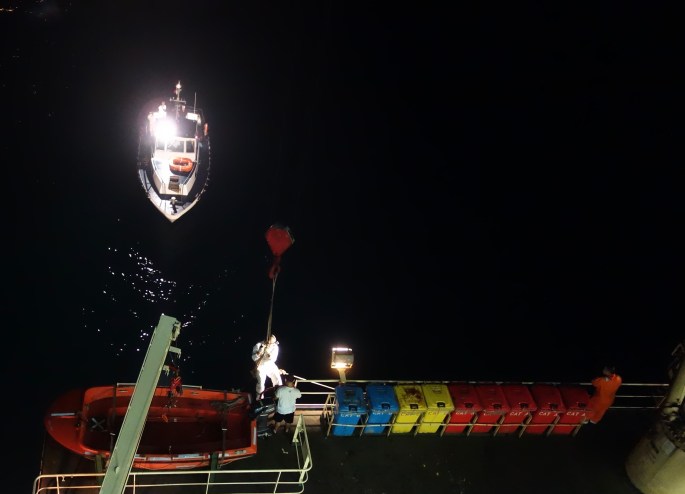
At some signal, the ship moves off across the bay toward the entrance to the first lock. On the way, we take on the pilot crew that will help guide us through. They climb one at a time from a moving tug boat up a rope ladder and swing over to a small platform that is extended from the cargo deck of the New Orleans.
About 3 am we are in line and ready to move into the first lock.
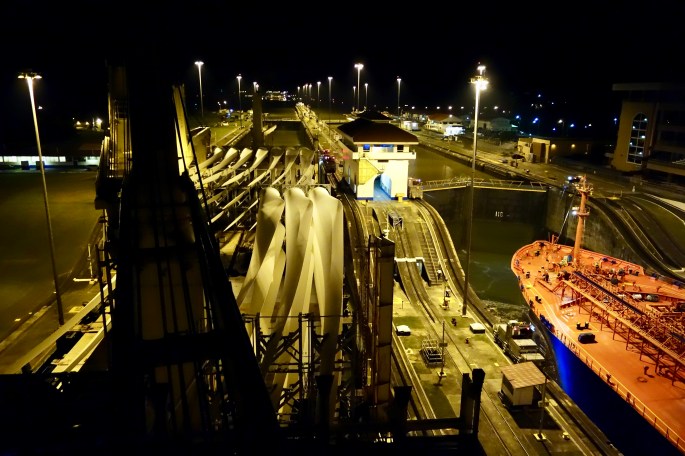
There are three sets of locks; from the Pacific where we are, the first lock is at the start of the canal. It lifts the ship through two or three stages up to the next level. It’s now 4:30 am, and we decide to take a little nap.
We arise just before 6 am as we enter the second lock, which takes us to the next level.

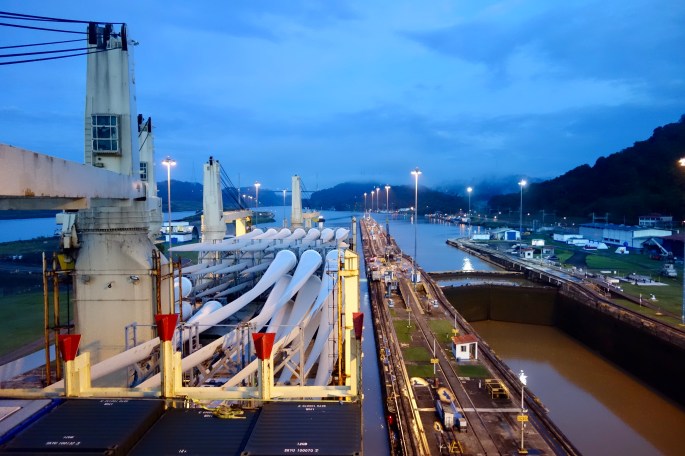
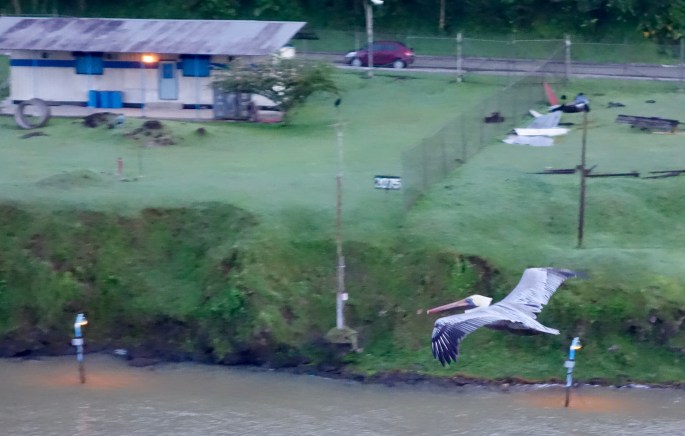
We are now in the jungle! The weather is perfect although it will get much warmer as the day continues. More of the huge pelicans fly overhead (their wing spans are up to 7 feet!), along with albatrosses, gulls and even some vultures.
After a false start by the French group which completed the Suez Canal some years earlier, the Panama Canal was completed by the US in 1914, an event that was almost completely overshadowed by the start of World War I. Many lives were lost during its construction – as many as 20,000 – mostly due to yellow fever and malaria, the vast majority of which could have been avoided with basic sanitary measures that are practiced today throughout the world.
Unlike Suez – which is basically just a big ditch, albeit one that was a real pain to dig – Panama is an extraordinary work of engineering and construction. The Canal has obviously been driven through the hills that lie on both sides of the passage here, overgrown with dark green tropical vegetation but clearly sculpted into deep terraces by the hand of mankind.
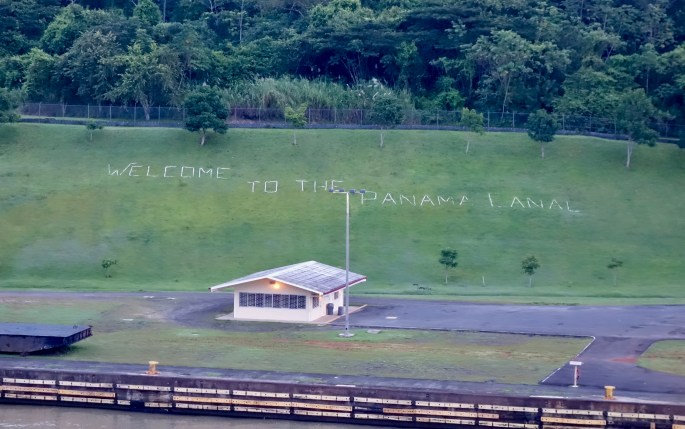
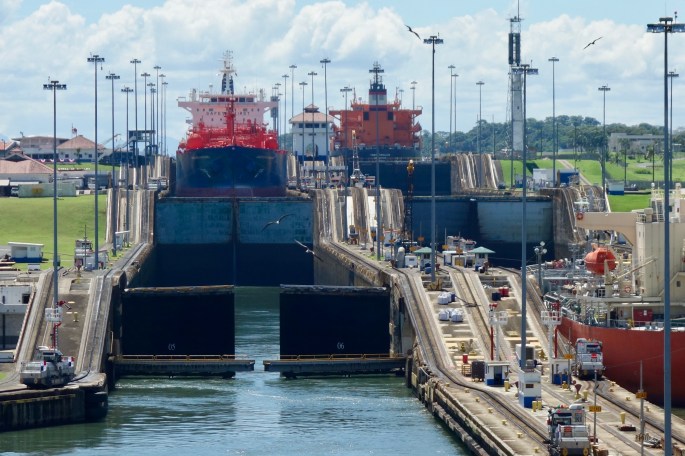
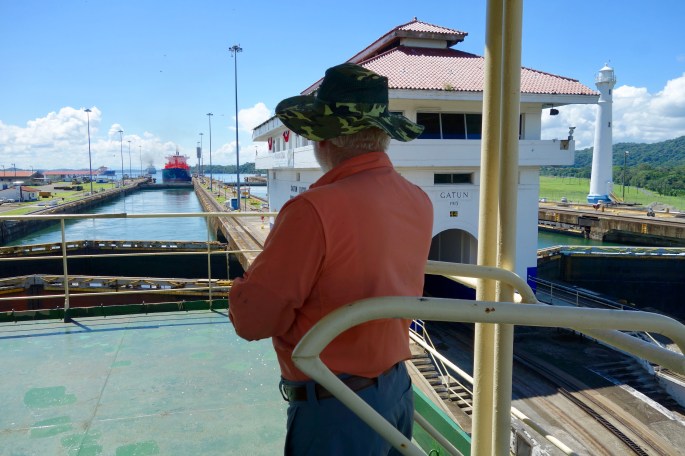
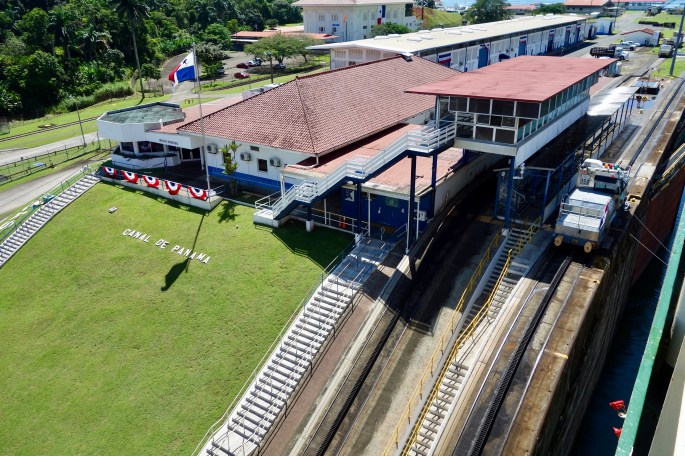
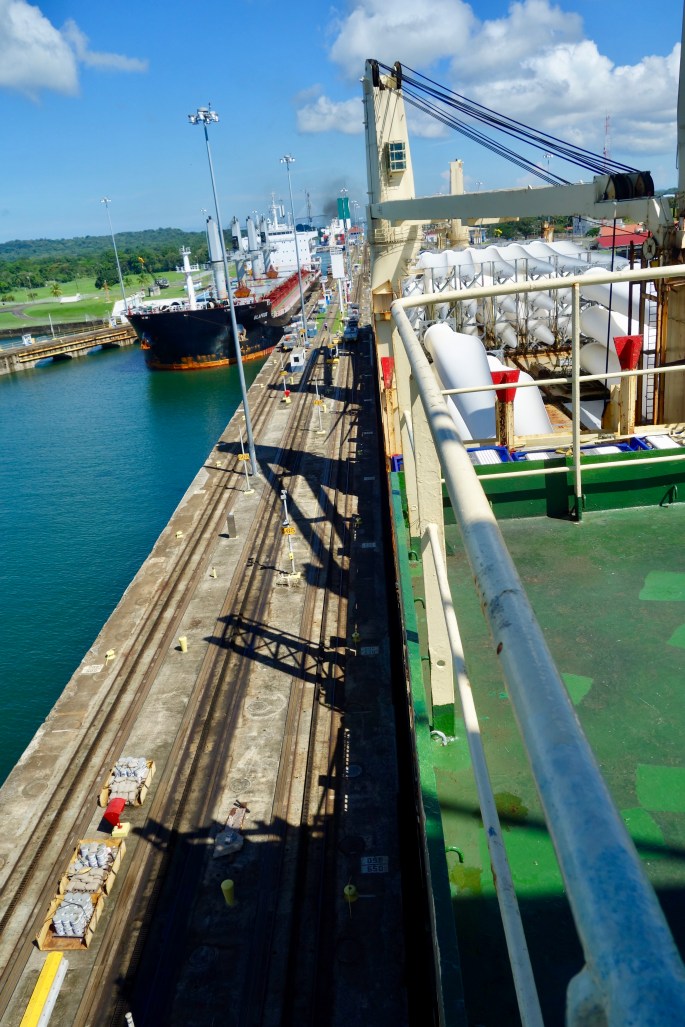
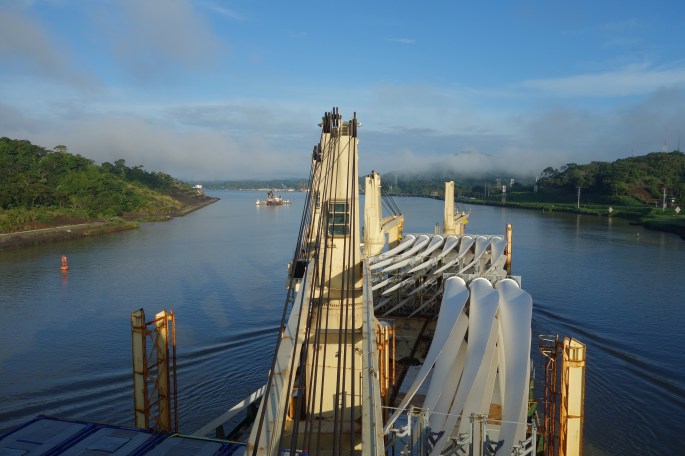
The Canal then opens into a broad but fairly shallow lake that has been dredged to accommodate the commercial vessels that pass back and forth. At the far end of the lake is the third lock, which returns us back to sea level on the Atlantic side. We have to wait a while here, but complete the process by about 1:30 pm.
We pass by the neglected-looking town of Colon, through its outer jetty with a gaggle of ships waiting their turn to go to the Pacific side, and on into the Caribbean Sea, which, protected as it is on all sides, appears startlingly calm and glassy.


13 November – Caribbean Sea
The water’s surface is a little choppy today; it’s cloudy and rains off and on.
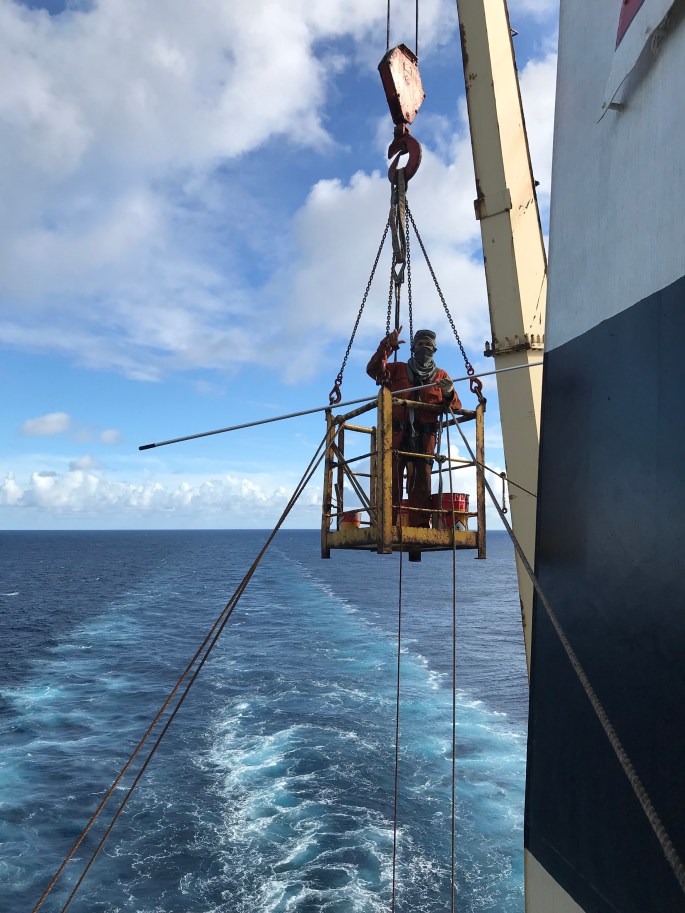
Despite the weather, the crew has been assigned to continue the painting project on the deck around the Blue Bar, where we spend most of our waking hours. The Blue Bar is the only place on the ship with somewhat effective air conditioning, which was not a big issue until we arrived in the tropics.
We decide to take a short nap, and lie down on the plastic lounge chairs we have installed in the Blue Bar to take advantage of the coolness. As we start to drift off, it occurs to the more alert of us that the paint fumes are very thick, and we might have trouble waking up. We spend the rest of the afternoon in the less toxic but stickier discomfort of our cabins.
We are alone again for the most part. The falcons decided that the pickings were better on the Pacific side of Panama; the sparrows are gone; the dolphins have not popped up, and passing ships are few and far between. Just a few gulls wing their way around the bow.
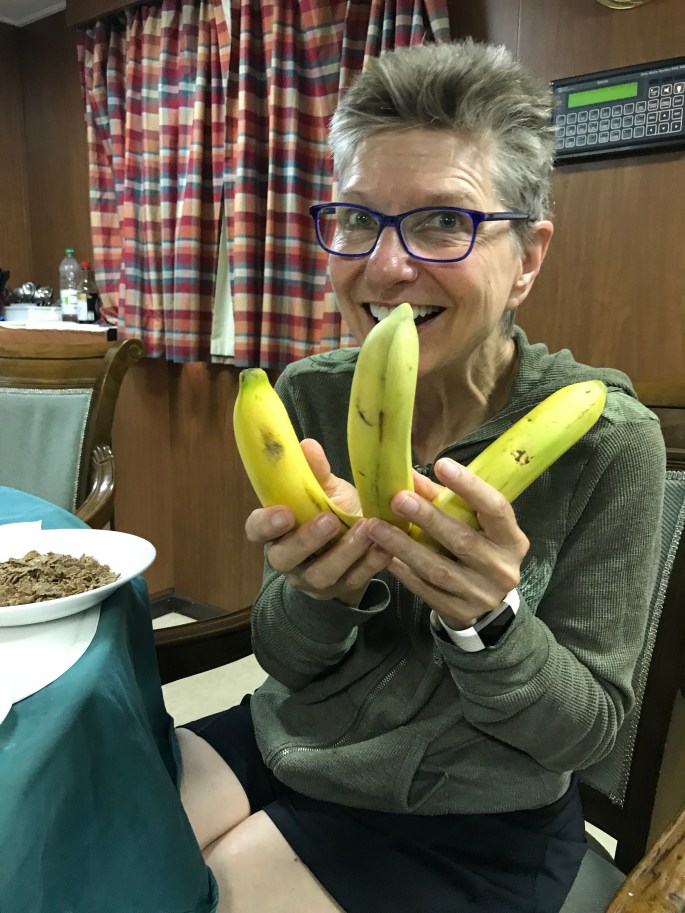
Think I’ll have a banana.
14 November – Caribbean Sea, west of Grand Cayman
Some rain today, and the wind has picked up.
The falcons have not abandoned us after all! Two of them were zooming all around the ship at sunset. They were either engaging in very spirited play, or else they were fighting – banging into each other and squawking. We could hear them in spite of the strong wind. Could be Wanda and Wes having a spat, or possibly the stranger, back to challenge Wes for Wanda’s claw…. Or possibly two completely different falcons.
15 November – Gulf of Mexico
Early this morning, we pass between Cancun and the tip of Cuba, and on into the Gulf of Mexico. We are on track for arriving in Corpus Christi the afternoon of the 17th. We’ll spend some time there with Henry’s sister Ann and husband Jerry while the windmill wings we’ve been carrying are unloaded and packed off to West Texas. Then we re-board the New Orleans for the final push on to Houston.
Drama in the galley (other than the day-to-day desecration of all that’s holy in nutrition) – Mark the cook, whose contract would otherwise be up in Houston, has been asked to stay on for two more months, thus missing Christmas with his family in the Philippines…. again. In a desperate move, he proposes promoting the steward to take his place as cook. For what it’s worth, the steward is the likely perpetrator of the Crime against Peas mentioned a few days ago.
Mark is a clever guy – hope it works out for him. He tells Henry that he deliberately makes the food unappetizing….. if it were good, the crew would chow down like hogs at the trough, and the galley would run out of provisions.
 Travels with Henberta