
2 November – North Pacific Ocean
Ed passes away peacefully this afternoon. We heard his chirp last night; he was sluggish this morning, and then just shuts down. Of course we knew his time was coming, but you’re never really ready.
His remains will accompany us for the rest of our trip; we are planning a Viking funeral – complete with floating flaming pyre – once we have returned to East Texas and settled in a bit.
His life was brief but remarkable (for a cricket). From presumably humble beginnings in Xi’an, China, he traveled to Nanjing, Beijing and Tianjin, then traversed the greater part of the Pacific Ocean. We like to think Ed’s spirit will continue on with us as we complete the adventure he was able to actively share only for a short while.
As if in tribute to his passage, the evening sky puts on a phenomenal show, the likes of which neither of us has ever seen. Not just a sunset, though that is part of it. Yes, to the west the sun reflects off multiple layers of long narrow clouds lying above the horizon, in shades from rich gold to bright salmon to smudges of purple. But the rest of the sky – from unbroken horizon to horizon in all directions – is clear and robin’s egg blue, with very high feathery cirrus clouds scattered all about, reflecting the only slightly fainter pinks and yellows of the light. And to the east, the moon, just a hair’s breadth short of full, rises to take its place in the sky. As if an enchantingly-painted bowl of unimaginable scale has been upended on this spot in the ocean, and we are the only witnesses to the display.

It lasts, as these things do, not much more than 15 minutes, during which time we circle the deck breathlessly, tipping our heads back and whirling around to take in the otherworldly panoramas. Then, of course, the colors fade away….. until the only illumination left in the universe is the silver of the moon, reflecting off the now black water tipped with occasional flecks of foam.
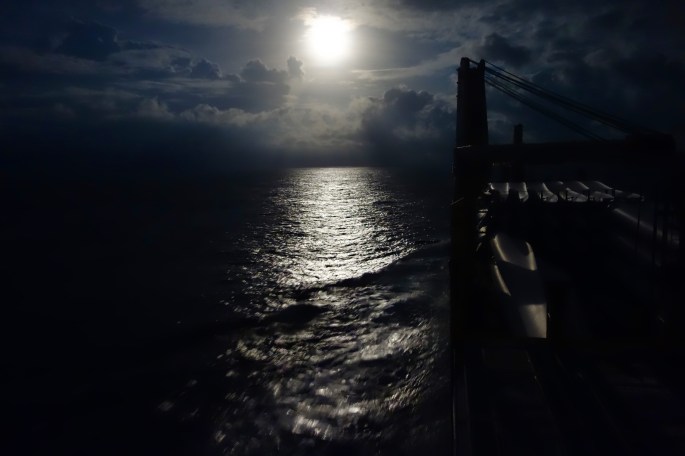 What a tribute from Mother Nature. Godspeed, Ed.
3 November – North Pacific Ocean
Just a quiet day – no chirping ever more.
We now have 11 birds following the boat. Captain claims they are living on board somewhere as stowaways, although it’s hard to imagine that many of them sharing quarters. He also says he has seen the little sparrow, who boarded in China.
Tonight’s sunset is a drab nothing compared to last night’s. This evening, however, a very full moon rises… and peeks out through heavy clouds.
4 November – North Pacific Ocean
The captain initiates a safety muster this morning. It’s a topic that is taken seriously, and everybody participates with complete attention. (We never had a safety meeting on the container ship, although the T’ird Officer showed us how to don an immersion suit, which was really cute.)
A barbecue party is held for the crew and passengers tonight.
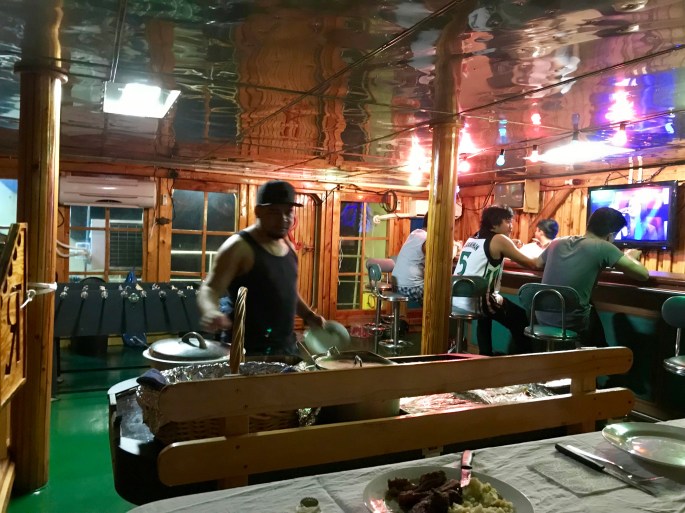
Henry is relentlessly determined to find common ground and a friendly rapport with this crew, in spite of repeated snubs. We find a beaten-up Italian atlas in one of the unused lounges, which he works on painstakingly, repairing the binding and tagging pages of interest. Armed with the atlas, a highlighter and two computers – one with photos of travel and home, the other with his prodigious and eclectic collection of music – he holds court in the Blue Bar. His attempts with music fall flat pretty quickly – Hank Williams is abandoned in favor of the unidentifiable, mediocre soft-pop vocal renderings favored by the Filipinos. A core group clusters around the photos on display, with near-endless questions about Henry’s life in the piney woods of East Texas.
He scores a real hit, however, when he says, “Show me where you’re from!” while offering the open atlas and highlighter. All the crew come forward, with everything from a happy story to just a shy grin as each specifies his spot on the map. Even a couple of the Romanian officers (who have mostly isolated themselves on the outdoors deck) grudgingly make a mark in the book to signify where their homes and families await their return.
(Note about the officer group – no surprise that they are not particularly friendly. This is a solitary job, far from wives, kids and parents for many months on end. Good for loners – if they were gregarious and extroverted, they would be working on cruise ships.)
5 November – North Pacific Ocean
Sundays we get pancakes for breakfast and the crew (except for the officer-in-charge and galley staff) takes the day off. Not sure what they do – it’s spooky-quiet all over the ship. Fortunately for them (and probably essential on such a long trip), each crew member has a private room, very much like the cabins we inhabit.
BUT, the ever-weak internet service is not working at all…. we are supposedly in a satellite “blind spot.” So e-mail and catching up with the folks at home is not an option.
6 November – North Pacific Ocean
Everybody knows about jet lag. You would think that passing slowly from one time zone to another over the course of days would not take much of a toll, but it does so insidiously. The body clock shifts and is always a bit off. Some times you lie down at night and can’t sleep at all; other times you fall asleep at 9 pm and wake up at 3. Don’t even ask about gastro-intestinal habits! (If you must, ask Henry. It’s a subject near and dear to his – ahem – heart.)
7 November – North Pacific Ocean
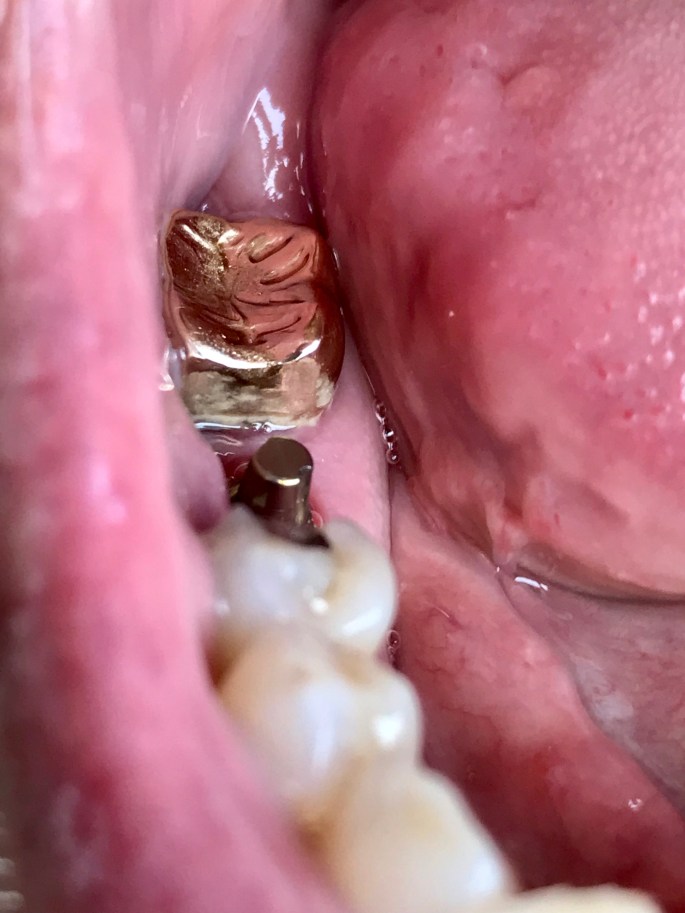
Henry loses a tooth.
Well, it’s not actually lost – it’s right here. Just popped out between bites of bland and gristle-y food at lunch. And it’s actually an on-lay that fits over an implant that was installed a couple of years ago. He’ll survive.
And speaking of physical complaints, I have a rash on my back and my fingers are stiffer than usual in the morning.
All attributable to poor diet, which I will not carry on about further.
Speaking of inevitable decline, Ed’s body is not desiccating as we had hoped, but collapses slowly in on itself. May have to do a burial at sea after all.
8 November – North Pacific Ocean
Good news all around. The internet service is low-functioning again. And rumor has it that we may get bananas in Panama!
We still have the feeling of being out alone on the ocean. Since we entered the Pacific Ocean more than three weeks ago, we have personally seen a total of 3 other far-off ships. Even as we do so, it’s hard to fully fathom that this ship is trudging along at an average of 14 miles per hour, all day, every day, covering the 9,600 miles from our last port, Tianjin, to Panama. And won’t even re-fuel until we get to Houston!
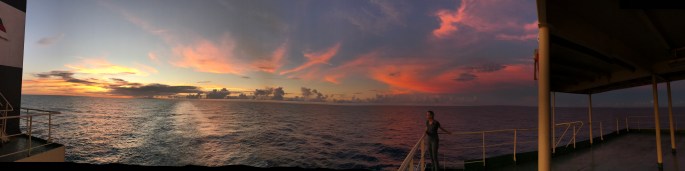
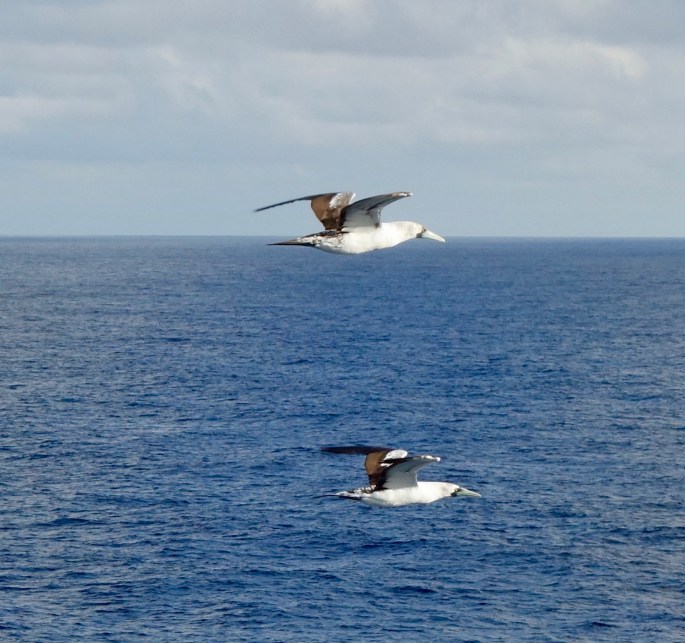
Our bird population, now numbering about 13, includes some sort of frigate bird and albatrosses.
The poor, maligned albatross. Was it Samuel Taylor Coleridge in the Rime of the Ancient Mariner who doomed this magnificent bird? To be forever a synonym for an insufferable burden, draped around the neck of the unfortunate, bereft of all human succor and pity. How unfair.
The albatross is a big diving bird. He sails alongside the ship, scanning the water for some sign of prey on or around the surface. When he sees a fish, he executes a sharp and swift dive straight into the water, remains submerged for a short while, then pops to the surface, with or without a delicious prize. Then off he goes again. Little of his life is spent on land; he derives both food and water from the ocean, fish flesh filtering out the salinity of its water content. I guess he finds a niche on board to sleep in at night, or maybe he floats on the ocean’s surface.
To watch him soar is the best. He can glide without flapping his wings for up to 6 hours at a time, his body automatically making the small adjustments required to maintain his flight. Imagine such a pure sensation! He’s King of the World!
 Travels with Henberta
so sorry to hear about Ed. Rex
LikeLike
How wonderful to hear from you and Bruni! Will send e-mail to catch up once we get on land…..
LikeLike
Hi… it’s Bruni! So sorry to hear about Ed. What a great adventure he had! We are so enjoying your blog. ( Brian G was kind to share info while we were in Puerto Vallarta.)
xoxo
LikeLike
Yet another wonderful description. I hope you took some photos of that lovely sunset. By the way it is the Rhyme of the Ancient Mariner. I’m sure it was the computer correction that got it wrong. It makes me mad , this predictive texting!
LikeLike
Thanks Noelle. Henry took some photos of the sky, but I’m not sure they will capture the big picture. Interestingly, in US textbooks it’s “Rime of the Ancient….” Don’t know why. Maybe the use of an archaic version of the word better captures the tragic gravity of the piece……
LikeLike
I stand (sit) corrected. My memory of the poem is from school, so many years ago. After an internet search I see that the original verse is Rime of the Ancient Mariner. Over 200 years ago. The only albatross Ihave seen was in New Ireland a few years ago. Poor thing was on his own , I presume after loosing his bearings. Keep on posting.
LikeLike