Xi’an, Part II

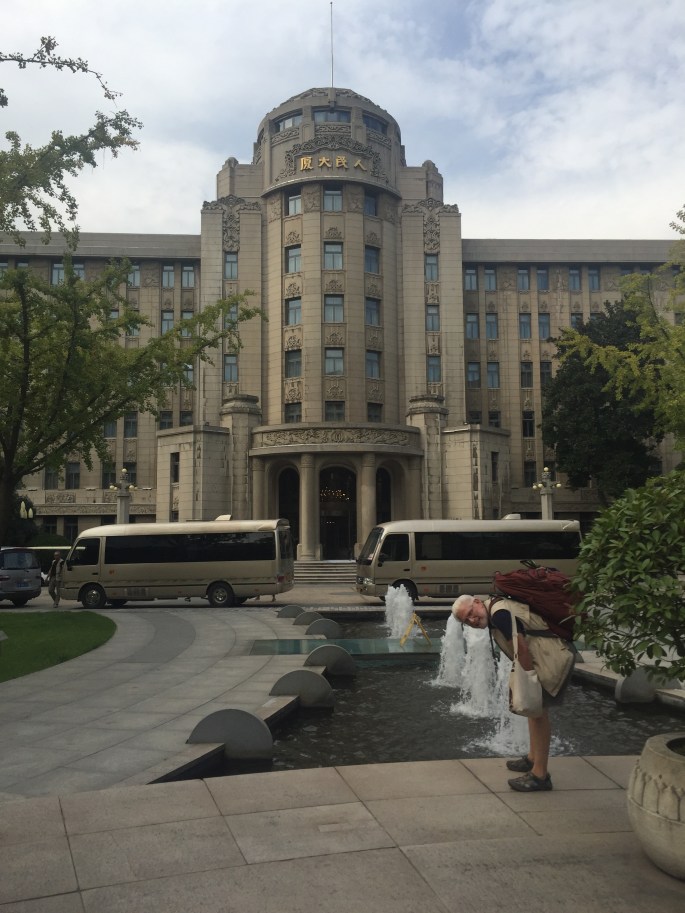
Xi’an was the most logical stopping point for our journey from Xining to Nanjing.  Our first stop, we stayed in a very luxe hotel that was built in 1953 (what a great year!) for China’s Soviet compadres….

IMG_4224

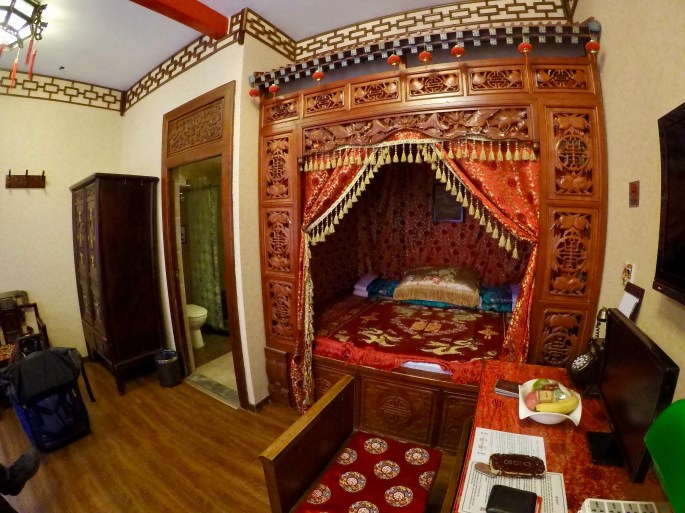
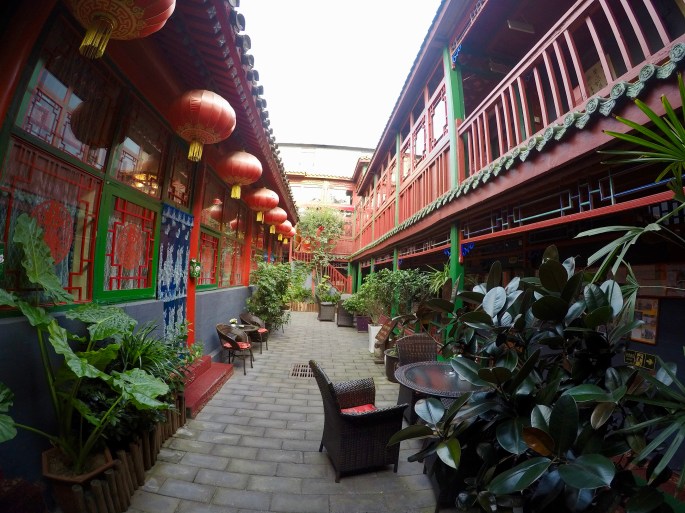
This time, we stayed in a garden hotel that was small, very Chinese, and lovely:

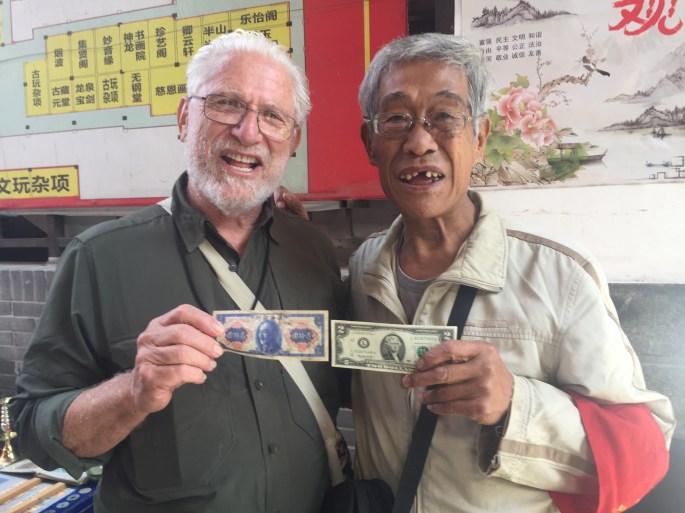
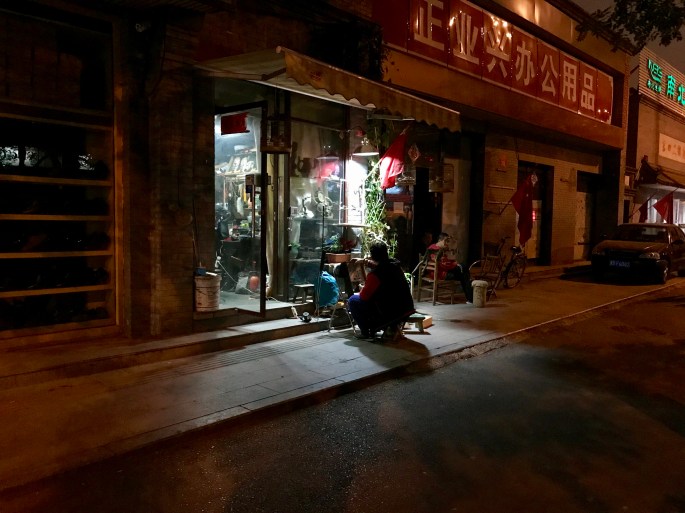
Most of our time was spent walking through the fascinating streets….. Henry traded some legal tender US dollar bills for some obviously counterfeit Chinese bills, to the delight of all parties:

IMG_4296

Equally pleasant was the acquisition of Ed and his house:

IMG_4301.JPG

Ed’s first outing was dinner at a noodle restaurant with some folks celebrating China’s National Holiday, which runs a full week from 1 to 8 October.

IMG_4308

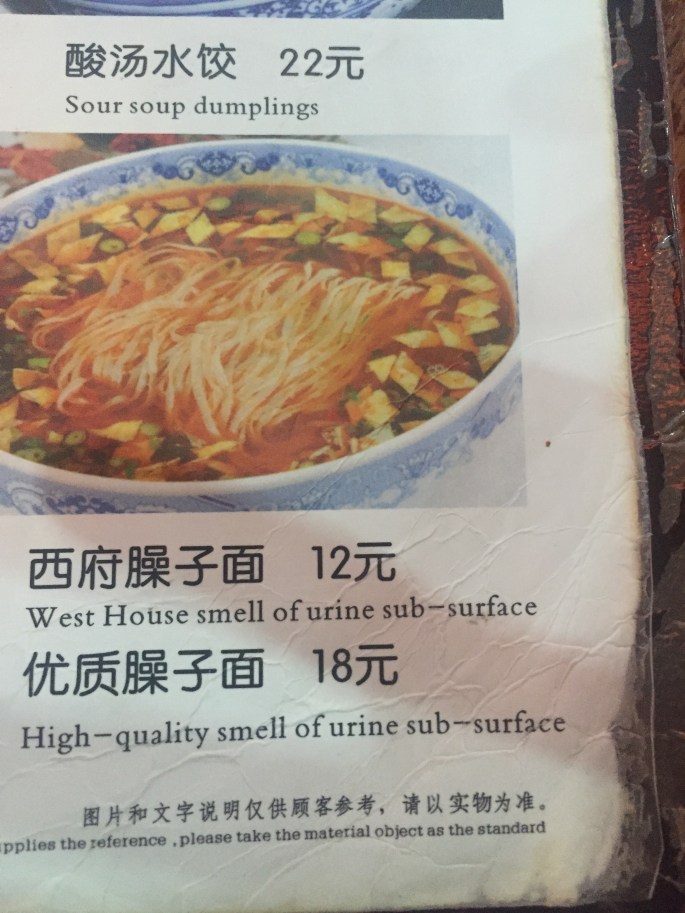
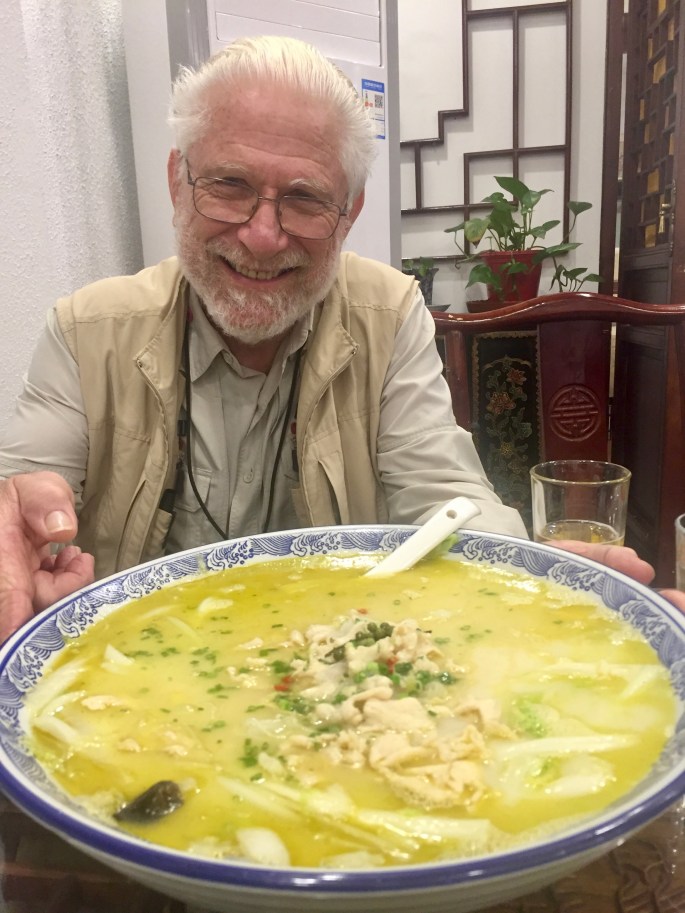
An interesting noodle-house menu item:

IMG_4306

Being affluent western tourists, we would only consider the high-quality version of this dish!


Nanjing

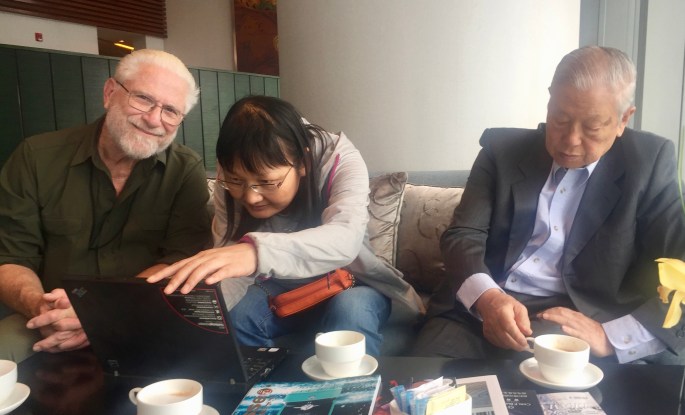
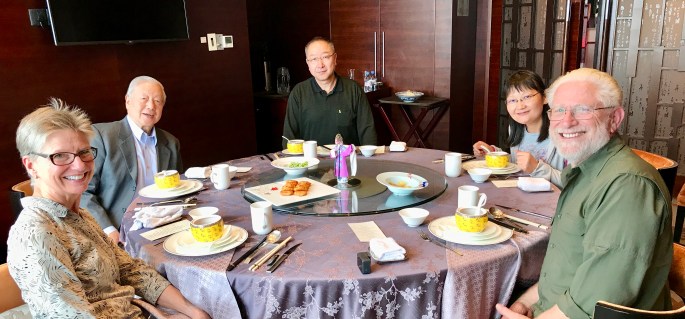
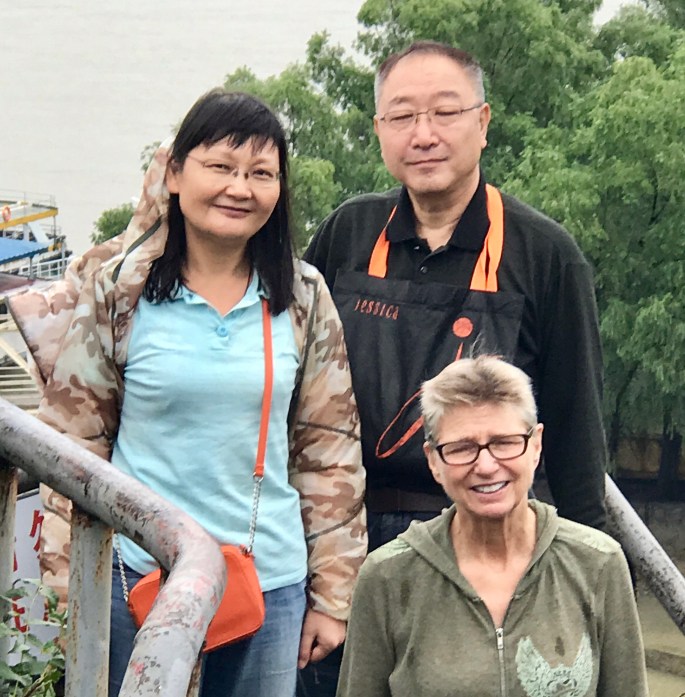
Henry has had a good time catching up with his agricultural colleagues from Nanjing University, including Zeng, He Shanan and Yu Hong (and her husband) to talk about blueberry cultivation here:

fullsizeoutput_79afullsizeoutput_79cfullsizeoutput_7b4fullsizeoutput_7a3

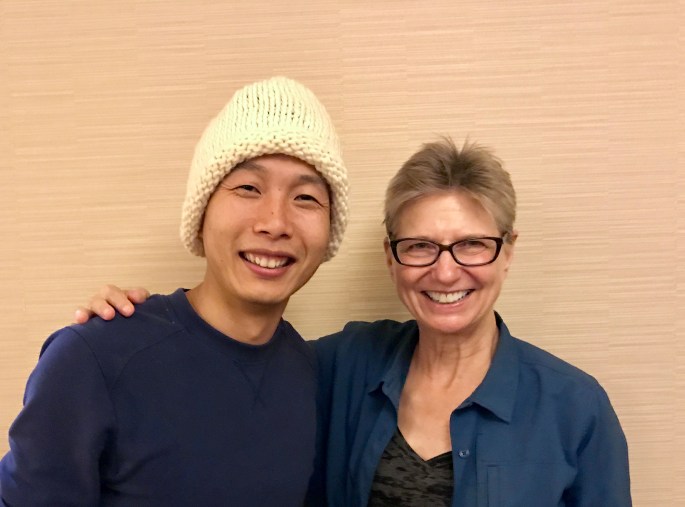
We said goodbye to Zeng for now, with his solemn assurance that he would come to the US to visit before long.  (Please note, he now has a new hand-made knit hat!)

fullsizeoutput_7a2

Most of our time here, we stayed on the 68th Floor of a modern Western hotel; Ed loved it:

The street also yielded a variety of interesting cultural experiences, especially since it is the China National Holiday week, when virtually every citizen is traveling around the country:

fullsizeoutput_7b7

And Ed, as usual, enjoyed his surroundings:

fullsizeoutput_7b5

Off to Beijing tomorrow, amid the hubbub of the holiday traffic.  Hope all of you are well and happy!

Beijing

Hordes of citizens on the move for the 8-day-long national holiday have rendered travel through-out the country a stressful, sweaty ordeal for those of us not accustomed to being pressed together like a Peking duck.  The government has gleefully reported that more than 705 million “trips” were taken this past week within the country by its residents.  Not clear how “trip” was defined, although they pointed to train and highway statistics.  People in the crowds are incredibly good-natured about the jostling, although no less insistent on reaching their destinations.

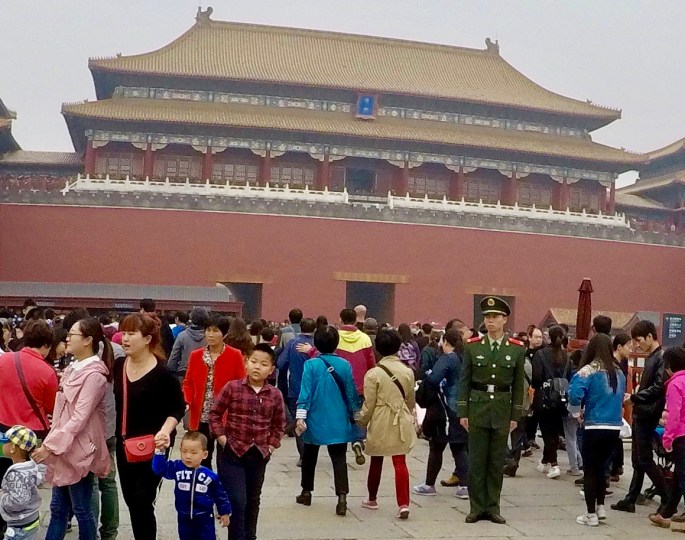
Attempts to visit points of interest in Beijing were miserable.  The entry point to the Forbidden City was clogged with visitors, and security officers were monitoring movement through-out.  We didn’t go past the gate.

DCIM101GOPROGOPR3777.JPG

Tianamen Square had literally tens of thousands of souls trundling slowly through, and we gave up on that as well (but not until we had elbowed our way through to an apparently quiet location for a selfie):

DCIM101GOPROGOPR3785.JPG

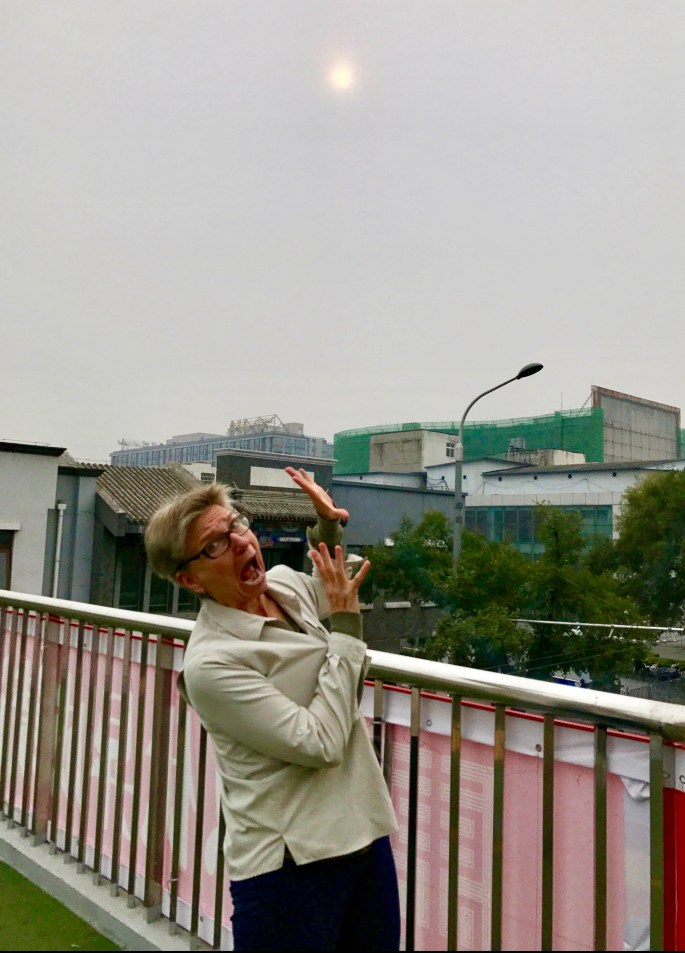
This was the closest thing we got to a glimpse of sunlight, initially because of the ubiquitous smog; later because of clouds and rain:

fullsizeoutput_7cf

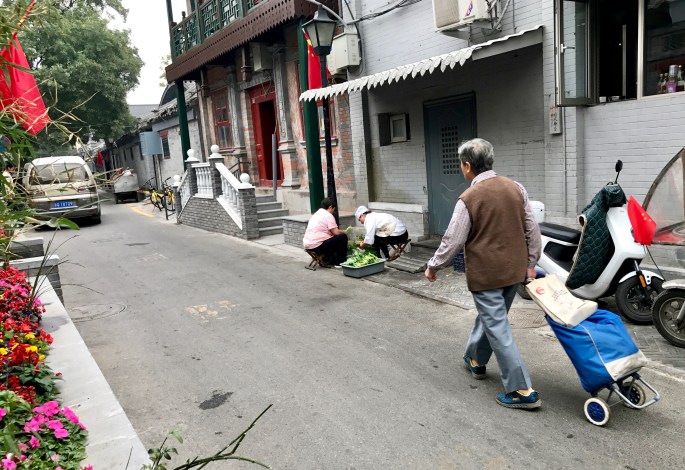
Initially, we stayed in a 500-year-old building in an old Hutong, or historic neighborhood, down an alleyway in the heart of the city where people live publicly as they have for generations:

fullsizeoutput_7cefullsizeoutput_7daDCIM101GOPROGOPR3757.JPGDCIM101GOPROGOPR3759.JPG

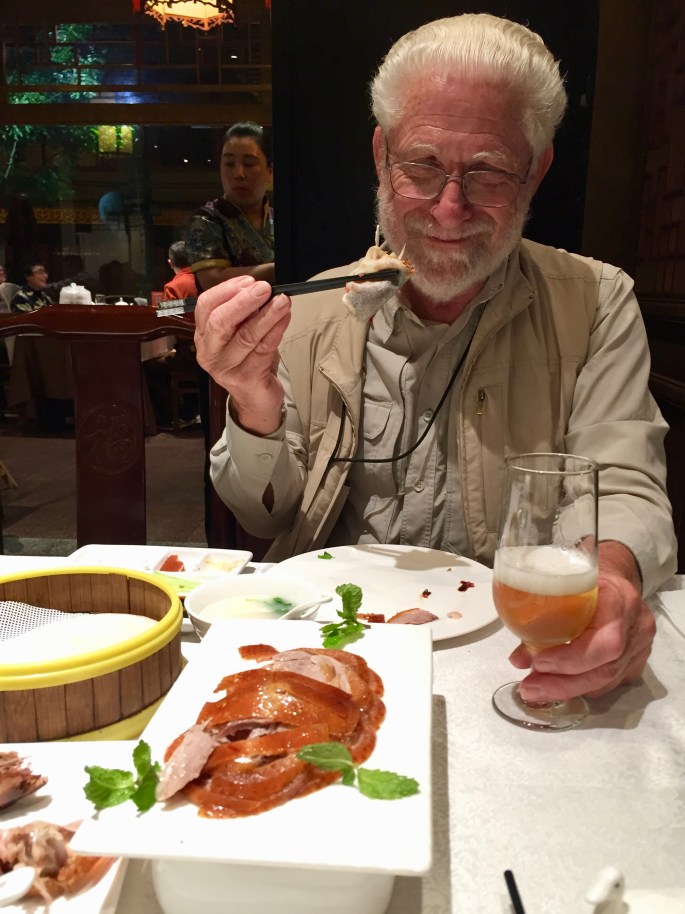
Lots of great food, of course – all Chinese – including the renowned duck referenced earlier… 

fullsizeoutput_7dffullsizeoutput_7dc

Very little popular interest in cuisines from other countries, except in places frequented by Western tourists – not even Mexican food or pizza!!!!

Cautionary note for independent visitors to the big cities here – we were approached several times by apparently well-meaning, congenial folks with excellent English, claiming to be artists or teachers.  They welcomed us to their country, engaged in small talk about our trip, and invited us to visit an art gallery with them.  They were in fact the nicest rip-off artists you could ever meet.  We were warned about them at the hotel….. but also have to admit to having been hood-winked in a similar situation when we were encouraged to attend a “tea-tasting” in Shanghai three years ago.  Yes, we were “Shanghai-ed”!  They back off pretty quickly when you make it clear you have other things to do…… but visitors should understand that they hope to get their hands on some of your money – not through out-right theft but by over-charging for goods or services you don’t really want.

Tomorrow we head to Tianjin for a day or two before boarding the ship for the final segment of our voyage.

Twelfth Port – Tianjin

Ed has become quite the accomplished train traveller:

fullsizeoutput_7e5fullsizeoutput_7e1

Let’s hope he’s as good on boats, since we are getting on one tomorrow!  Back to the Rickmers m/v New Orleans, which we have not seen since the first of July.  

Tianjin, a port only about 50 kilometers from Beijing, is a way-station for us.  We have been shopping here for snacks and alcohol to sustain us on the extended voyage back to the US.  Leaving the port on Friday 13 October, our next point of interest (barring typhoons or nuclear attacks) will be the Panama Canal, then Corpus Christi, ETA 14 November.

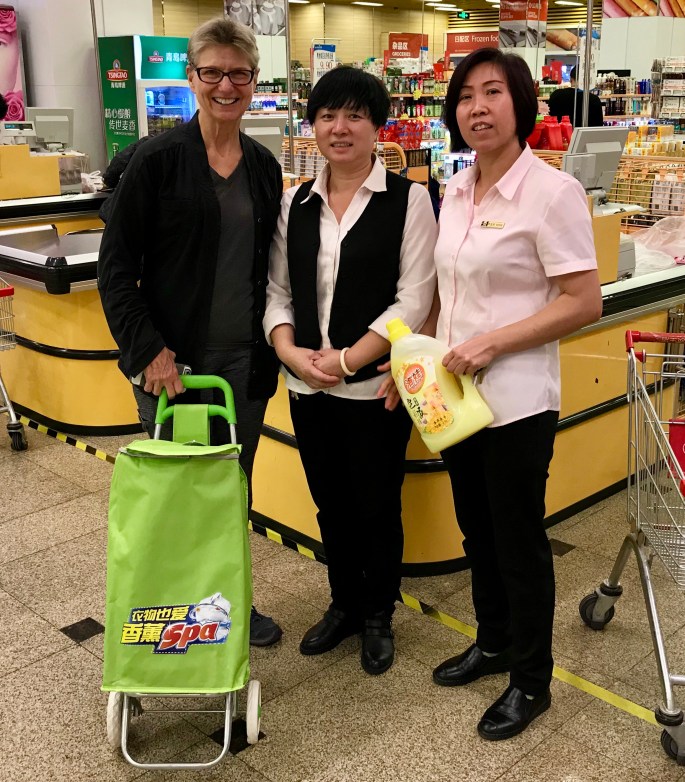
The local shopping mart was typical of so many here, but we had a great time negotiating the acquisition of a promotional item (the wheeled carry-all) from the store ladies without a single syllable of common language between us!  (We had to buy a large bottle of dish detergent which we gave back to them…)

fullsizeoutput_7ed

Speaking of shopping malls, we have found that some of the best places to eat in cities are in the mall food courts – lots of options, not outrageously expensive, and the food has been amazingly delicious…. much fresher and tastier than what we have been getting at the hotel buffets.  

Over previous visits and the past 5+ weeks, we have formed many impressions of China, its people, its politics and the ways things have been and are changing – thoughts and opinions that are out of the scope of an on-line blog.   Looking forward to sharing those with any of you who are interested in the future.

For now, we wish you all well and will plan on sending one or more short postings from time to time from the New Orleans, as internet service may allow.  Certainly should have much to report from Corpus Christi before returning to Houston on or about 18 November.  Very excited to be entering the last phase of this adventure, and eager to complete our great circumnavigation.


Diary at Sea

Update – More or less back in civilization now, and will add photos to the last few blog posts….

12 October, Port of Xingang, China –

The ship is much smaller than it used to be. With help from two seamen, we wrangle all of our baggage aboard and into our two small rooms. Find out immediately that the ship will be delayed as much as 2-3 days, awaiting delivery of cargo. Would have stayed in Tianjin had we known.

About a third of the crew are familiar to us – the others have all changed since we disembarked the ship in Hamburg around the first of July.

As it turns out, this Rickmers line is being sold to another firm, Seaborn. The ship’s registry and flag will change when we are close to our passage through the Panama Canal, set for on or around 6 November. This news has been met glumly, as scuttlebutt says the new company will pay less for more work.

13 October, still in port –

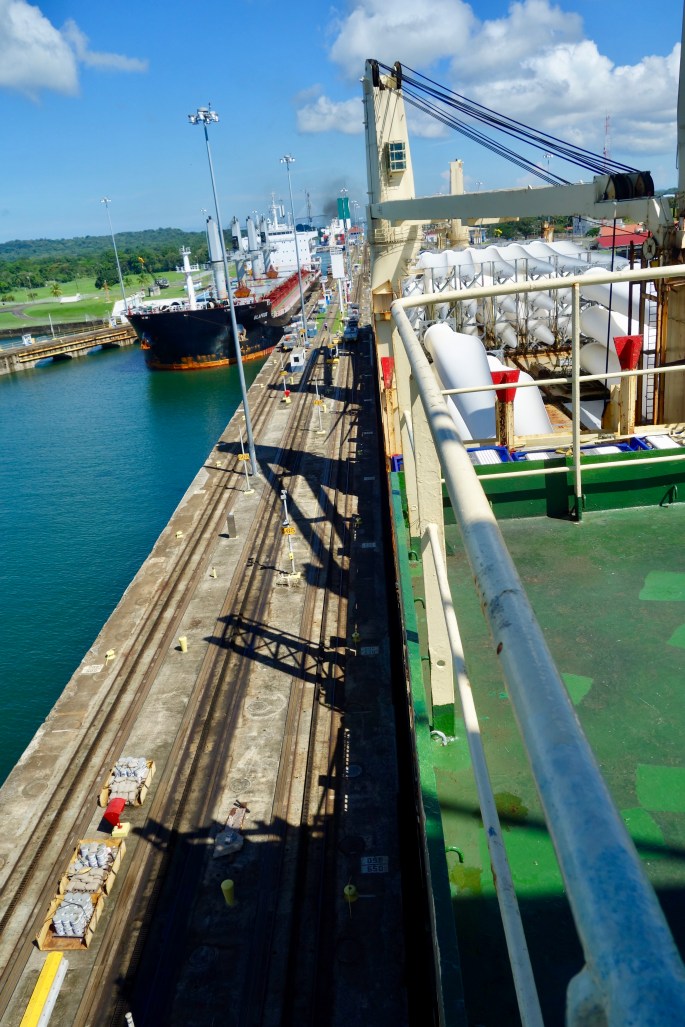
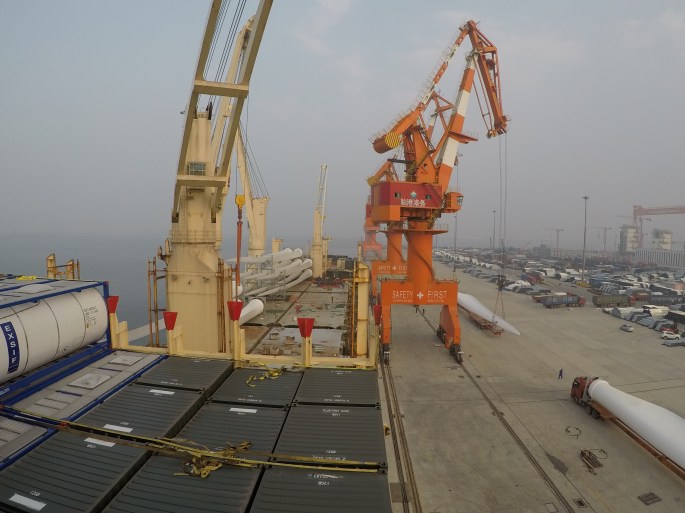
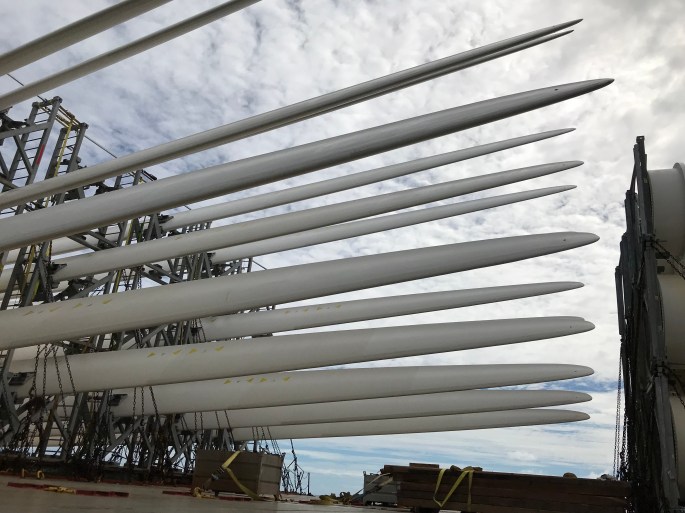
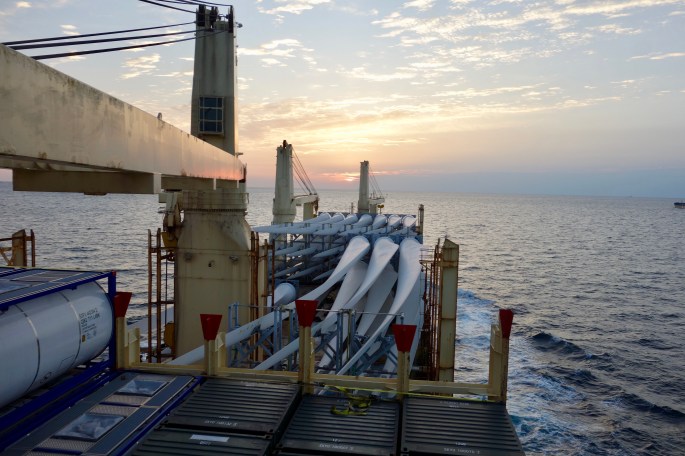
The ship’s top deck is being loaded with 33 windmill wings, to be transported in addition to other cargo. They look quite graceful, destined for unloading in Corpus Christi, ultimately to populate West Texas wind farms.

DCIM101GOPROG0273892.JPGIMG_9937

We are desperately trying to figure out a way to get back into town. After our first mute and miserable meal with the crew yesterday, we determined that we don’t have nearly enough alcohol to get us through the next 36 days. The challenge is to find reliable transport into – and more importantly, back from – town that won’t rip us off. The captain is unable to get a recommendation from his port agent, and the service that brought us to the ship suggests we should just find a taxi.

But where? The port area is heavily restricted for both security and immigration/customs reasons. This is one of several tragedies for the professional seaman. He may get shore leave when in port, but has few options on where to go. He is not well paid, so a $100 taxi fare is out of his range. He likely does not speak the local language or know where it would be best to go in the port city. He is a target for predators who will take advantage of all of these things to deprive him of what meager assets he has. In some countries, charitable organizations and/or churches have set up Seamen’s clubs where the crew can go to relax, call home and enjoy some time away from the workplace. They even provide free transportation from the dock. And sometimes enterprising businessmen have legitimate stores at or near the port, where goods may be sold duty-free or not, but at reasonable prices.

Sadly, such options do not exist here, so we decide that we must ration what booze we have, to be supplemented by beer from the “slop chest”.
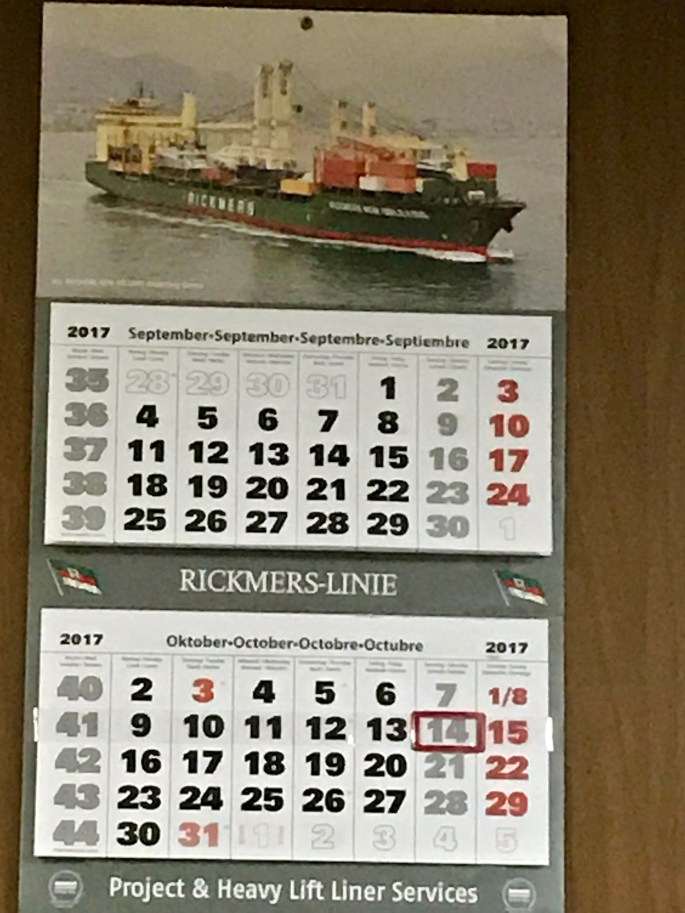
14 October, embarkation –

fullsizeoutput_270a

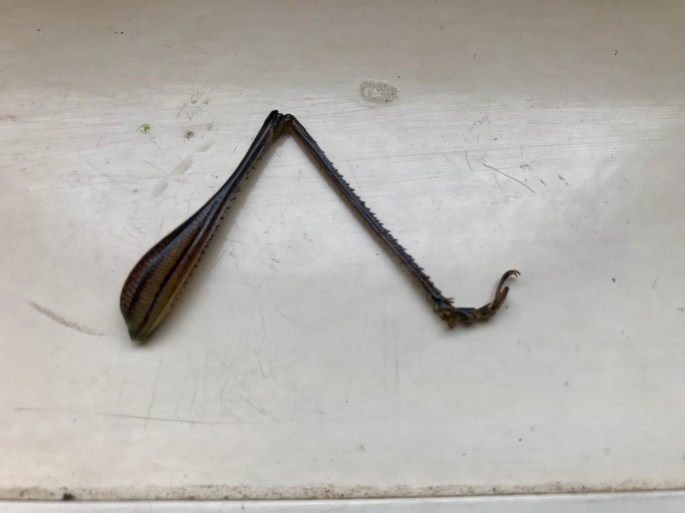
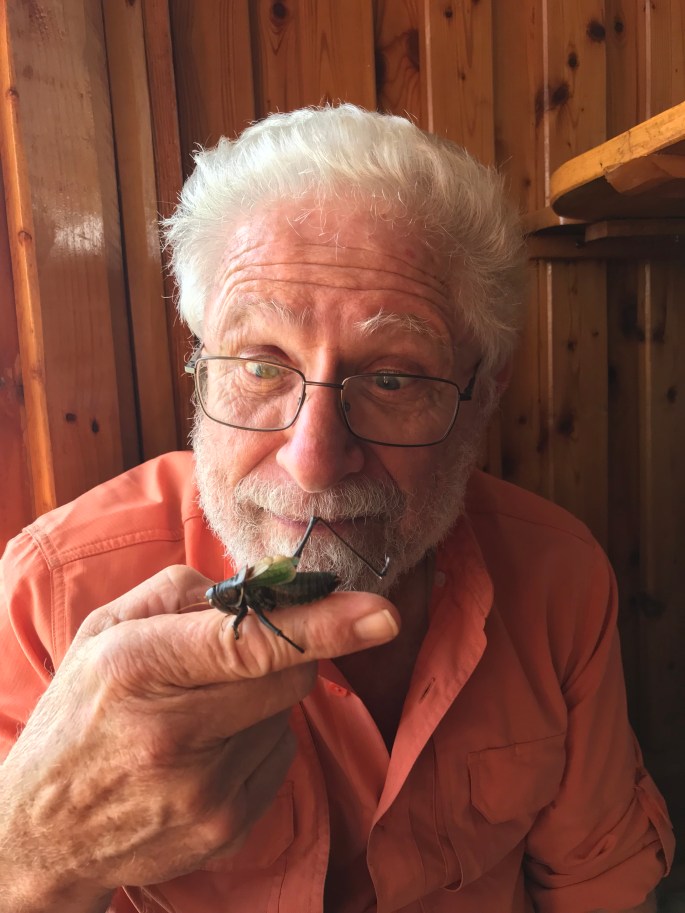
Ed has lost a leg.

fullsizeoutput_27bf

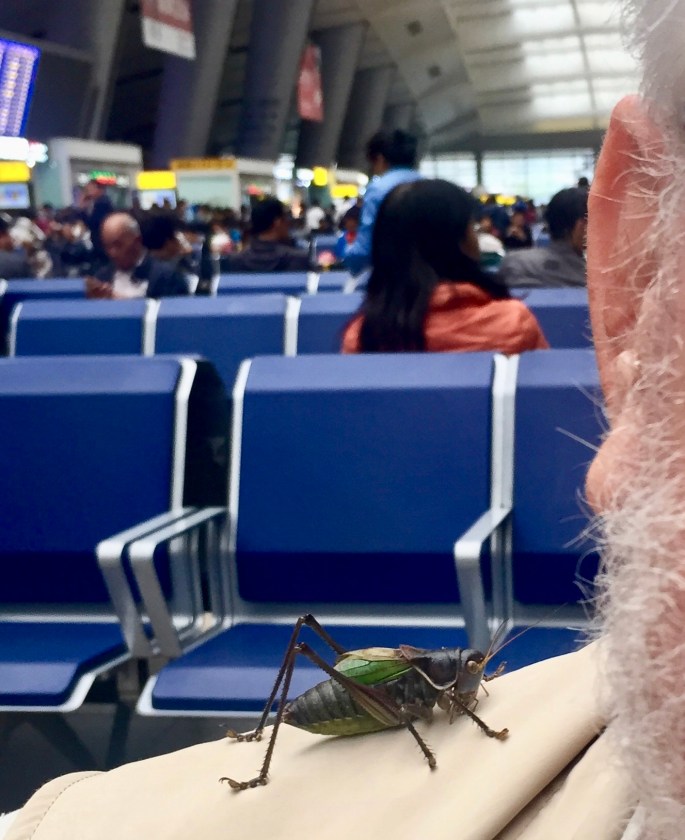
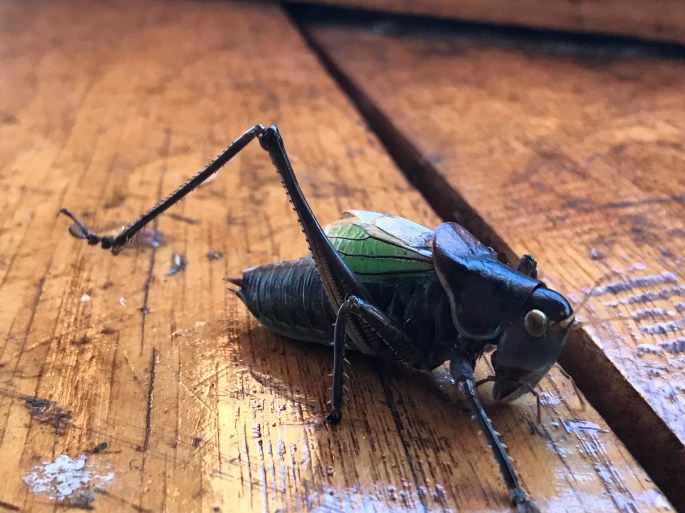
Well, it’s not actually lost – it’s right here, but has somehow become detached from his body. It’s the left rear leg, which has been dragging for a while. Such a delicate limb, and yet it enables him to scale vertical surfaces with ease. He does not seem to be in pain, and has resumed chirping enthusiastically. We’ll get through this. (Ed may not, but we will.)

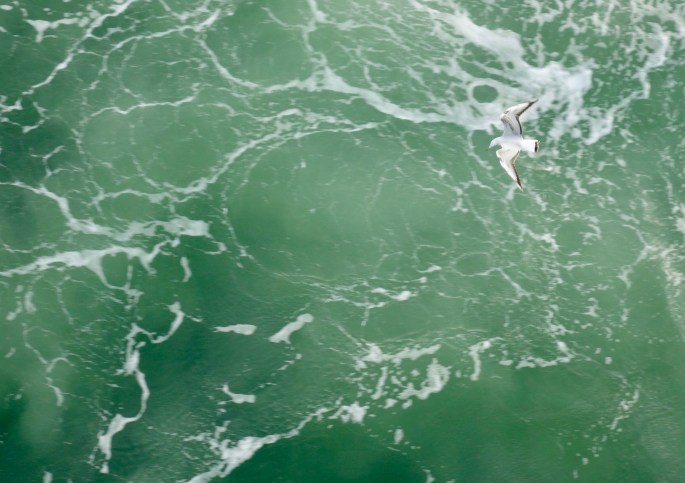
The New Orleans loads the rest of its cargo, and puts to sea a bit earlier than called for in the revised plan. Xingang is not a very dramatic port, so there are no interesting panoramas to view as we leave – only another city in China with a few skyscrapers towering over multitudes of mid-sized apartment buildings. As we pull away from the wharf, a single gull trails behind us – joined by hundreds more after we pass through the jetty that separates the port area from the sea.

Version 2

It feels great to be back under way. The wind is fresh and brisk, and the gentle motion of the water is reassuring.

fullsizeoutput_26fe

15 October, Yellow Sea –

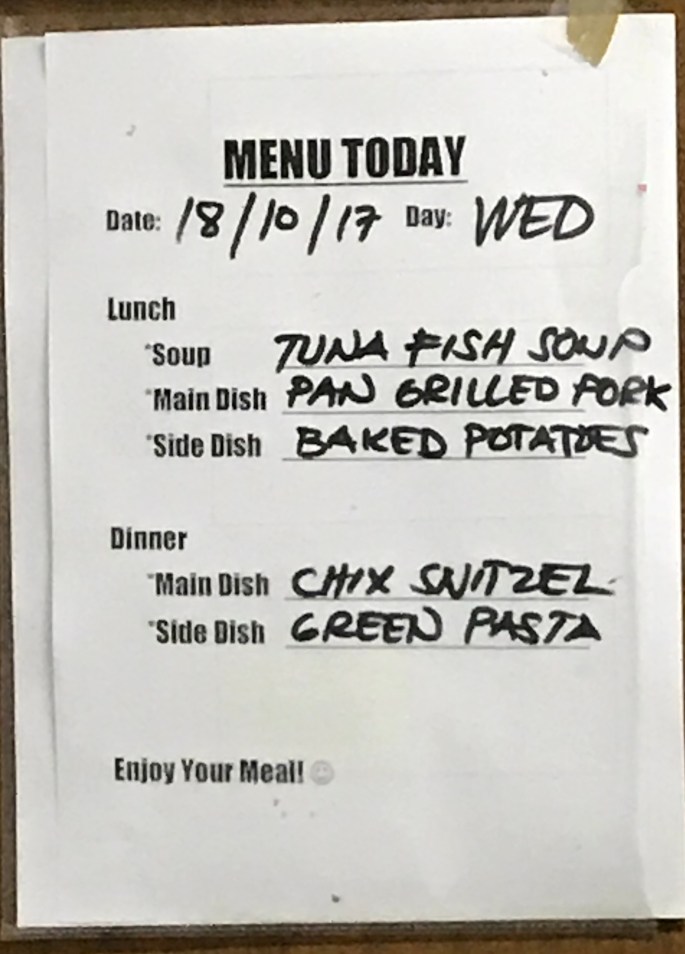
Lunch was virtually inedible strips of fried beef gristle. A flurry of activity at the confluence of the galley, officer’s and crew mess rooms tips us off that the “slop chest” is open. Only to find that no wine is available, the beer supply scanty, and we are lucky to get on the list for a case of 24 bottles. (Not really much for 2 thirsty people for a month!).

The slop chest is basically a company store – stocking beer, wine, cigarettes, snacks and grooming supplies (toothpaste, shampoo) that can be sold offshore duty-free to the crew for their personal use during the voyage. This cargo ship business is clearly squeezed financially (witness the cheap provisions, including poor-quality food, and the less-than-pristine maintenance of the accommodations). As a cost-neutral proposition, what possible reason could there be to be stingy with the slop chest?

Frozen pizza for dinner, no salad. Apparently the cook gets a little break Sunday nights. He has the nerve to ask how we liked it…. Fishing for a compliment? Not bloody likely!

Update on Ed – with free access to the cabin for a couple of hours, he’s quite active climbing around and snuggling up to his Papa Henry. Falls a couple of times as he learns to compensate for his severed limb.

fullsizeoutput_26a8

16 October, East China Sea –

A typhoon near the Philippines sends rough seas north to the East China Sea. We wake to wind, rain, and pitching and rolling that continues through the day. We spend some time on the bridge watching the water break over the front of the ship, contemplate another mostly inedible lunch (fried pork fat), but mostly we nap. (Henry feels a teensy bit queasy and takes a prophylactic dramamine pill; Robbie’s inner ear seems unaffected by the ship’s movement.)

fullsizeoutput_26e6

Another indication of the state of the general cargo shipping business – it appears the karaoke machine is on the fritz. The Filipino crew members are reduced to singing gently along to the guitar strumming of one of their shipmates. This sad fact, added to the paucity of available beer, reduces the overall hilarity factor on board rather considerably.

17 October, East China Sea –

I now understand better why so many poor people are fat.

Our bodies crave proper nourishment. When we eat healthful food in appropriate quantities, we tend to be a healthy weight. When, however, we are fed cheap food, our bodies (still seeking needed nutrients) continue to eat whatever is available – and if that is only cheap food, we eat more and more of it, and are still unsatisfied. And the cycle continues until we’ve packed on way too much avoirdupois.

Cheap food includes the usual suspects – potatoes, white rice, white bread, processed items (such as cereal) with lots of sugar, inexpensive cuts of meat (pork fat, stringy and gristly meat), imitation dairy products, sugary beverages.

We desperately need vegetables, fruits, pure dairy, lean protein and whole grains for optimal functioning of our systems…… and satiety.

My erstwhile trainer Edward had many clients who, when introduced to healthful eating, complained that they could not eat all of the (nutrient-dense) food prescribed. But those that did lost weight, improved their health and felt great.

This phenomenon is becoming apparent as we experience the limited range of cheap food that is served here. Our weight gain may be hard to determine as we have overdone a bit on this trip already. But we look forward to regaining control of hunger and eating upon our return home.

fullsizeoutput_26d3

18 October, North Pacific Ocean –

The weather has calmed down a bit – blue sky and sun emerge, and the sea quiets. We venture to the bow of the ship, hoping to see dolphins cavorting nearby, but all we see is a flying fish or two, and a frigate bird seeking the same.

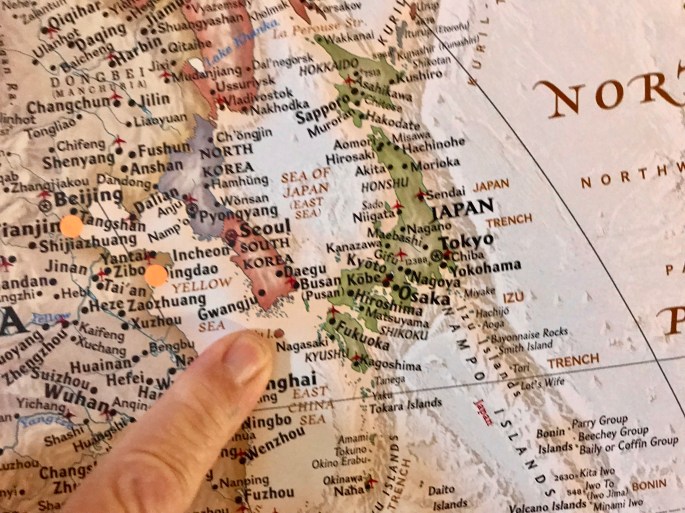
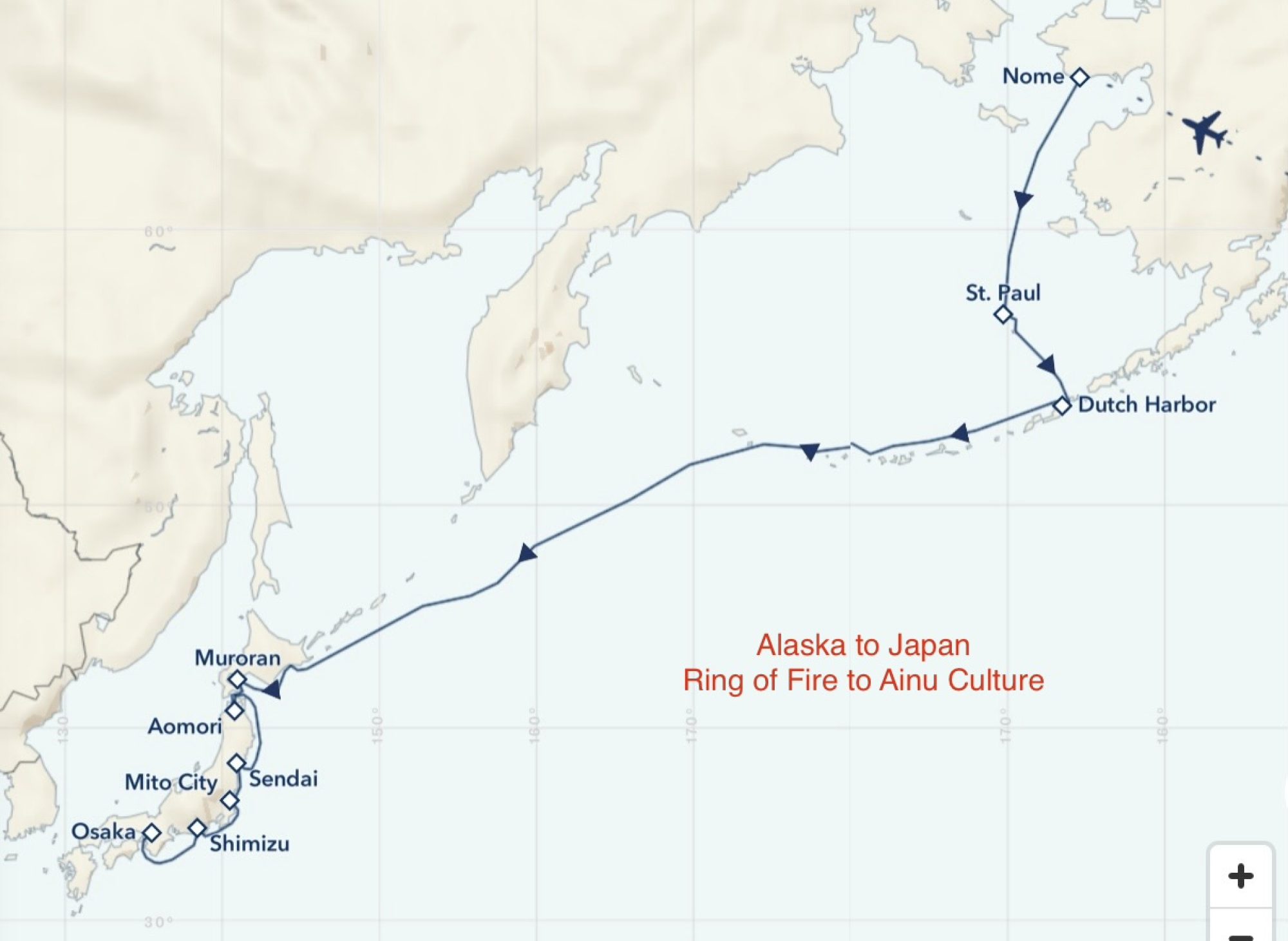
We have now passed the tip of Japan and are headed straight across the Pacific Ocean, roughly along the 30 degree latitude line. Originally we were to loop far north near the Aleutian Islands, but the captain changed our course to avoid some bad weather. This adjustment may add as much as 4 days to our passage. (The straight-across path may look shorter on a map, but it does not factor in the curvature of the earth, which makes the loop north the shorter route…..)

We will see how we progress, however, as we trundle along at roughly 12 to 15 miles per hour.

PS….  Ed is still fine, and we scored another case of beer through gentle manipulation of our “honored” status as passengers.  Happy days.

Diary at Sea, Part 2

19 October, North Pacific Ocean, north of Iwo Jima

Holy smokes! Major turbulence all night long and early morning. Normally the rolling of the sea promotes sleep, like rocking a babe in arms. This, however, is like being towed behind a bucking bronco, with not much quality sleep to be had.

Things settle down by noon and Robbie cuts Henry’s hair.

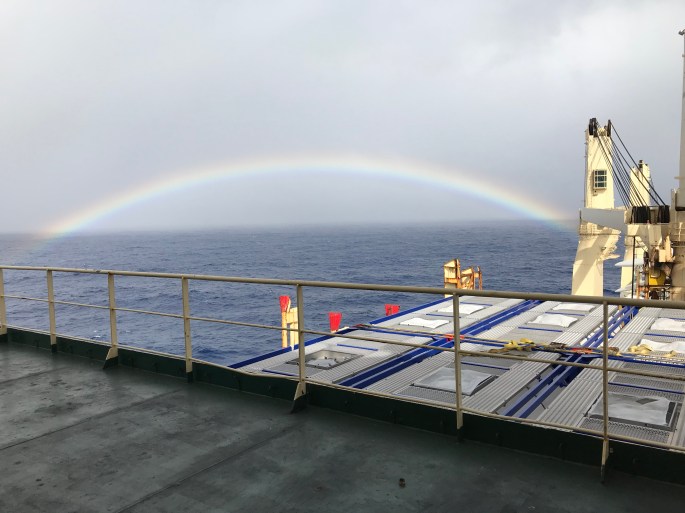
At mid-afternoon, the most magnificent rainbow emerges ahead of the ship. You can see both ends of it as it touches the sea, and every color in the spectrum is easily detected in its span. Even the officer on duty emerges on the bridge to goggle at it and take a photo…. And these guys are not easily impressed with things you see from a ship!

IMG_9993

Many people wonder what we do with all of the time we have at sea. Well, our days are defined by mealtimes – at 7:30 am, 11:30 am and 5:30 pm. This is the only schedule we have.

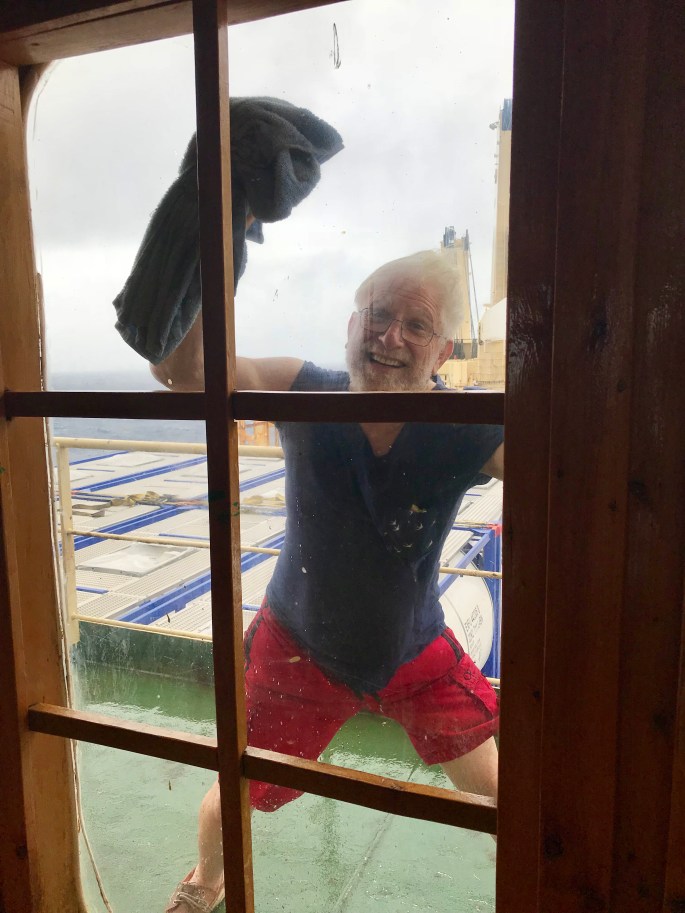
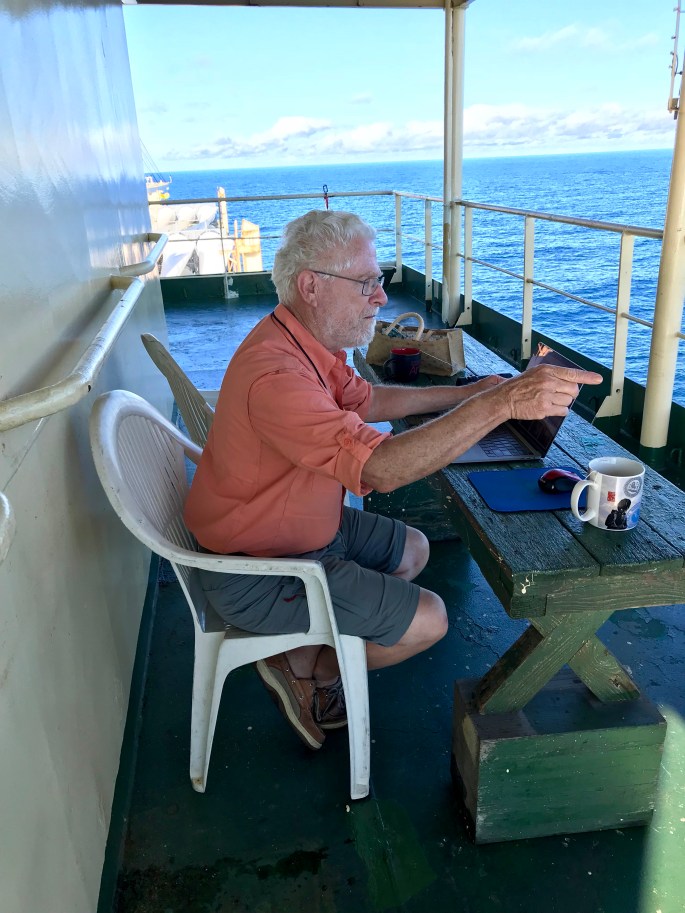
Henry gets up very early to explore the ship and take pictures of the sunrise. Often he will spend time with the crew on the bridge, trading stories and histories. Much of the rest of his day is spent editing and organizing some 20,000+ photos taken over the last 8 years. He also works on his music collection and studies books selected for this occasion on how to use his iPhone and photo apps.  He also likes to help clean and maintain the common areas of the ship.

fullsizeoutput_26dd

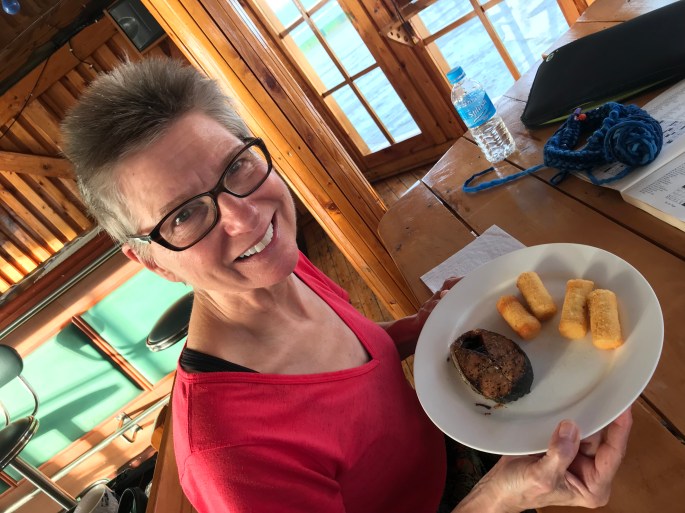
Robbie learned knitting specifically for a craft pastime for the trip, and just started a new dishcloth project. She also brought along a volume of New York Times Sunday crosswords to work, and is now trying to learn how to play the Xun flute, a simple potato-shaped instrument acquired in China made of heavy fired clay. Many books to read – mostly fiction and many selected because they are set in locations to be visited on the journey. For example – right now, a biography of Benjamin Franklin, inspired by our stop in Philadelphia. (Which I hope will help me reclaim a teensy bit of pride in being an American, which frankly has dissolved almost completely over the last year or two). And of course writing the blog and selecting photos for it from Henry’s vast output.

Walking the cargo deck of the ship has been a fun activity in good weather; however, the captain has advised in the future that he does not want us on the deck without a crew member present…. out of safety concerns, particularly since we have had some very rough going and he doesn’t want to lose a passenger.

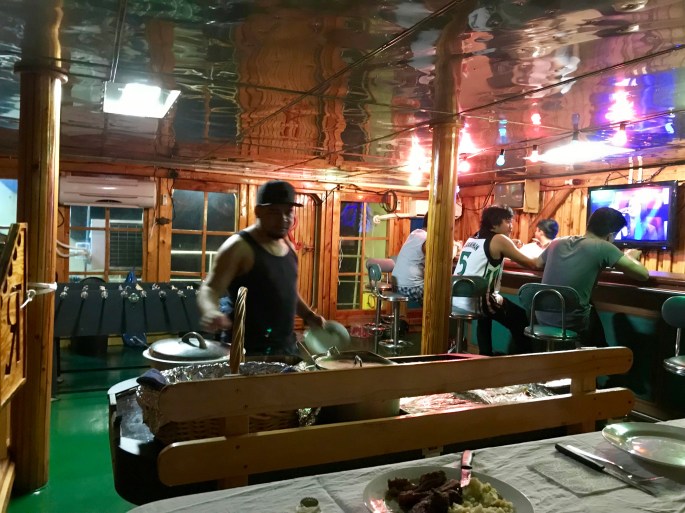
We nonetheless have full access to the large Pilot Deck, which is partially shaded and includes a 360-degree view of the ocean around us, as well as The Blue Bar, a recreation room with lots of windows which we can use when the weather is bad. Simply gazing out to sea consumes a fair amount of time.  

fullsizeoutput_26ab

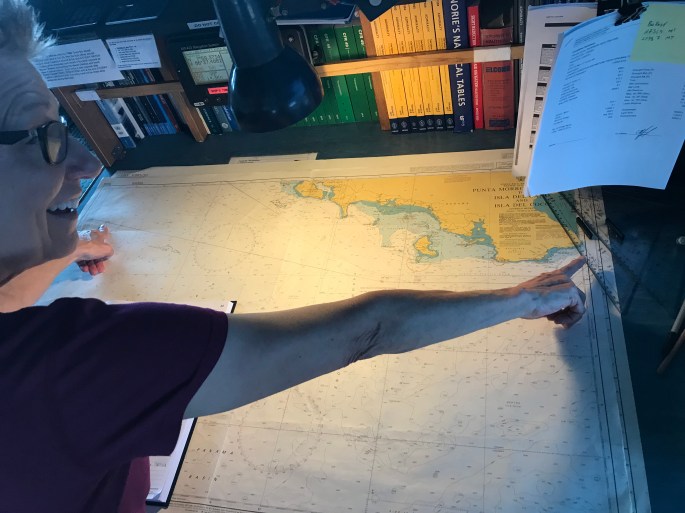
Sometimes we check out our progress on the bridge.

IMG_0803

We get a little internet service on this ship, but it’s pretty weak – and after a while, you realize that 95% of your email is junk and that most of the news has a boring sameness to it that you can easily forgo.

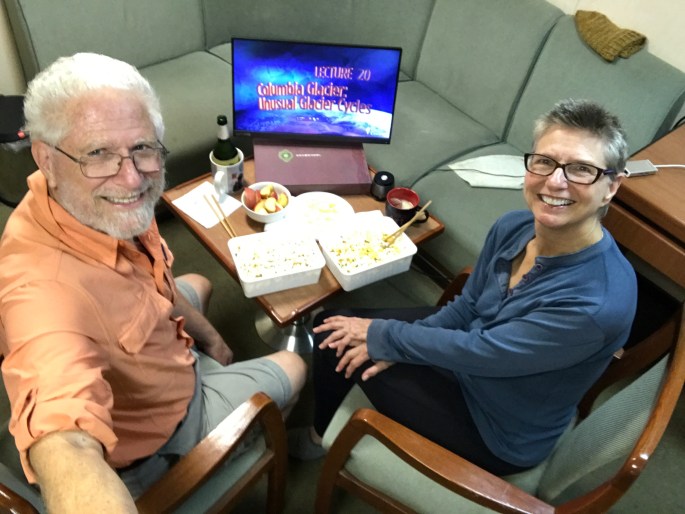
Evenings after dinner we often watch video material on a monitor we brought with us. We purchased a number of The Great Courses lecture series – Oceanography, Extreme Weather, Music History, Geographical Wonders of the World, Human Culture and Geography and Astronomy – hundreds of hours’ worth. Also a variety of movies.

fullsizeoutput_26a0

And, as noted early on, sleep factors significantly. The freshness of the air, tang of the salt water, thrum of the engine, rocking of the boat (sometimes gentle) and rushing sound of the water as we plow through it combine to create a near-perfect environment for deep and restful napping.

That’s it.

20 October, North Pacific Ocean, a little further east

An occasional bump but mostly smooth sailing today.

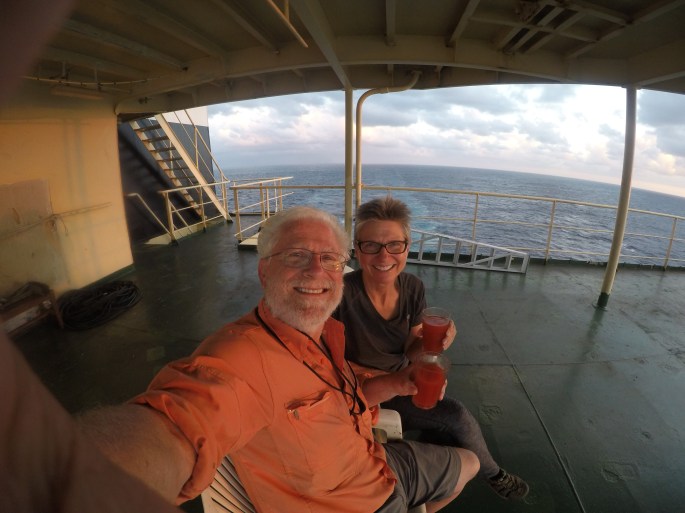
We have dinner brought up to The Blue Bar so we can watch the sun set while we dine.

fullsizeoutput_26fb

21 October, North Pacific Ocean, a bit more east

Catastrophe! It appears that the cable on our external hard drive device has given out. A tragic event as that drive contains all of our Great Courses lectures and most of our movies. And it appears we have a month or more to go on this trip.

Henry cuts Robbie’s hair – his first experiment with barbering. The technique used is to stand in strong wind (so the cut hair flies away). Robbie pulls her hair up away from her scalp between her fingers with hands held flat, palms downward, and Henry cuts whatever is above her fingers. This way, if it is too short, it is her own fault! The results are … well, about what you’d expect. Patchy. Fortunately, the stuff grows back.

The crew holds a barbecue party tonight. Pork ribs and chicken wings are on the grill, and the Romanian officers prepare some special sausage, garlic sauce and steak. All served with toast, boiled shrimp (with heads for the Filipinos), fruit ambrosia for dessert, and beer supplied by the captain. A superb repast compared to the daily swill.

fullsizeoutput_26b7

The captain is chatty tonight, and talks about some of his favorite topics – the voyage of Columbus (his hobby on land is making balsa ship models, including the Santa Maria, the only one of Columbus’ ships that made it), which ports have the most beautiful women (many of them do) and the spiritual aspect of being out on the ocean.

22 October, North Pacific Ocean, a teensy bit to the east

The provenance of the title of this blog, Slow Boat to China, is kind of interesting.

According to the consensus on the most reliable authority available (quick Internet search), it originated in the early 20th century among serious gamblers – card players, I guess. When one of them had a losing streak, the beneficiary thereof would state, “Wish we were on a slow boat to China.” Meaning, China is far, far away; a slow boat will take a very long time to get there, and in the meantime, I can win all of your money since your luck is so bad.

It was only later (in the 30’s or 40’s?) made into a romantic song:

“I’d like to get you on a slow boat to China, all to myself alone.
To get you and keep you in my arms ever more, leaving your lovers weeping on a far-away shore.

Out on the briny with the moon big and shiny, melting your heart of stone.
I’d like to get you on a slow boat to China, all to myself alone.”

They just don’t write ‘em like that any more! Unless you count, “Roll Me Up and Smoke Me When I’m Gone” by Wm. Nelson.

After a sleepless night and some expensive and time-consuming research, we figured out how to connect our external hard drive wirelessly, so we are back in business with our video entertainment…. At least for now! Quite a relief.

23 October, North Pacific Ocean, north of Marshall Islands

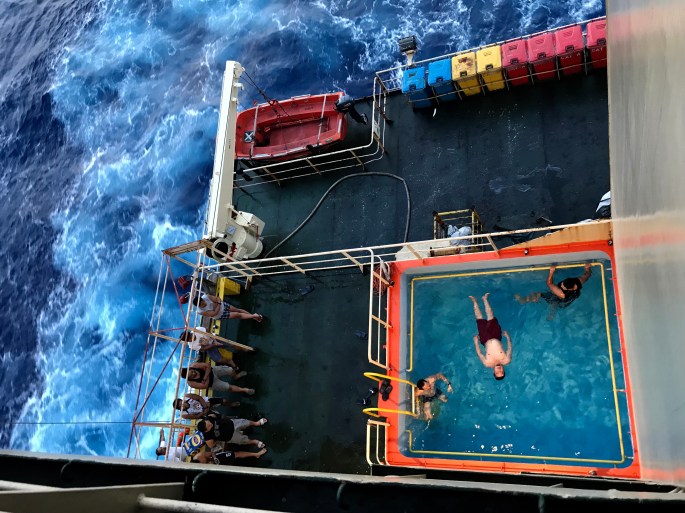
The crew, having repainted and repaired it, filled the swimming pool today and had a pool party just before dinner time. They had a blast. The water looked inviting, but it was a bit too cool and breezy for us to join them.

fullsizeoutput_26af

24 October, North Pacific Ocean, an iota to the east of last time

We have now been at sea since 14 October. For at least the last 7 days, we have not seen another single sign of …. anything. Not a ship, not a rubber raft, not a distant shoreline, not a dolphin or whale, not a plane flying overhead. Just the good ship New Orleans, with 22 human souls and a bug on board, in the midst of seemingly endless ocean extending out in all directions. A single frigate bird hitches a ride with us and soars out over the wake from time to time.
It’s impossible to be more remote from the rest of the world and still be on this planet. Think about it…. What an incredible feeling – peaceful and exhilarating all at once.

Thanks to the Internet and satellites – if you insist, you can still find out that rumor has it Melania is going to leave The Donald since she has hired a “body double.” Oh boy.

Finished knitting a hat.

25 October – North Pacific Ocean, just west of Midway Island

We turn southeast so that we will be running parallel to the Hawaiian Island chain to our north. Here we are in the neighborhood of US territory for the first time since leaving Philadelphia back in June!

Three sea birds and a small bird (a stowaway sparrow?) welcome us back today, although we still cannot see any land and have a long way to go.


25 October AGAIN – North Pacific Ocean, south of Hawaiian Island chain

This morning we passed over the International Date Line, and will be able to re-live October 25th!

Second chances – we don’t get very many of them. What to do? How about telling the people you care about that you love them. Feel grateful to be alive. Do something that will make somebody else feel that way. Maybe that’s enough….

fullsizeoutput_2697

Poor Ed has now lost two feet from his remaining five legs. Perhaps this is how insects age – body parts fall off until none are left. Immobility – a sad precursor to the end. Ed, however, has a “can-do” attitude! He continues to attempt to scale vertical surfaces (with middling success) and chirps lustily.

Truth be told – there probably aren’t too many giant crickets who have the opportunity to die of old age. Lucky bug!

Diary at Sea, Part 3

26 October – North Pacific Ocean, south of Hawaiian Islands

Most people think of Hawaii as a neat group of 7 islands, starting with Kauai in the west and ending with the big island in the east. But there are actually a whole slew of islands that make up this chain, stretched out in a long arc of about 1500 miles, extending much further west than typically thought. All by way of saying that it will take a while for us to pass them by. Not that we can see them….. the islands are about 270 miles north of us.

fullsizeoutput_25b4DCIM102GOPROG0034816.JPG

27 October – North Pacific Ocean south of Hawaii

We finally see another ship – it’s a tanker, a long way off, but just visible on the horizon. Huzzah! We have not fallen off the map into a kind of twilight zone….. Other life exists on this Earth.

Or does it? Maybe it’s a mirage.

The starts are bright tonight, as is the moon. There’s a bit of cloud cover, but we can see the one constellation I can consistently identify – Orion. But he has shifted position – reclining on his side instead of standing solidly upright, the way I usually see him…. A lyin’ Orion! (Easily explained by the fact that we are viewing from a perspective on the planet much different from that of East Texas…)

28 October, North Pacific way south of Hawaii (the Big Island)

Once we pass Hawaii, there will be no further nearby geographical reference points to use other than our destination in Panama. Just open ocean as we chug along the 15th parallel (approximately) toward the Canal. It will take about two weeks.

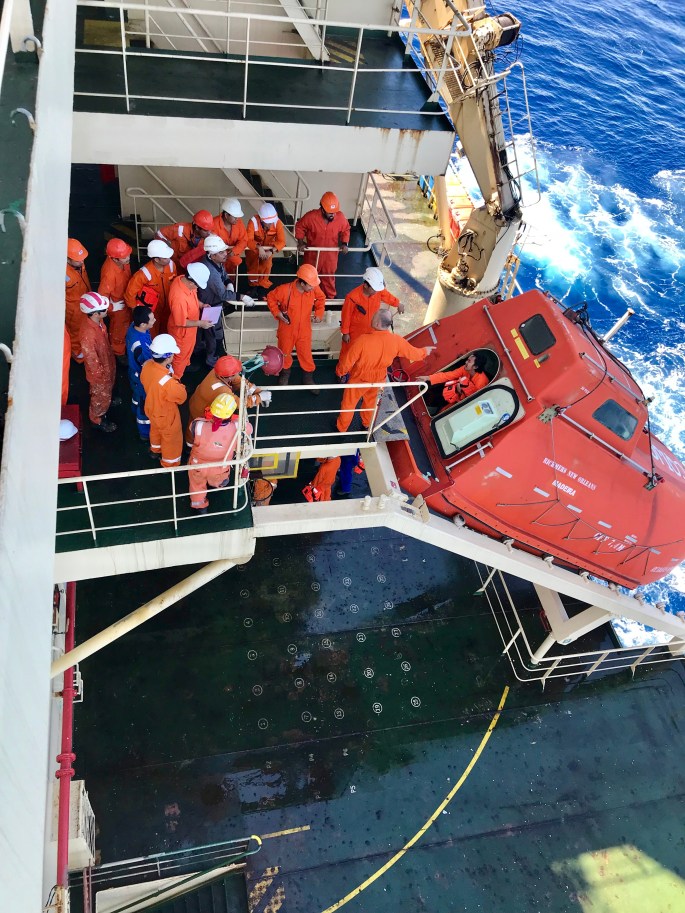
The crew conducts an emergency muster today – all hands gather hard hats and life jackets to rendezvous next to the big life boat on “A” deck. We check the whistles and lights on our life jackets and practice strapping into our designated seats.

fullsizeoutput_263d

In addition to the big life boat, which can presumably easily accommodate all of us, there are 8 to 10 rubber rafts positioned around the ship, as well as a motorized dinghy. All are stocked with water, food, motion-sickness meds and emergency rescue devices, such as flares, horns, etc.

The stowaway sparrow is still with us – infrequently spotted flitting by on the pilot deck or bridge. We sprinkle bread crumbs from the galley around for her – maybe she finds a way to get into the trash cans to forage for food. Fresh water…. from the puddles of air conditioner condensation? Hers is a genuine survival story. Gosh, hope she makes it.

29 October – North Pacific

Ed endures. His body seems to be shrinking, but his will to live is strong….. as is his fundamental desire to mate, expressed through his repeated chirping. What a bug!

A whole flock of seagulls joins us for a time today, wheeling across the front of the ship and diving for fish. We are easily 500 miles from land of any kind. Where did they come from?

And then they are gone. Where did they go?

30 October – North Pacific

I’m in the doldrums.

Mind you, the ship moves on at its usual “brisk” pace of almost 15 miles per hour. The ocean undulates up and down gently and the breeze is cool. The air is clean and delicious, blue skies and fluffy white clouds complement the dark marine blue of the water.

No, mine is a doldrums of the spirit. Dull routine has set in and I’m ready to get off this old tub. I pick up the knitting for a while, then put it down. Find a deck of greasy and creased playing cards and try to remember how to deal a hand of solitaire. Cannot focus on a crossword puzzle. Turn to my book but it’s not very good (and I’ve read half of it already so must force myself to struggle through the rest). Actually look forward to washing a small load of clothes and hanging them to dry around our rooms since the ship’s dryer does not and never has worked.

I fantasize a crisp salad – any fresh lettuce other than iceberg, deep green of spinach, peppery surprise of arugula, bright red counterpoint of ripe tomato, crunch of celery, a sprinkle of garlic sprouts and maybe the creaminess of a dab of goat cheese and the mellowness of toasted pine nuts, topped with…. dare I dream big?…. a tangy dijon vinaigrette that brings it all together. My mouth waters, my soul yearns……

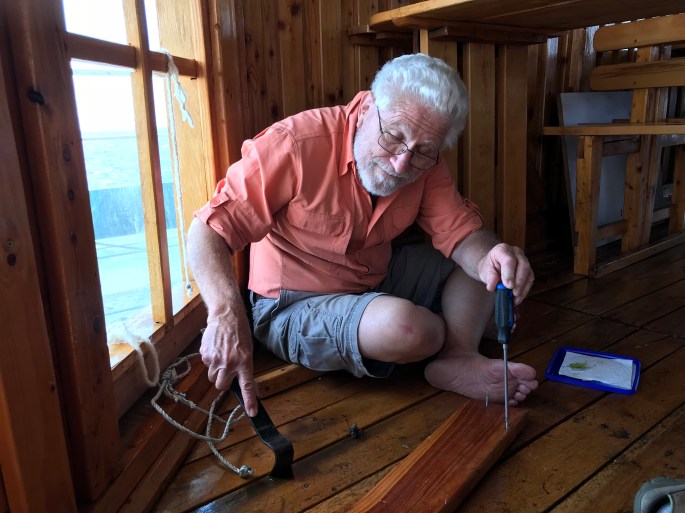
Ed falls down a crack between the wooden floor boards of the Blue Bar. Henry pries up a board, but Ed has crawled down underneath the window frame where we cannot reach him. He continues to chirp periodically (which helps us track his approximate location) and appears to be in no distress.

Since he has lost his feet, we are challenged to find a life line that he can climb using his remaining legs. I make an 18-inch braid of knitting yarn which Henry weights with a bolt found on the deck. It is lowered through the gap in the window frame, and we use a phone flashlight and hand mirror to try to see his progress.

Hey – we’ve got nothing better to do.

After several failed and one almost-successful rescue attempt, we toss some wet celery leaves down the hole for his sustenance and reluctantly abandon the search for the night.

31 October – North Pacific Ocean

Seriously, the galley is almost completely out of fresh produce. We cadge a couple of the last oranges – from here on it is canned fruit, if any. Plain shredded cabbage was on the menu a couple of days ago, but if there are any canned or frozen vegetables, they are doled out rarely and very stingily.

IMG_0743

On a joyful and highly unlikely note, this morning we track Ed’s chirping, pull up another floor board, and there he is! A little the worse for wear – he’s dirty, both antennae have been foreshortened, and he’s quite grumpy, sinking his mandibles into Henry’s hand immediately upon being freed. But he is safely installed back in his little cricket home. Future perambulations will be more closely monitored.

IMG_0664IMG_0645

We contemplate getting dressed up for Halloween – the only option would be the Arab attire we purchased in Dubai – but discard the idea as we realize that the cheerless Romanian officers would only grimace briefly at our effort to lighten the atmosphere, and then dig back into their greasy brown grub.

1 November – North Pacific Ocean

Sadly, we have not seen the little stowaway sparrow for a few days.

Things are otherwise looking up. Ed recovers well from his ordeal, and is back to a fairly normal chirping schedule. And it turns out we get a bit of a Halloween treat – the cook has made a sweet dish from sticky rice that is commonly consumed this time of year in the Philippines to commemorate deceased family and friends. It’s tasty.

The month of November is here; feels like we’ve passed a milestone. We can see past the next week or so to the exciting conclusion to our adventure.


Diary at Sea, Part 4

2 November – North Pacific Ocean

Ed passes away peacefully this afternoon. We heard his chirp last night; he was sluggish this morning, and then just shuts down. Of course we knew his time was coming, but you’re never really ready.

His remains will accompany us for the rest of our trip; we are planning a Viking funeral – complete with floating flaming pyre – once we have returned to East Texas and settled in a bit.

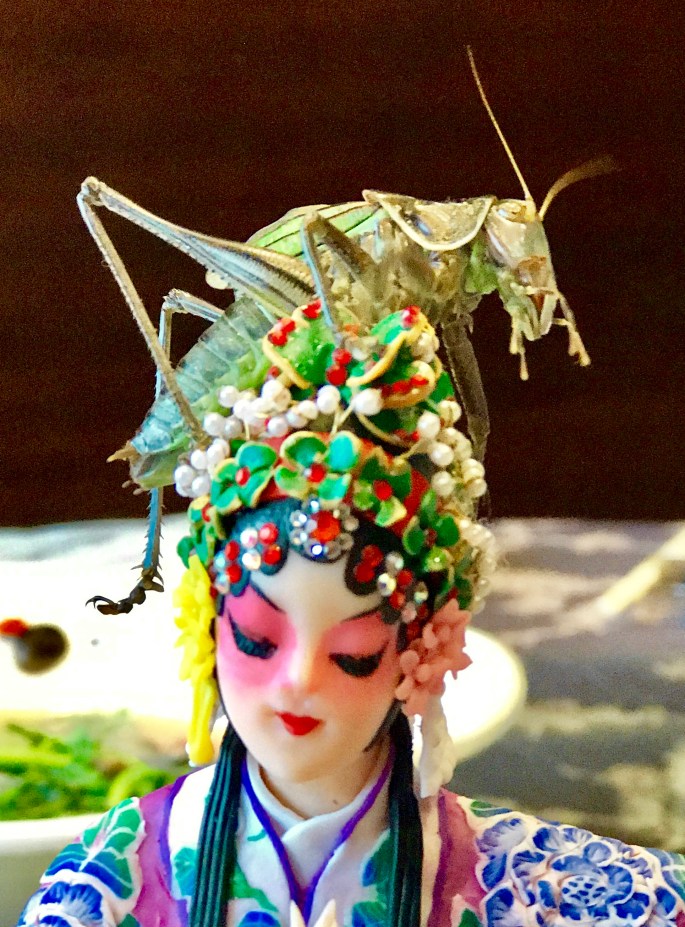
His life was brief but remarkable (for a cricket). From presumably humble beginnings in Xi’an, China, he traveled to Nanjing, Beijing and Tianjin, then traversed the greater part of the Pacific Ocean. We like to think Ed’s spirit will continue on with us as we complete the adventure he was able to actively share only for a short while.

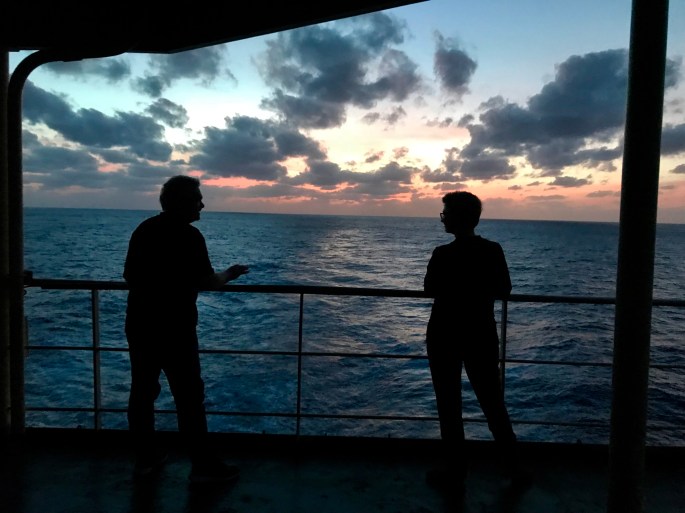
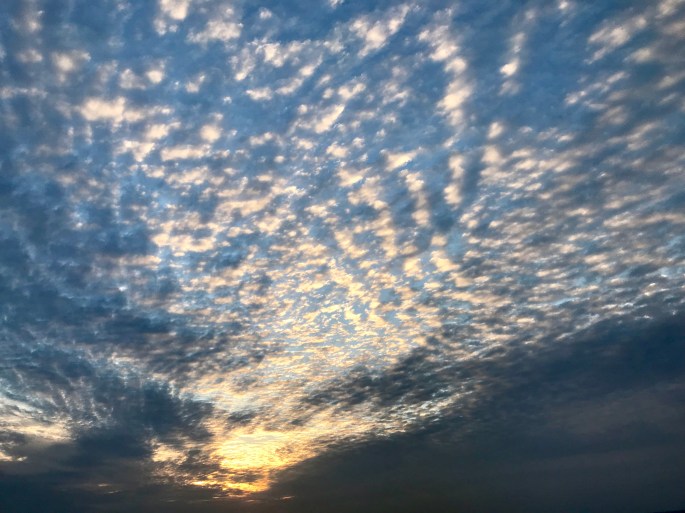
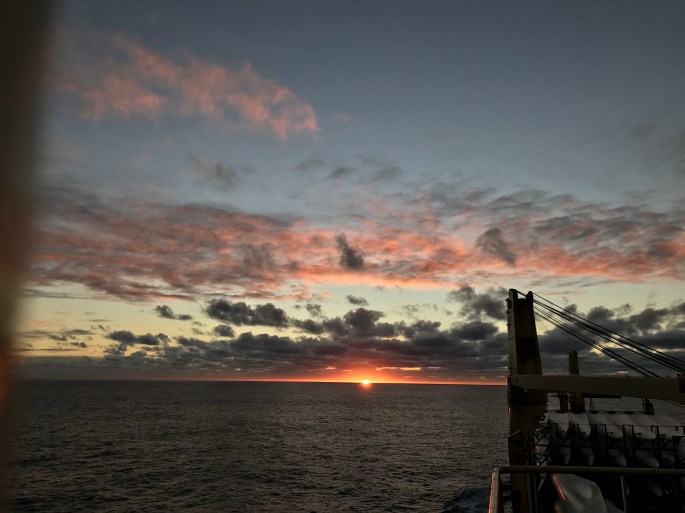
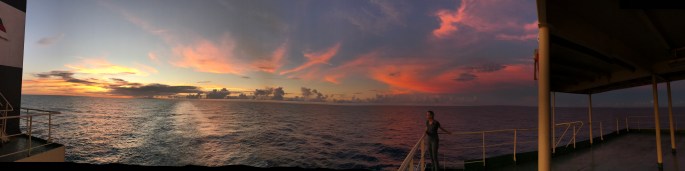
As if in tribute to his passage, the evening sky puts on a phenomenal show, the likes of which neither of us has ever seen. Not just a sunset, though that is part of it. Yes, to the west the sun reflects off multiple layers of long narrow clouds lying above the horizon, in shades from rich gold to bright salmon to smudges of purple. But the rest of the sky – from unbroken horizon to horizon in all directions – is clear and robin’s egg blue, with very high feathery cirrus clouds scattered all about, reflecting the only slightly fainter pinks and yellows of the light. And to the east, the moon, just a hair’s breadth short of full, rises to take its place in the sky. As if an enchantingly-painted bowl of unimaginable scale has been upended on this spot in the ocean, and we are the only witnesses to the display.

fullsizeoutput_2659

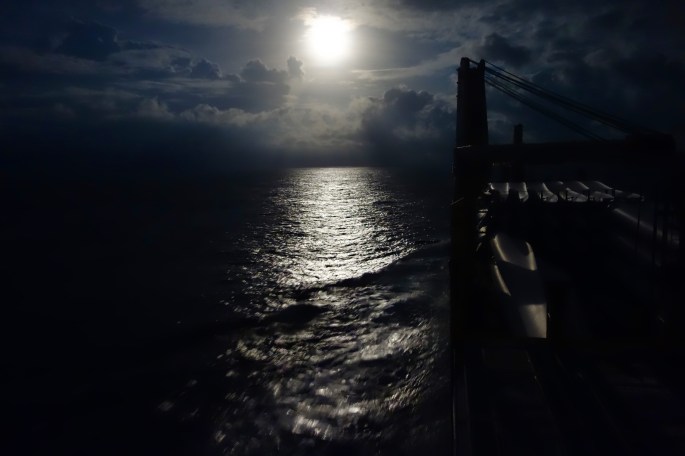
It lasts, as these things do, not much more than 15 minutes, during which time we circle the deck breathlessly, tipping our heads back and whirling around to take in the otherworldly panoramas. Then, of course, the colors fade away….. until the only illumination left in the universe is the silver of the moon, reflecting off the now black water tipped with occasional flecks of foam.

fullsizeoutput_2639What a tribute from Mother Nature. Godspeed, Ed.

3 November – North Pacific Ocean

Just a quiet day – no chirping ever more.

We now have 11 birds following the boat. Captain claims they are living on board somewhere as stowaways, although it’s hard to imagine that many of them sharing quarters. He also says he has seen the little sparrow, who boarded in China.

Tonight’s sunset is a drab nothing compared to last night’s. This evening, however, a very full moon rises… and peeks out through heavy clouds.

4 November – North Pacific Ocean

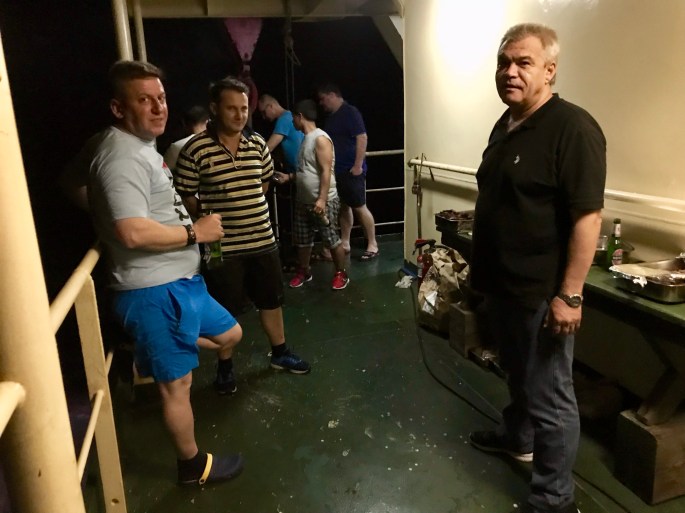
The captain initiates a safety muster this morning. It’s a topic that is taken seriously, and everybody participates with complete attention. (We never had a safety meeting on the container ship, although the T’ird Officer showed us how to don an immersion suit, which was really cute.)

A barbecue party is held for the crew and passengers tonight.

fullsizeoutput_26b5

Henry is relentlessly determined to find common ground and a friendly rapport with this crew, in spite of repeated snubs. We find a beaten-up Italian atlas in one of the unused lounges, which he works on painstakingly, repairing the binding and tagging pages of interest. Armed with the atlas, a highlighter and two computers – one with photos of travel and home, the other with his prodigious and eclectic collection of music – he holds court in the Blue Bar. His attempts with music fall flat pretty quickly – Hank Williams is abandoned in favor of the unidentifiable, mediocre soft-pop vocal renderings favored by the Filipinos. A core group clusters around the photos on display, with near-endless questions about Henry’s life in the piney woods of East Texas.

He scores a real hit, however, when he says, “Show me where you’re from!” while offering the open atlas and highlighter. All the crew come forward, with everything from a happy story to just a shy grin as each specifies his spot on the map. Even a couple of the Romanian officers (who have mostly isolated themselves on the outdoors deck) grudgingly make a mark in the book to signify where their homes and families await their return.

(Note about the officer group – no surprise that they are not particularly friendly. This is a solitary job, far from wives, kids and parents for many months on end. Good for loners – if they were gregarious and extroverted, they would be working on cruise ships.)

5 November – North Pacific Ocean

Sundays we get pancakes for breakfast and the crew (except for the officer-in-charge and galley staff) takes the day off. Not sure what they do – it’s spooky-quiet all over the ship. Fortunately for them (and probably essential on such a long trip), each crew member has a private room, very much like the cabins we inhabit.

BUT, the ever-weak internet service is not working at all…. we are supposedly in a satellite “blind spot.” So e-mail and catching up with the folks at home is not an option.

6 November – North Pacific Ocean

Everybody knows about jet lag. You would think that passing slowly from one time zone to another over the course of days would not take much of a toll, but it does so insidiously. The body clock shifts and is always a bit off. Some times you lie down at night and can’t sleep at all; other times you fall asleep at 9 pm and wake up at 3. Don’t even ask about gastro-intestinal habits! (If you must, ask Henry. It’s a subject near and dear to his – ahem – heart.)

7 November – North Pacific Ocean

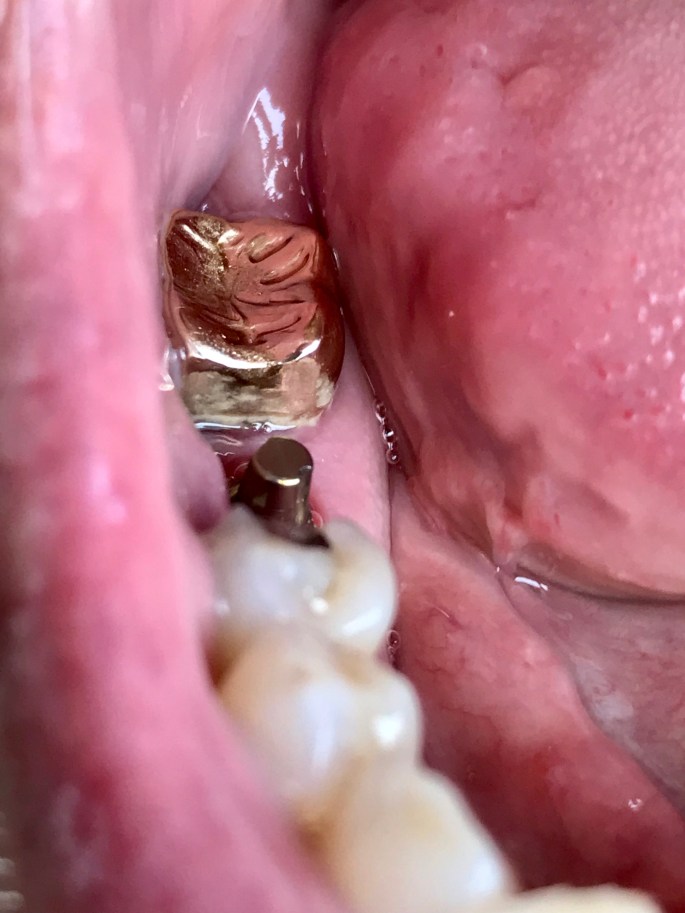
Henry loses a tooth.

Well, it’s not actually lost – it’s right here. Just popped out between bites of bland and gristle-y food at lunch. And it’s actually an on-lay that fits over an implant that was installed a couple of years ago. He’ll survive.

fullsizeoutput_25ee

And speaking of physical complaints, I have a rash on my back and my fingers are stiffer than usual in the morning.

All attributable to poor diet, which I will not carry on about further.

Speaking of inevitable decline, Ed’s body is not desiccating as we had hoped, but collapses slowly in on itself. May have to do a burial at sea after all.

8 November – North Pacific Ocean

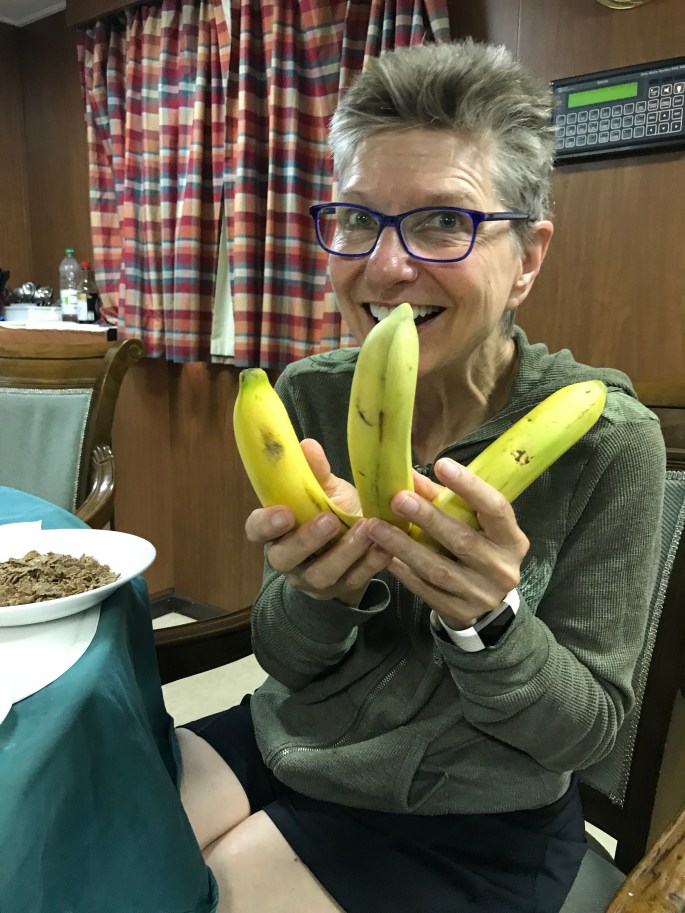
Good news all around. The internet service is low-functioning again. And rumor has it that we may get bananas in Panama!

We still have the feeling of being out alone on the ocean. Since we entered the Pacific Ocean more than three weeks ago, we have personally seen a total of 3 other far-off ships. Even as we do so, it’s hard to fully fathom that this ship is trudging along at an average of 14 miles per hour, all day, every day, covering the 9,600 miles from our last port, Tianjin, to Panama. And won’t even re-fuel until we get to Houston!

IMG_0726

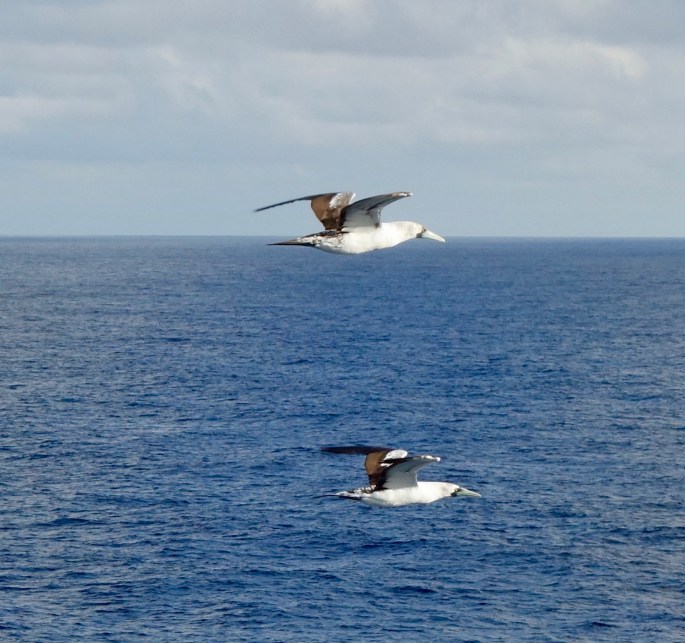
Our bird population, now numbering about 13, includes some sort of frigate bird and albatrosses.

The poor, maligned albatross. Was it Samuel Taylor Coleridge in the Rime of the Ancient Mariner who doomed this magnificent bird? To be forever a synonym for an insufferable burden, draped around the neck of the unfortunate, bereft of all human succor and pity. How unfair.

The albatross is a big diving bird. He sails alongside the ship, scanning the water for some sign of prey on or around the surface. When he sees a fish, he executes a sharp and swift dive straight into the water, remains submerged for a short while, then pops to the surface, with or without a delicious prize. Then off he goes again. Little of his life is spent on land; he derives both food and water from the ocean, fish flesh filtering out the salinity of its water content. I guess he finds a niche on board to sleep in at night, or maybe he floats on the ocean’s surface.

To watch him soar is the best. He can glide without flapping his wings for up to 6 hours at a time, his body automatically making the small adjustments required to maintain his flight. Imagine such a pure sensation! He’s King of the World!

fullsizeoutput_2619

Diary at Sea, Part 5

9 November – North Pacific Ocean

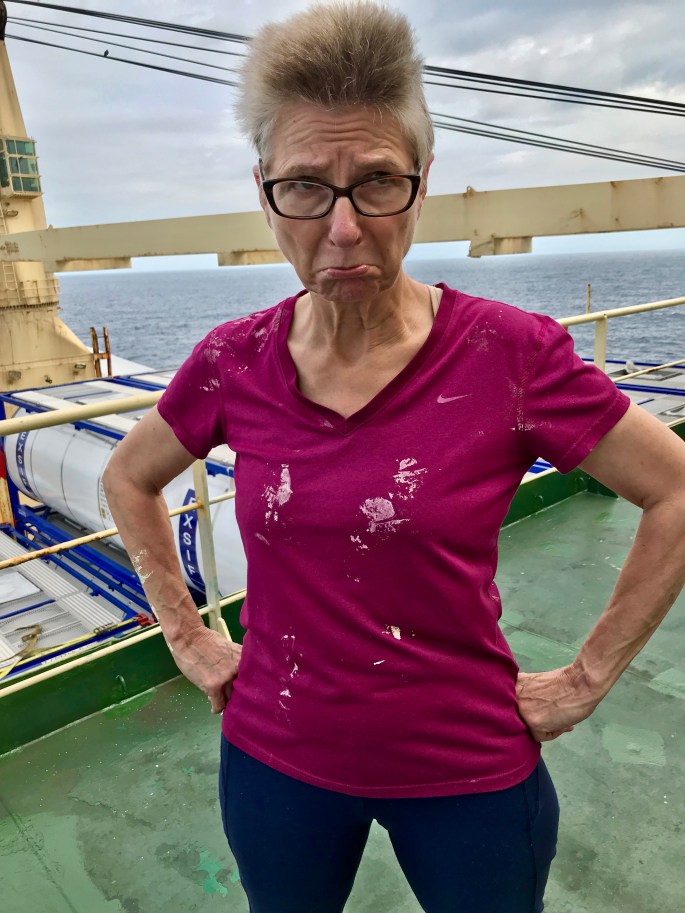
The crew has been scraping the rusty places on decks and railings and priming them with paint. They do not, however, feel the need to mark the freshly-painted spots, so the unwary passenger can and of course does get smeared.
fullsizeoutput_25cc

The steward was very excited last night – he saw three splashes and a “big fish” off the starboard deck outside the galley…. maybe a whale! Oh, phooey – we missed it.

But then this afternoon, during a perambulation around the deck….. off to port appear a ripple and a shadow. A quick rush to the railing; the giant rolls over to show his tummy – a slick expanse of grey – and comes up again shortly after to expel a mushroom cloud of air from his blow hole!

It is so easy to forget the phenomenal quantity and variety of life that exists just beneath our feet…. and how vast that area is. The earth’s surface is something like 70 percent water, with an average depth of 5 kilometers, just over three miles. Unbelievable! Even at the greatest depths are exceedingly strange life forms of which scientists until recently were completely unaware.

But back on the surface, the officer on the bridge did not see the whale; as we describe the sighting to him, an area a bit larger than a full basketball court near the bow of the boat starts to shimmer……and suddenly a host of dolphins bursts from the water. There are easily a hundred of them in the group, executing smooth leaps and dives, one after another. An amazing display – they stay within a fairly consistent distance from each other, moving as a group further off to port. We follow their progress for a minute or two, then their number starts to dwindle until only one or two heads pop up, and then they are gone. It’s the finest moment at sea so far.

Several more viewings this afternoon – none quite so dazzling. A group of 3 or 4 dolphins play together, executing pirouettes in which they leap up, twist in the air, then hit the water flat on their backs. The loud “thwack” of the impact from each maneuver is audible on the deck. A couple of others rise up on their tails and seem to “surf” the wave that comes off the bow. And a mystery – twice “something” emerges from the water, shaped like a black and white triangle – almost like a ray had popped up. The captain guesses that it may have been a whale fin….

Wowie – today’s show was really worth the price of admission.

10 November – off the coast of Costa Rica

A few isolated dolphin sightings today, but very few. We must have sailed beyond their turf.

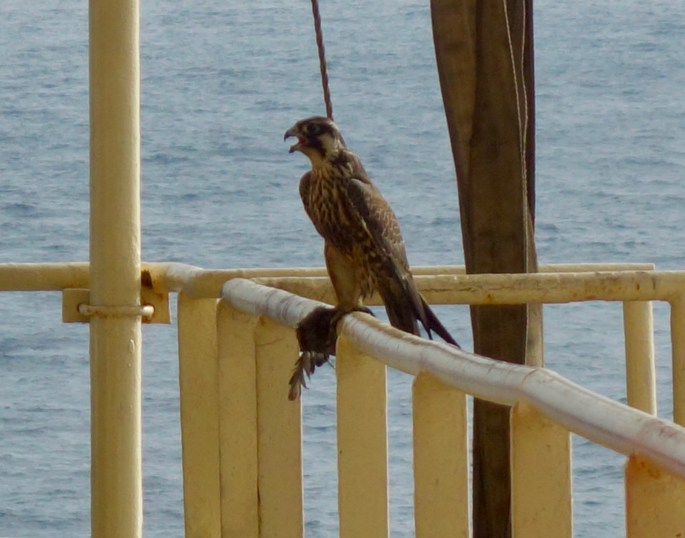
Two peregrine falcons – Wanda and Wes – join our floating menagerie today. They prey on small birds, hunting them in flight. We first become aware of their presence when we notice wispy feathers floating by. Investigation finds Wanda (the bigger one) hunching over a small dark body on top of one of the forward crane towers, tearing into fresh flesh. Wes (much smaller, a Mister Wimpet type) gazes at her fondly from a neighboring crane.

We figure this is the end of the stowaway sparrow, if she in fact lasted this long. Some swifts also started following the ship, and no doubt provide another source of food for the couple.

Wanda and Wes have no particular fear of humans. Wanda is in fact partial to perching on the railing of the pilot deck, not far from where we spend our time. At one point, she fluttered up to the railing with a newly-dispatched victim clutched in one of her claws. She gazed directly at us as though daring us to challenge her right to hunt and eat.
fullsizeoutput_25e4

IMG_0850

A third falcon stops by to check out the action, but does not stick around for long. These guys are monogamous; Wanda already has her Wes. And though he may not be much, he is definitely hers…….

11 November – Gulf of Panama
Hmmmm, what culinary outrage can we expect from the galley today? Wow – something green on the menu! Peas. Nobody can mess up peas!

Wrong. Here’s how you do it. Heat a small amount of vegetable oil in a big iron skillet over medium heat. Pull a large bag of frozen peas out of the freezer and dump them directly into the skillet. Stir for a minute or two, then turn off the heat and let them sit uncovered for no less than an hour.

The result – the skin of the peas is wrinkled and shriveled, and the flesh inside – while no longer frozen – is still not quite cooked. Tepid, mealy and flavorless. That’s how you screw up peas.

(Henry says they would work well in a pea-shooter. A better use, perhaps.)

Today we see land for the first time in almost 4 weeks. It’s still far off, but clearly mountainous and green. We question the crew about the timing for passing through the Canal, and have been told that we will begin somewhere between midnight and 5 am.

Since the Panama Canal is a highlight of this trip, we decide not to leave anything to chance.

After the sun sets, we put our loungers out on deck to admire the fine, starry night and have a beer.… When a light rain starts to fall, we head down below for a snooze, setting our alarm for midnight.

12 November – Panama Canal

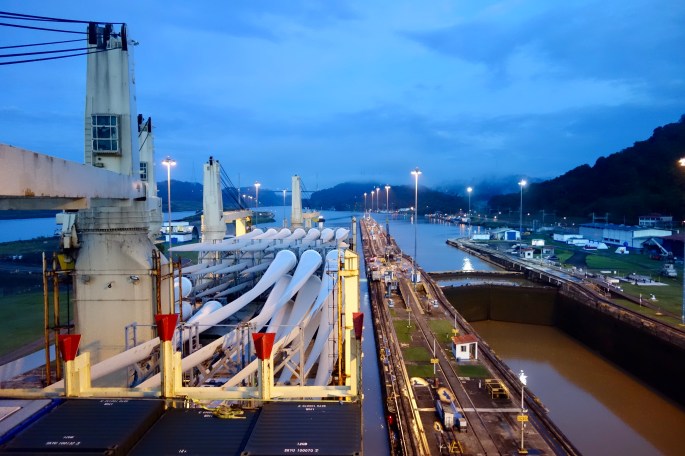
12:01 am. The ship has anchored outside Panama City in an industrial area, and preparations begin for the Canal passage. It’s a cool and humid night; the lights of the city are far off behind some dark hills. Looking quite prehistoric, a giant brown pelican swoops around the ship, occasionally diving for the fish that are attracted to the ship’s lights.

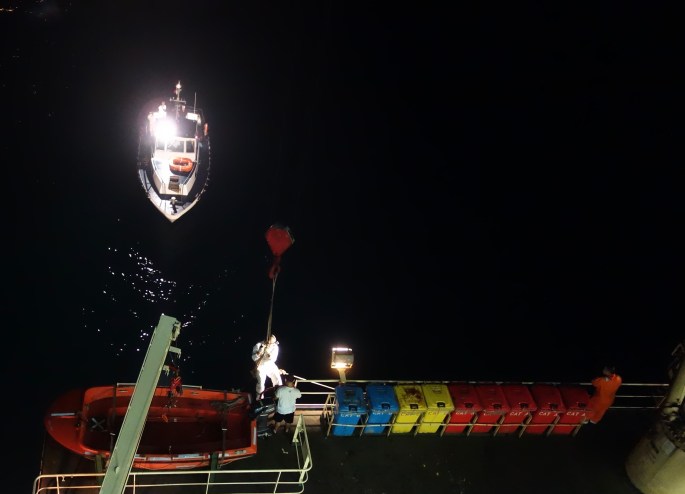
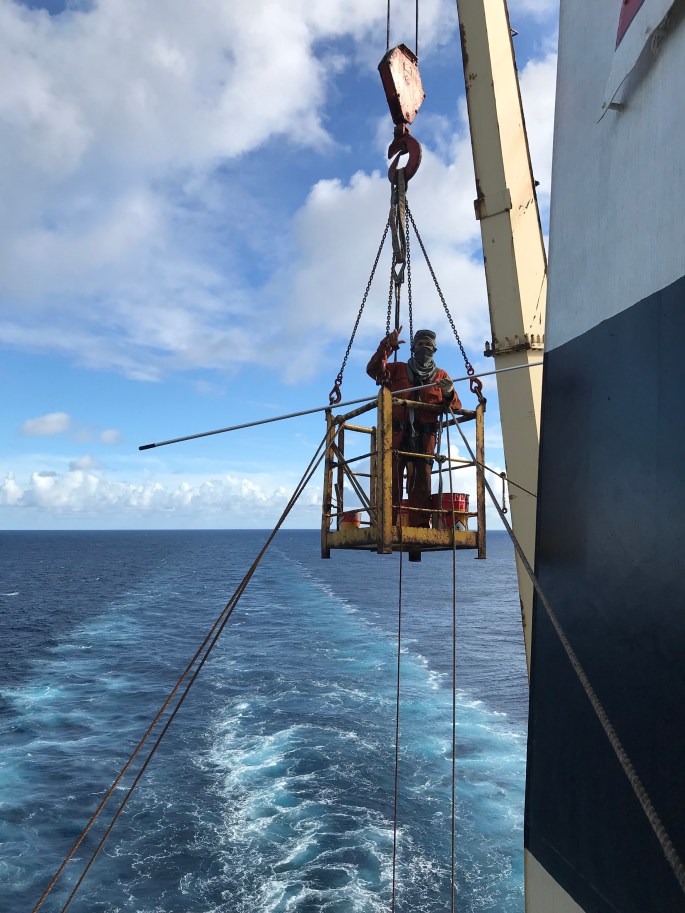
Smaller boats approach to perform a variety of functions. One has some provisions for the ship – fresh veggies and bananas! Another brings an inspector who is lowered on a rickety swing over the side, possibly to check for parasites?
fullsizeoutput_25b2

At some signal, the ship moves off across the bay toward the entrance to the first lock. On the way, we take on the pilot crew that will help guide us through. They climb one at a time from a moving tug boat up a rope ladder and swing over to a small platform that is extended from the cargo deck of the New Orleans.

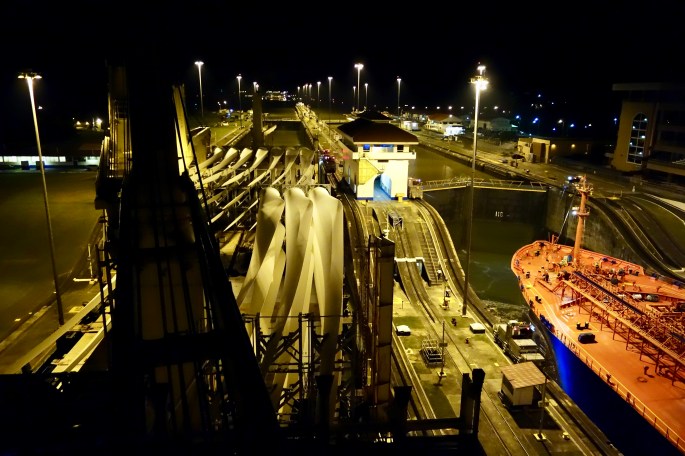
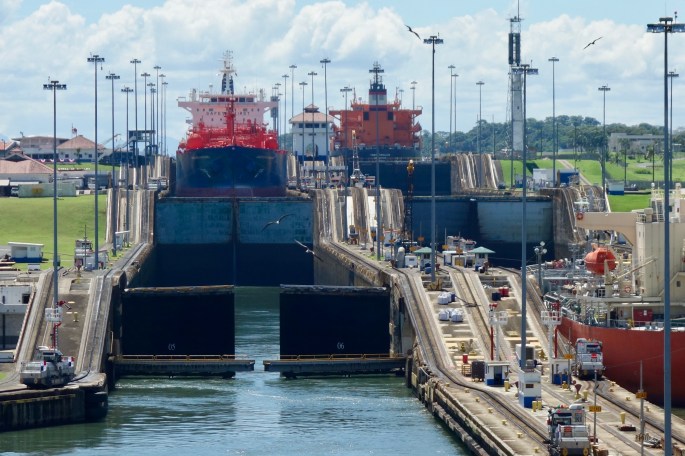
About 3 am we are in line and ready to move into the first lock.
fullsizeoutput_25a4

There are three sets of locks; from the Pacific where we are, the first lock is at the start of the canal. It lifts the ship through two or three stages up to the next level. It’s now 4:30 am, and we decide to take a little nap.

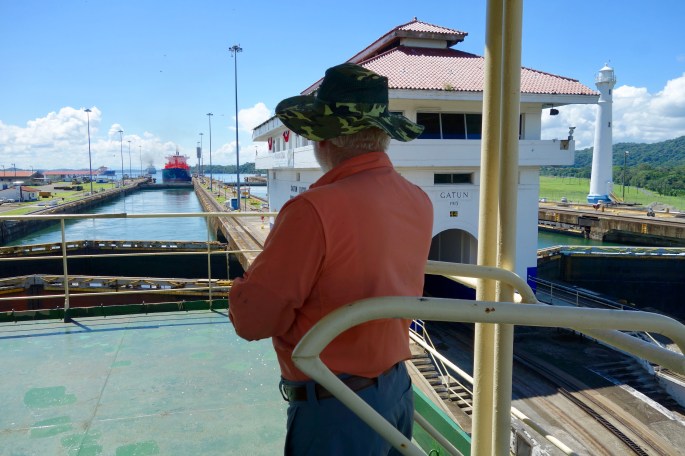
We arise just before 6 am as we enter the second lock, which takes us to the next level.

fullsizeoutput_2596fullsizeoutput_2595

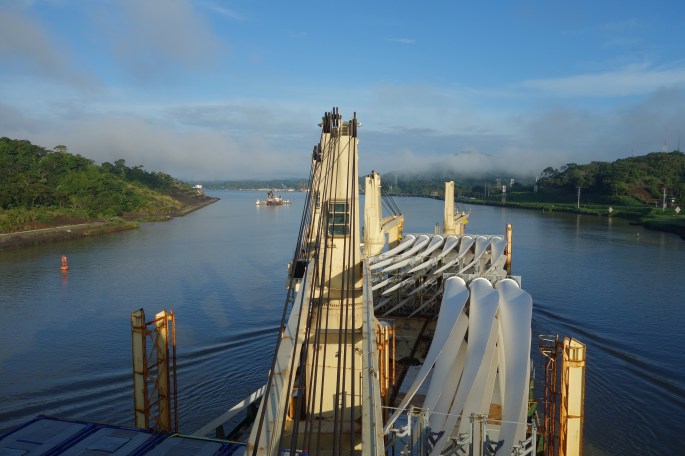
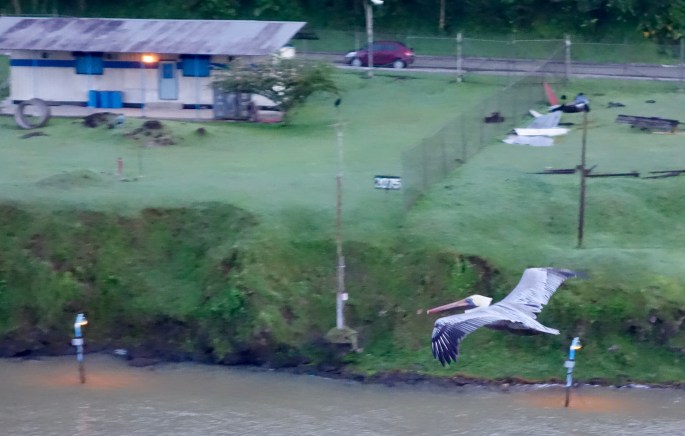
We are now in the jungle! The weather is perfect although it will get much warmer as the day continues. More of the huge pelicans fly overhead (their wing spans are up to 7 feet!), along with albatrosses, gulls and even some vultures.
fullsizeoutput_27be

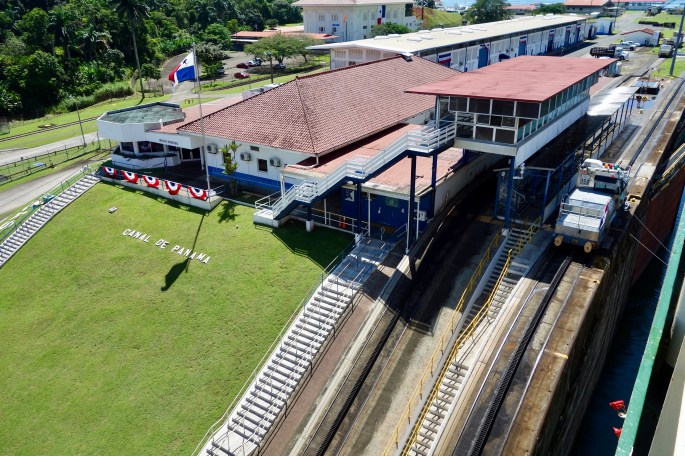
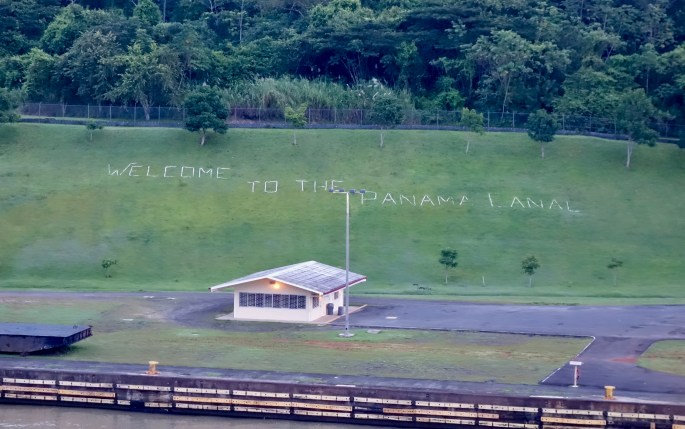
After a false start by the French group which completed the Suez Canal some years earlier, the Panama Canal was completed by the US in 1914, an event that was almost completely overshadowed by the start of World War I. Many lives were lost during its construction – as many as 20,000 – mostly due to yellow fever and malaria, the vast majority of which could have been avoided with basic sanitary measures that are practiced today throughout the world.

Unlike Suez – which is basically just a big ditch, albeit one that was a real pain to dig – Panama is an extraordinary work of engineering and construction. The Canal has obviously been driven through the hills that lie on both sides of the passage here, overgrown with dark green tropical vegetation but clearly sculpted into deep terraces by the hand of mankind.
fullsizeoutput_27c0fullsizeoutput_253bfullsizeoutput_2543fullsizeoutput_2548fullsizeoutput_2573DSC00906

The Canal then opens into a broad but fairly shallow lake that has been dredged to accommodate the commercial vessels that pass back and forth. At the far end of the lake is the third lock, which returns us back to sea level on the Atlantic side. We have to wait a while here, but complete the process by about 1:30 pm.

We pass by the neglected-looking town of Colon, through its outer jetty with a gaggle of ships waiting their turn to go to the Pacific side, and on into the Caribbean Sea, which, protected as it is on all sides, appears startlingly calm and glassy.

13 November – Caribbean Sea

The water’s surface is a little choppy today; it’s cloudy and rains off and on.

Despite the weather, the crew has been assigned to continue the painting project on the deck around the Blue Bar, where we spend most of our waking hours. The Blue Bar is the only place on the ship with somewhat effective air conditioning, which was not a big issue until we arrived in the tropics.
IMG_0847

We decide to take a short nap, and lie down on the plastic lounge chairs we have installed in the Blue Bar to take advantage of the coolness. As we start to drift off, it occurs to the more alert of us that the paint fumes are very thick, and we might have trouble waking up. We spend the rest of the afternoon in the less toxic but stickier discomfort of our cabins.

We are alone again for the most part. The falcons decided that the pickings were better on the Pacific side of Panama; the sparrows are gone; the dolphins have not popped up, and passing ships are few and far between. Just a few gulls wing their way around the bow.

Think I’ll have a banana.
IMG_2450

14 November – Caribbean Sea, west of Grand Cayman

Some rain today, and the wind has picked up.

The falcons have not abandoned us after all! Two of them were zooming all around the ship at sunset. They were either engaging in very spirited play, or else they were fighting – banging into each other and squawking. We could hear them in spite of the strong wind.  Could be Wanda and Wes having a spat, or possibly the stranger, back to challenge Wes for Wanda’s claw…. Or possibly two completely different falcons.

15 November – Gulf of Mexico

Early this morning, we pass between Cancun and the tip of Cuba, and on into the Gulf of Mexico. We are on track for arriving in Corpus Christi the afternoon of the 17th. We’ll spend some time there with Henry’s sister Ann and husband Jerry while the windmill wings we’ve been carrying are unloaded and packed off to West Texas. Then we re-board the New Orleans for the final push on to Houston.

Drama in the galley (other than the day-to-day desecration of all that’s holy in nutrition) – Mark the cook, whose contract would otherwise be up in Houston, has been asked to stay on for two more months, thus missing Christmas with his family in the Philippines…. again. In a desperate move, he proposes promoting the steward to take his place as cook. For what it’s worth, the steward is the likely perpetrator of the Crime against Peas mentioned a few days ago.

Mark is a clever guy – hope it works out for him. He tells Henry that he deliberately makes the food unappetizing….. if it were good, the crew would chow down like hogs at the trough, and the galley would run out of provisions.
Thirteenth Port – Corpus Christi

17 November – Gulf of Mexico
The New Orleans anchors in the bay outside Corpus Christi in the early afternoon…..and just sits. We are going nowhere.
Scuttlebutt in the galley has it that the winch is broken, we cannot pull the anchor back up, and we are marooned for who knows how long until the winch can be fixed. The captain, on the other hand, says that the pilot is delayed and we don’t know when he or she will arrive.

The pilot shows up around 8 pm to start the long process (3 to 4 hours) of guiding us into port. Those of us in the know just decide to go to bed.

18 and 19 November –

We arrive in the wee small hours of the morning in the port area of Corpus Christi. We are parked under the bridge near the downtown area, and from the pilot deck, we can see that very American landscape feature – a baseball field.

Henry’s sister Ann and her husband Jerry arrive at the port gate at 9 am; due to a series of administrative snafus and mis-direction, disembarkation is delayed for hours.

We are finally released around 1 pm, and spend a nice day and evening catching up with Ann and Jerry.

Unfortunately, our visit is shorter than anticipated. As noted, we arrived a day late due to delay in getting a pilot to guide the ship in. Apparently, however, things have fallen into place such that we will be able to leave Sunday afternoon instead of Monday.

After an expedited return to the ship, it does not in fact leave at 5 pm as planned; instead it is after 8 pm. No matter how much experience we have gained with cargo ship travel, we still just can’t fully appreciate that delay is the order of the day; promptness would be an anomaly.