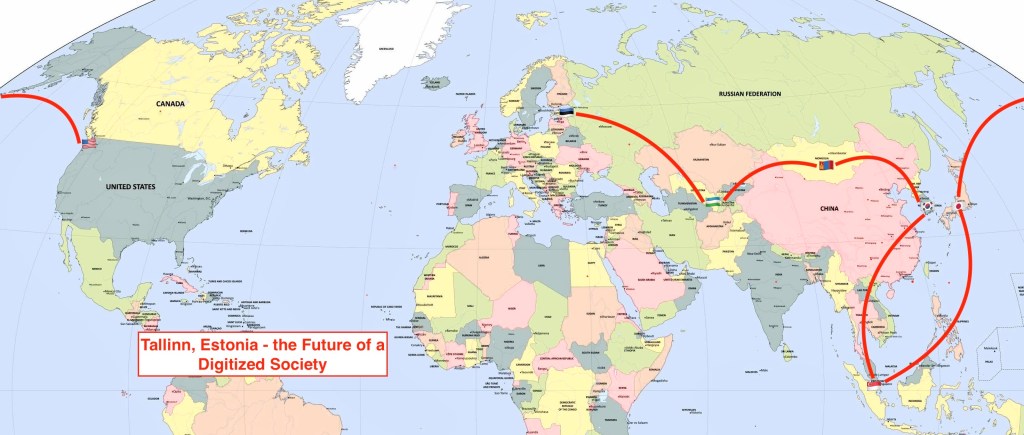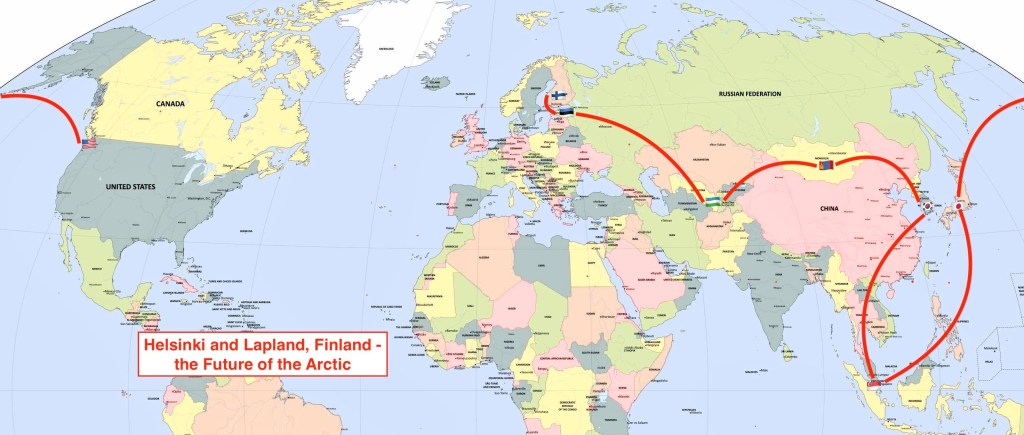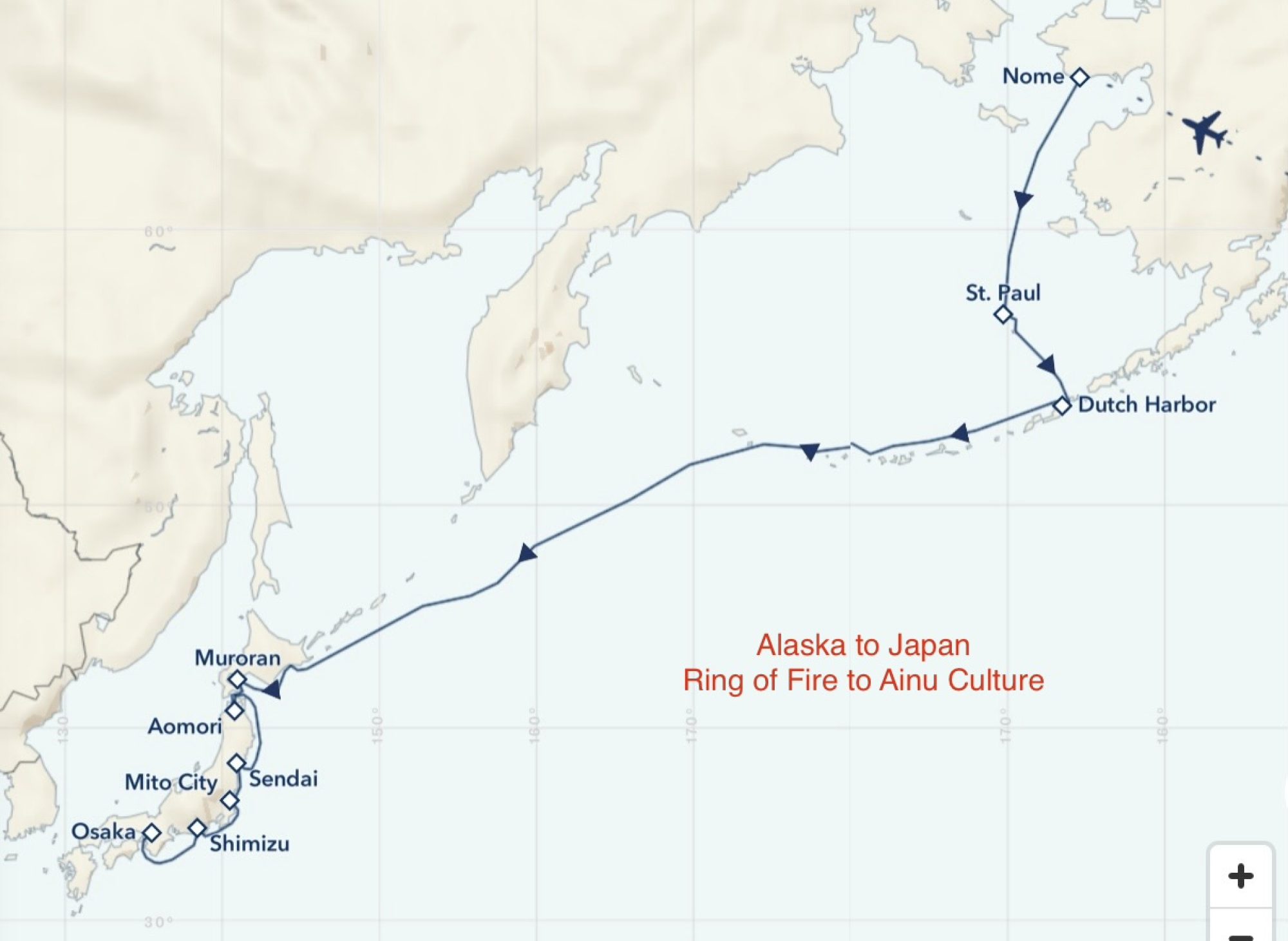
Estonia is proud of its leadership in digitizing administrative government functions and social services. Healthcare, banking, taxes, and welfare programs such as pensions and subsidized child care are all handled with a single identification card and password. (All of which is made easier by Estonia’s socialized system and small size…. 1.3 million people with single-payer medical coverage, a simple tax code and free and universal internet access.) In any event, its tax and legal structure have been designed to be attractive to businesses and start-ups, and it has become a high-tech hub.
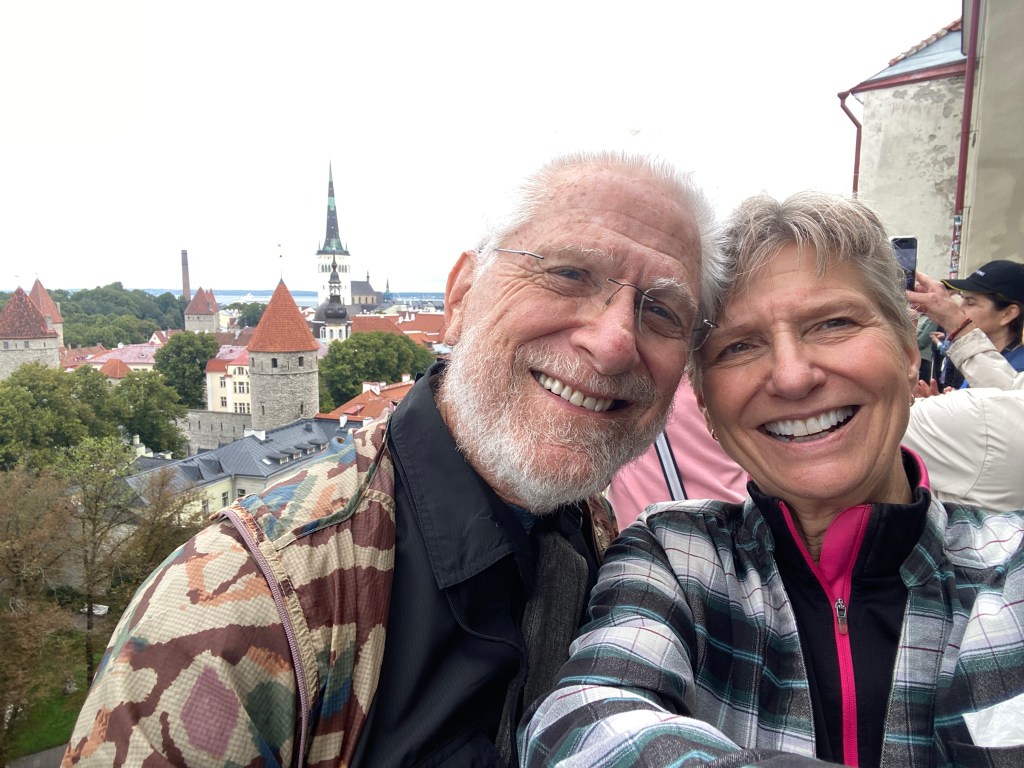
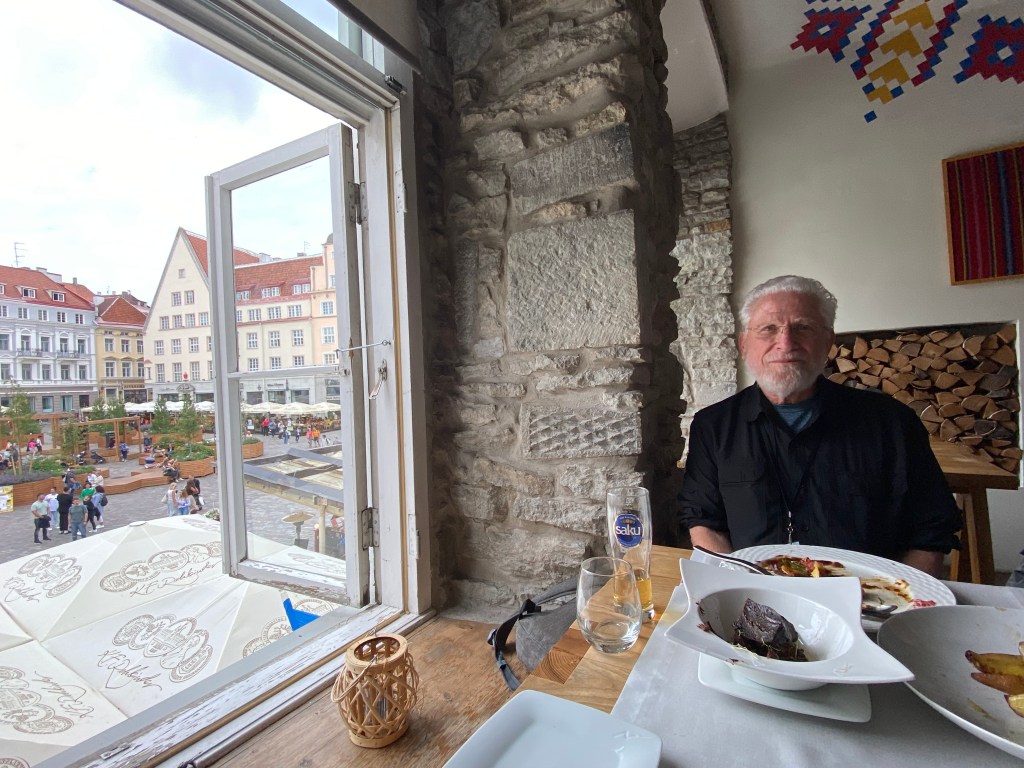
Tallinn, the capital city, is one of the best-preserved medieval towns in Europe…..
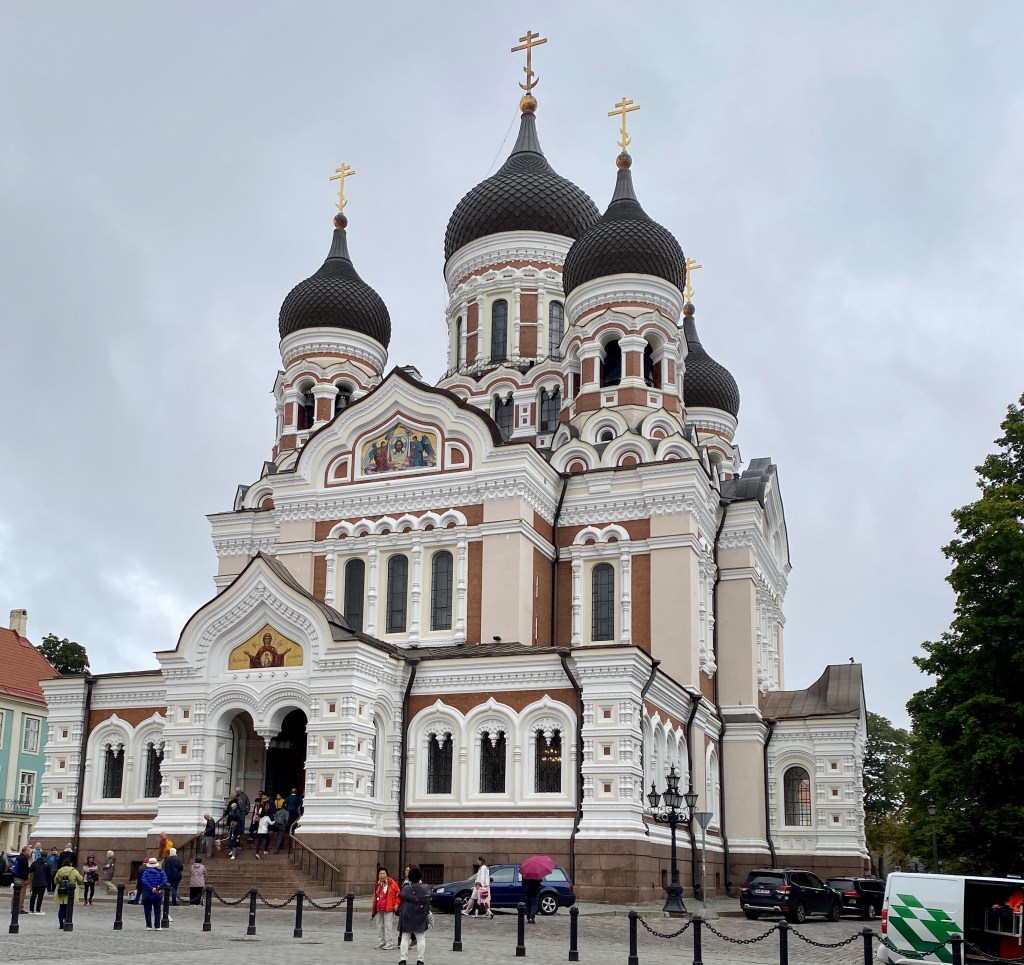
Estonia has been a part of many empires over the centuries, but gained its current state of independence from the Soviet Union 32 years ago. Remnants of Russian architectural influence are still evident…..
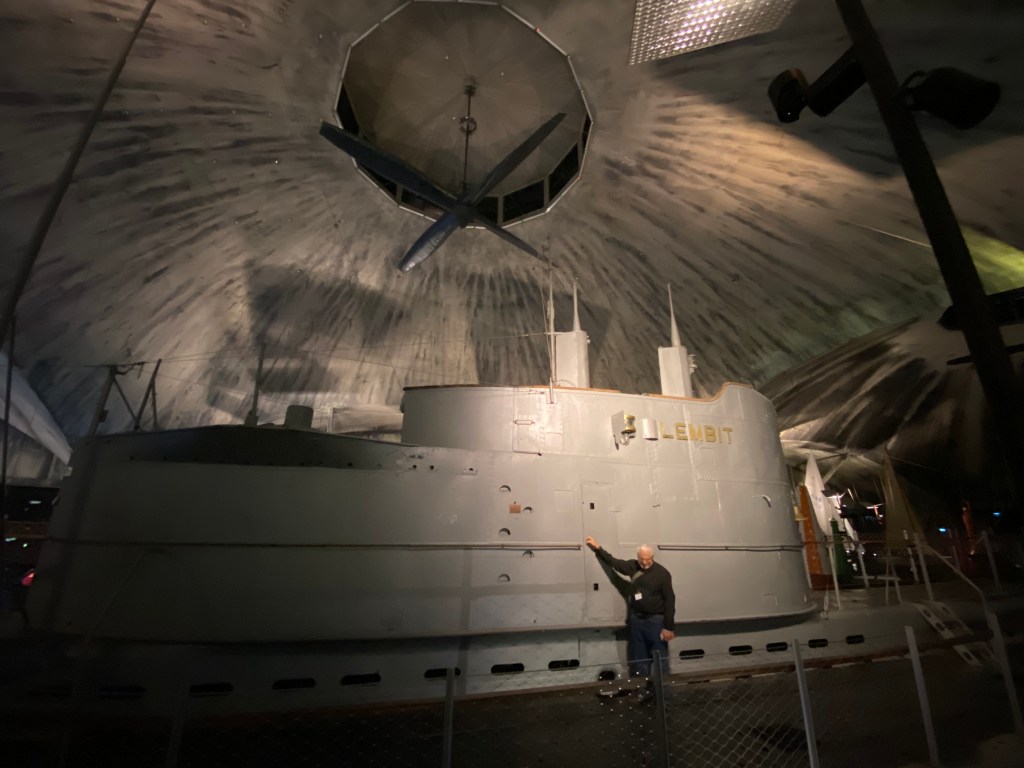
Our time here was short, but we were able to visit the maritime museum and see the pre-World War II submarine Lembit, which was the pride of the Estonian navy.
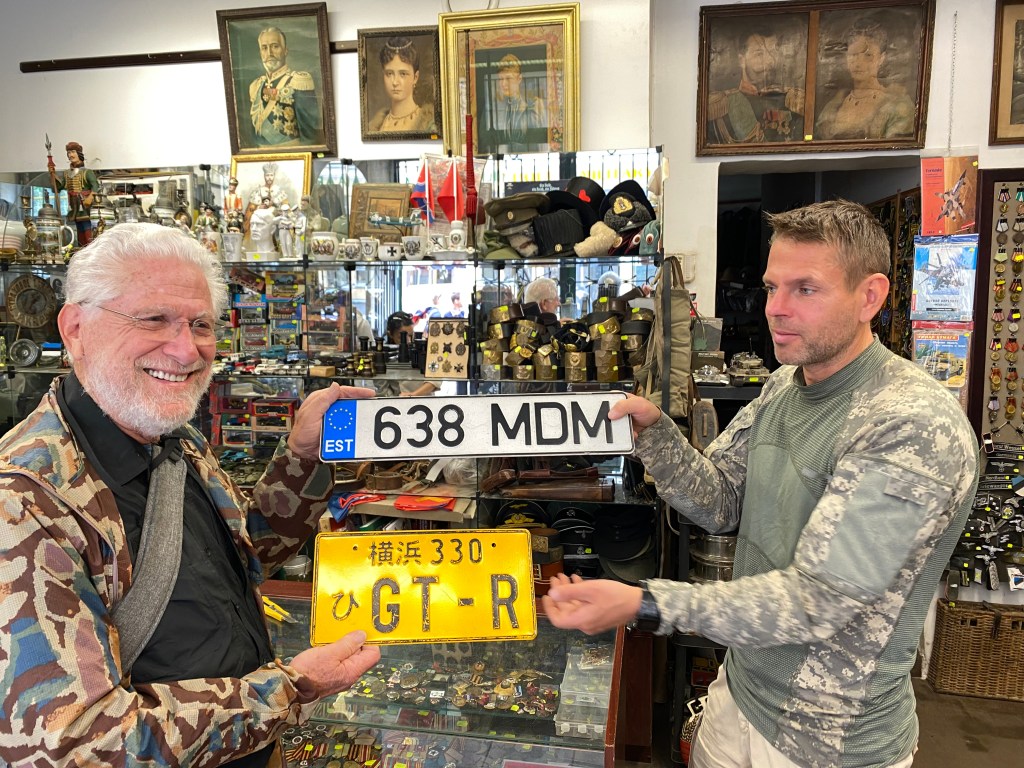
Henry found a fellow license plate enthusiast and scored a couple of new additions for his collection.
And another sign of an enlightened society…. Free sanitary products for women..
A fairly restful stay here before crossing the Baltic Sea to Helsinki, Finland.
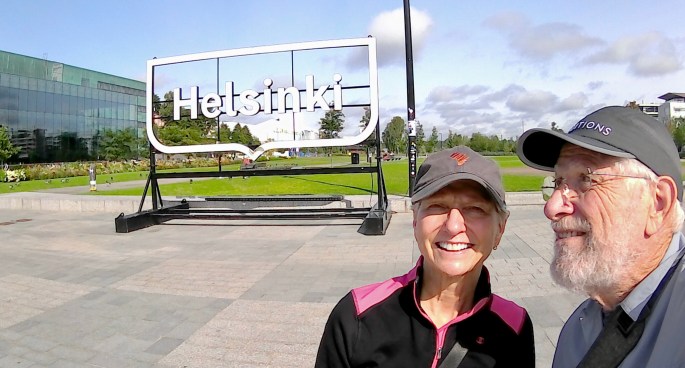
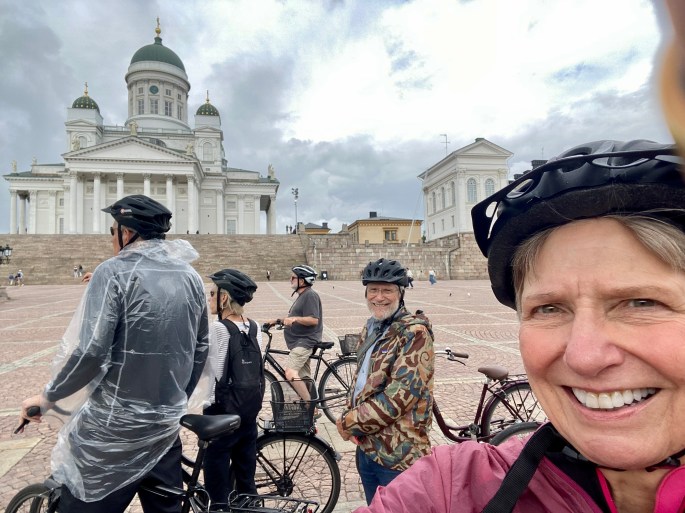
Helsinki is a fun city to explore – great spaces dedicated to its spirit of community.
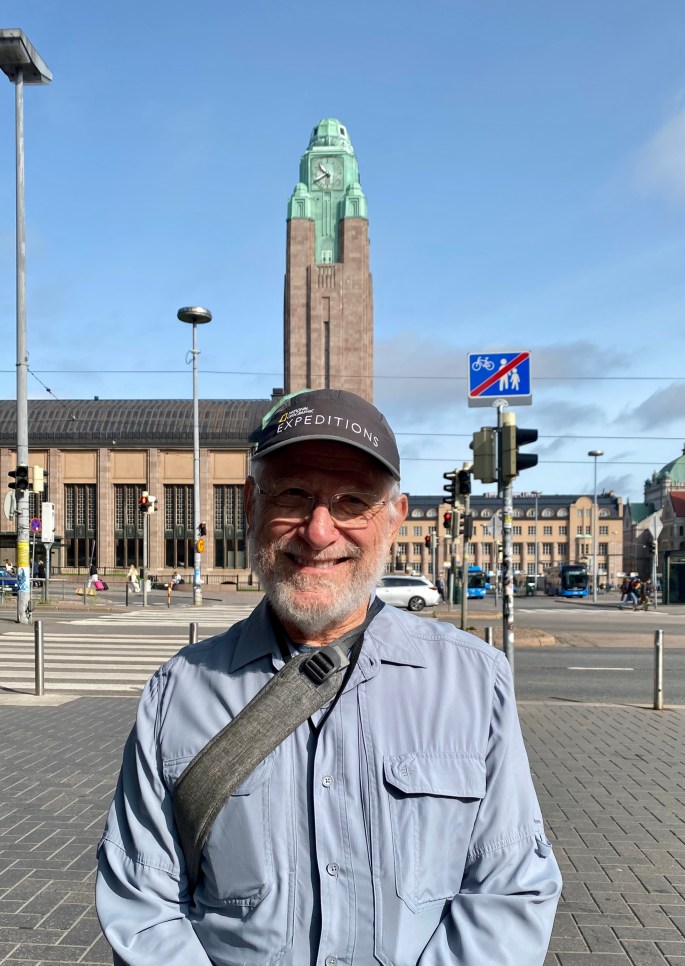
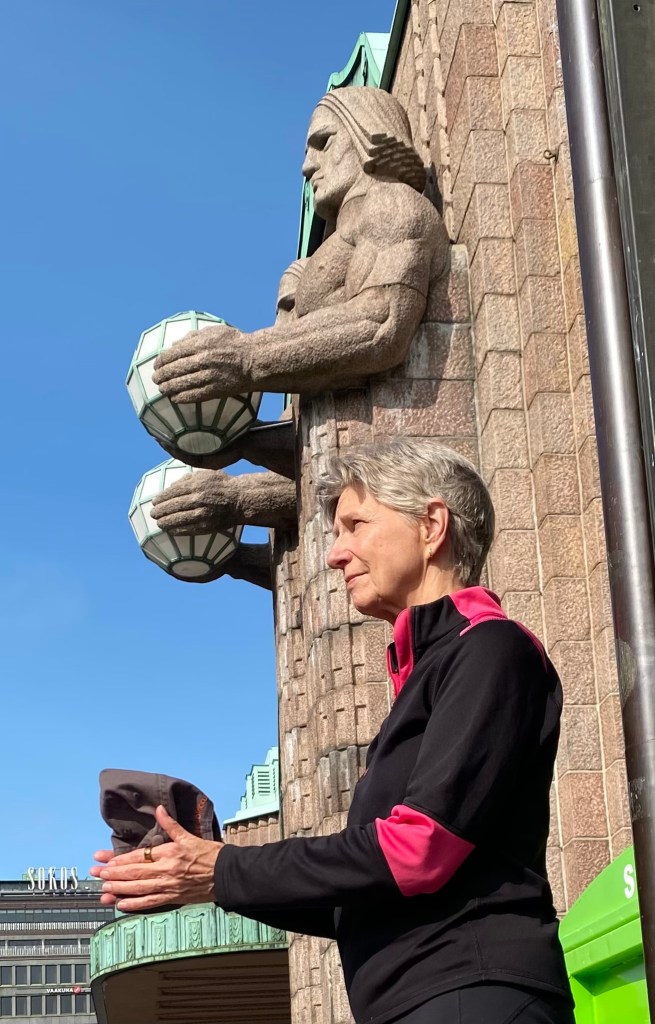
The central train station, constructed in 1919, was designed by Finnish architect Eliel Saarinen in a modern style…..
His son, Eero, gained renown as an architect in the US who designed the famous Gateway Arch in St Louis and the TWA flight center for New York’s JFK airport.
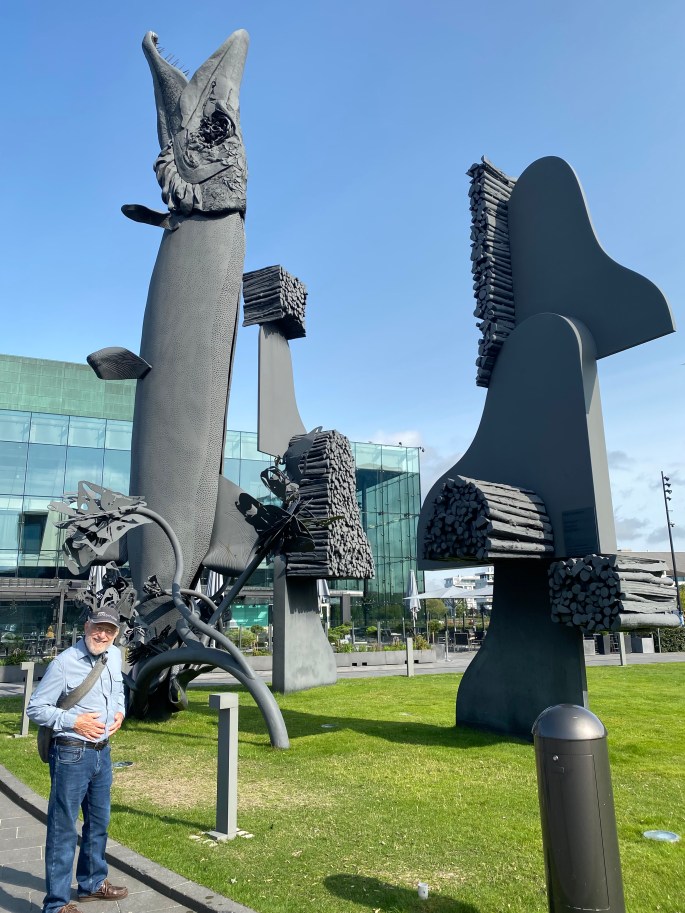
Some fascinating sculptures….
A singing fish surrounded by grand piano shapes and wood piles in front of the Helsinki Music Center.
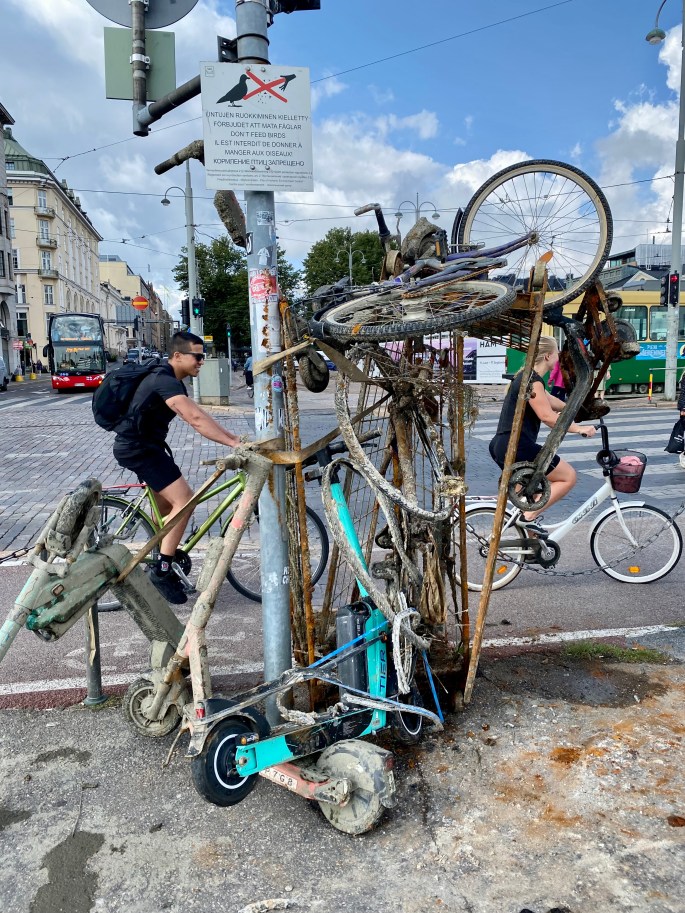
Junk becomes art….. a jumble of bicycle parts dredged from the bay on display.
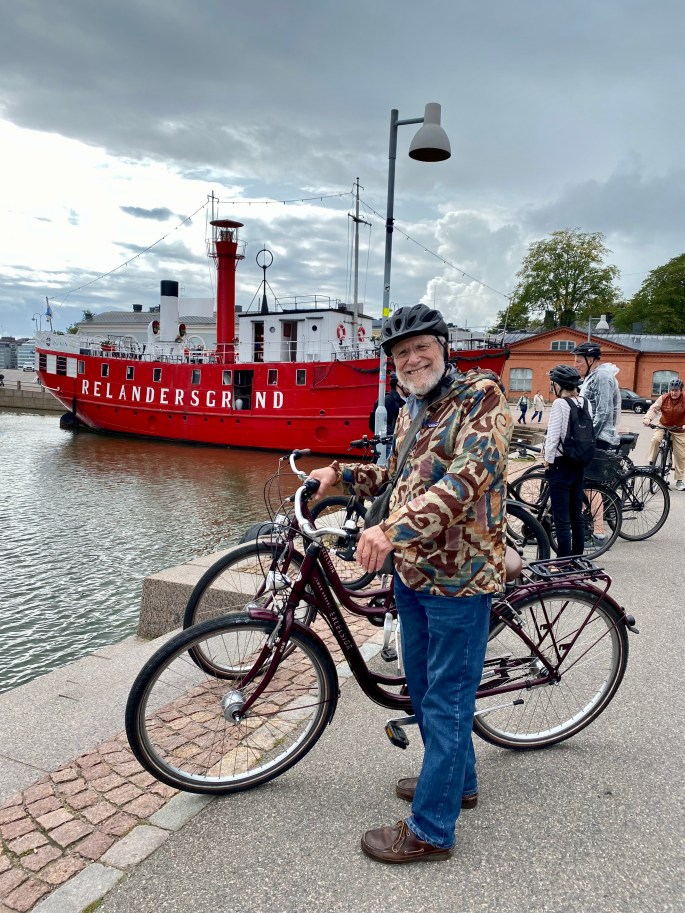
Lots of bike lanes and relatively light vehicle traffic make this a comfortable place to take a ride.
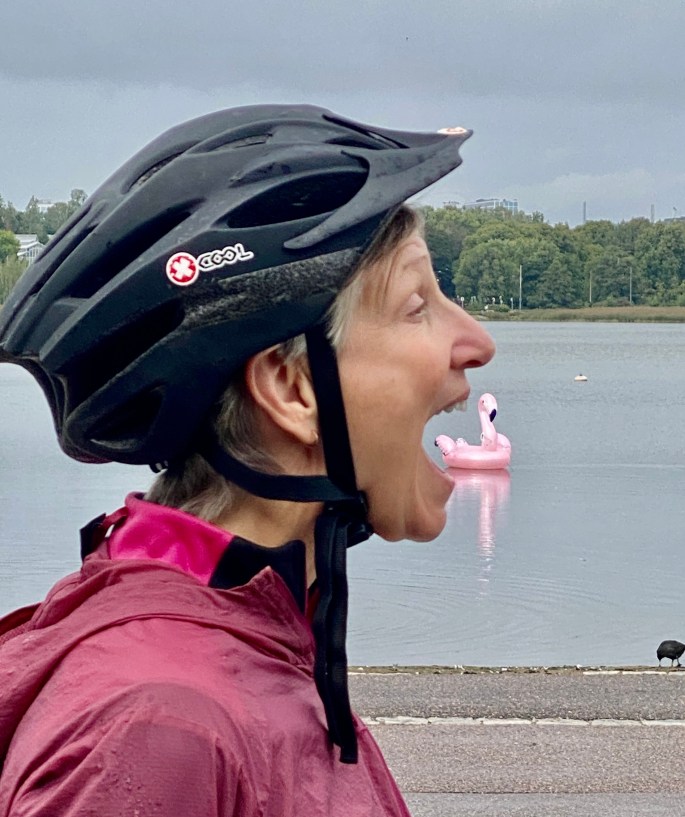
A “snack” at a little pond in the park.
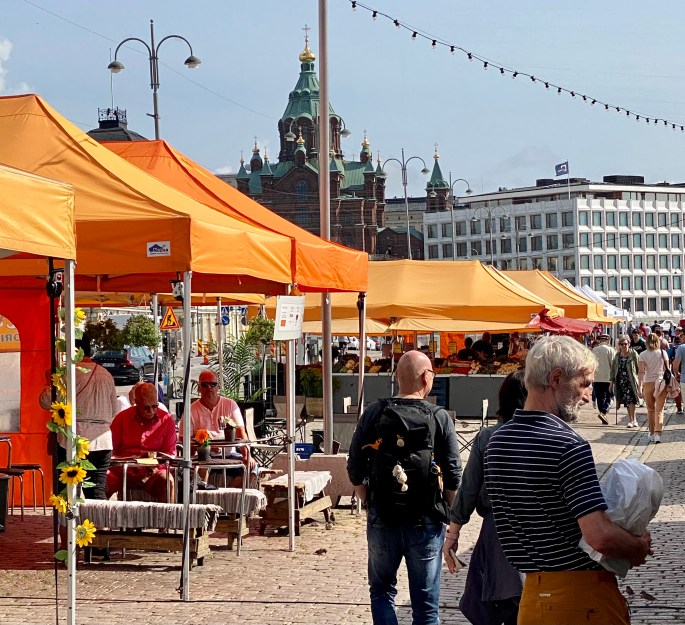
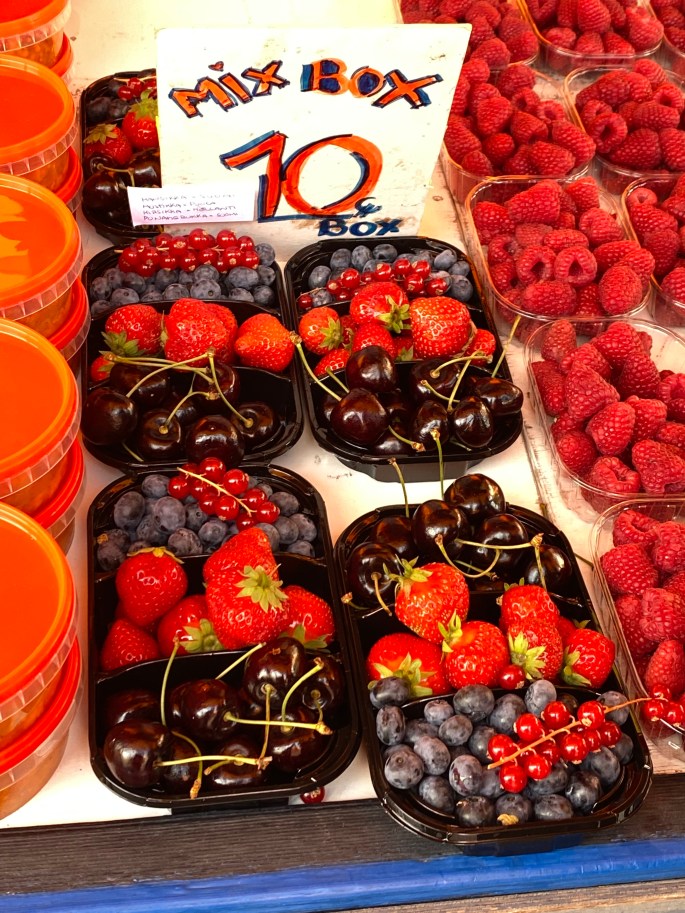
The waterfront features a colorful outdoor market.
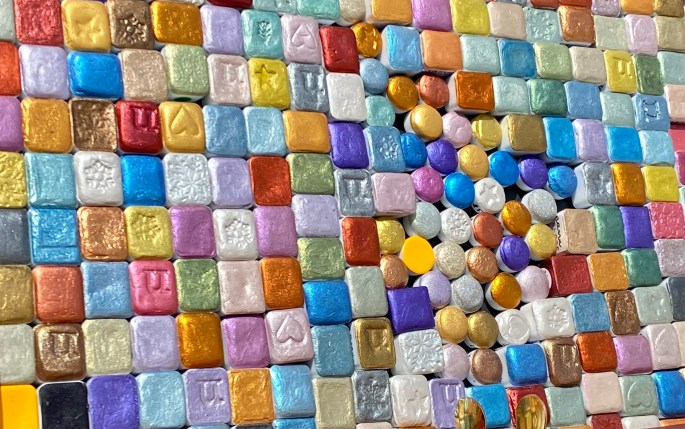
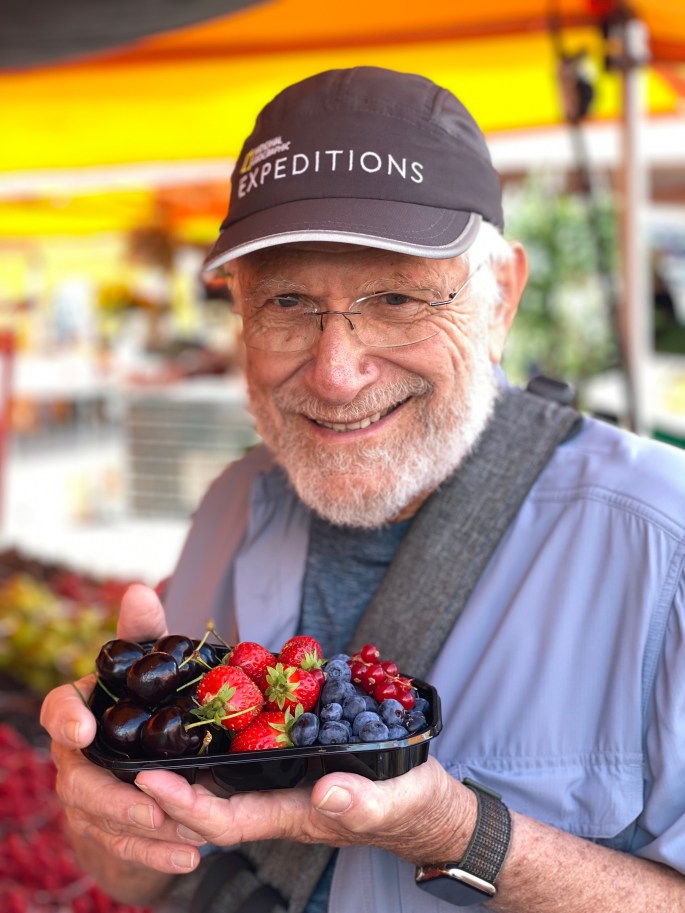
Cakes of watercolor paintSmart vendors sold tiny servings of a variety of gorgeous fruit at a ridiculously high price to happy consumers.
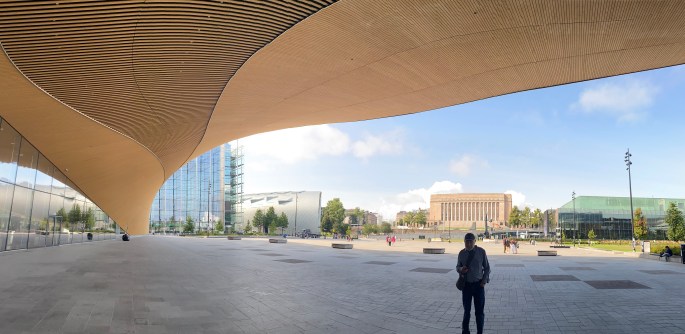
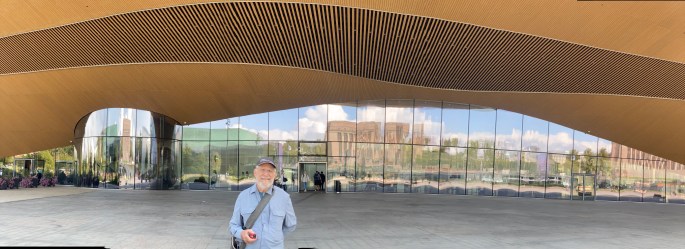
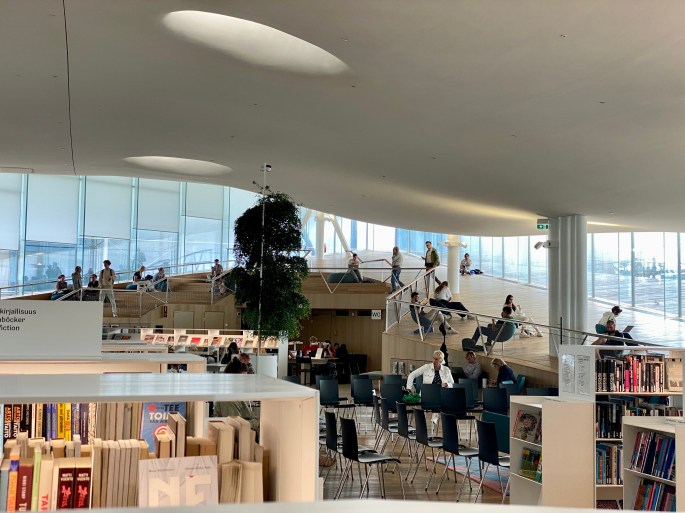
An unexpected discovery was the city’s library, a sweeping modern structure on a vast plaza….
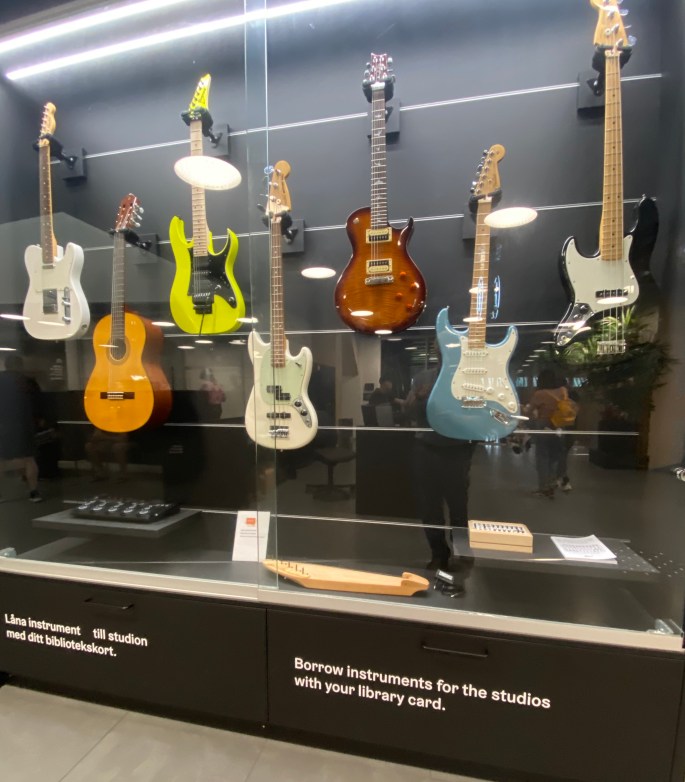
The best part was inside. This place functions as a community arts center, a brilliant adaptation of the traditional library to modern times. Meeting rooms, art studios and recording studios are available at little to no cost. Even musical instrument rentals are free…
The facility includes banks of sewing machines and all kinds of craft equipment for public use, including this 3-D printer.
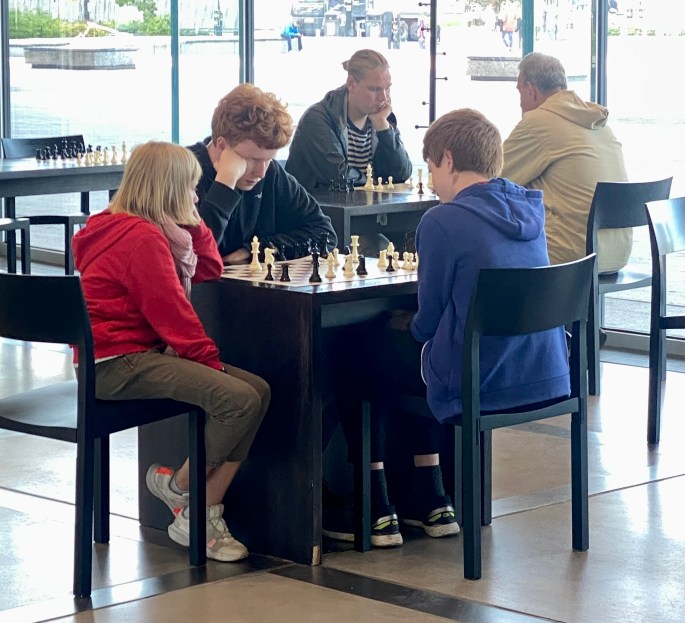
Play stations and virtual reality studios… and old-fashioned chess sets that people (even children!) actually use…
And of course there are books (carefully transferred for shelving by little robots)….
And places to enjoy them.
A cafe on the roof includes a sweeping terrace with a fabulous view.
To us, this is the Future of Community, where public spaces not only please the eye, but provide fodder for creativity and connection to fellow citizens!
SÁPMI (LAPLAND)
Sápmi, often called Lapland, a region inhabited by the indigenous Sámi people, includes the northern part of Finland, as well as contiguous parts of Norway, Sweden and Russia. The Sámi are traditionally reindeer herders, although they have been active in many other parts of society. (The Sámi were called Lapps, but they find the terminology offensive, so we will stick with Sámi and the name of their homeland, Sápmi.)
The Sápmi flag….
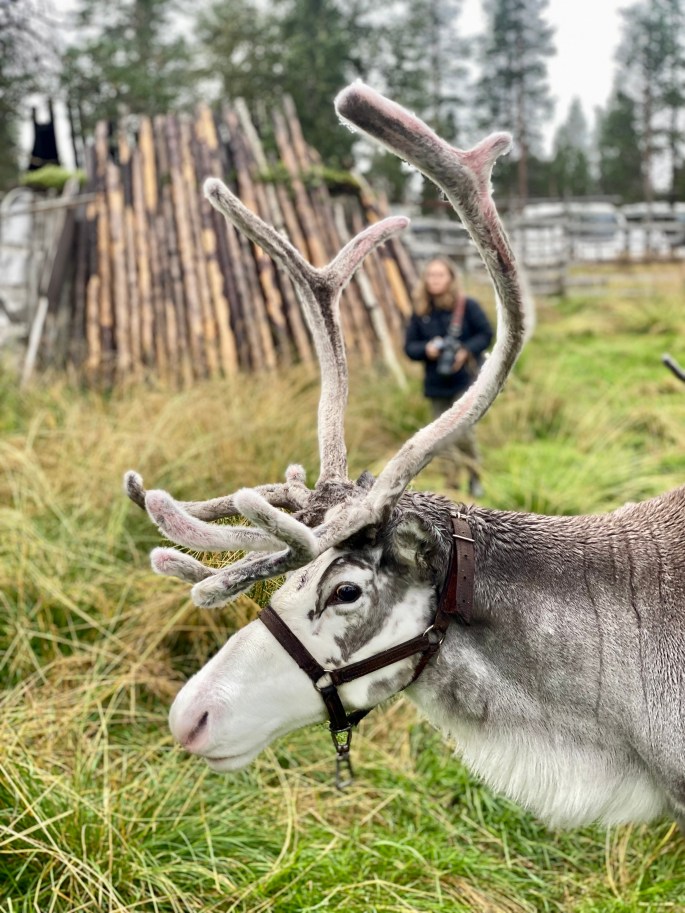
Our short visit included time at a reindeer farm…
And a performance of the a cappella Sámi singing form known as joiking, characteristically performed with a great deal of energy and quite a lot of volume!
We are continually amazed and delighted at what there is to learn about other places and cultures. But we will return to somewhat familiar territory at our next destination – Reykjavik, Iceland.
(Don’t forget to click on the title of the post so you can see the videos!)
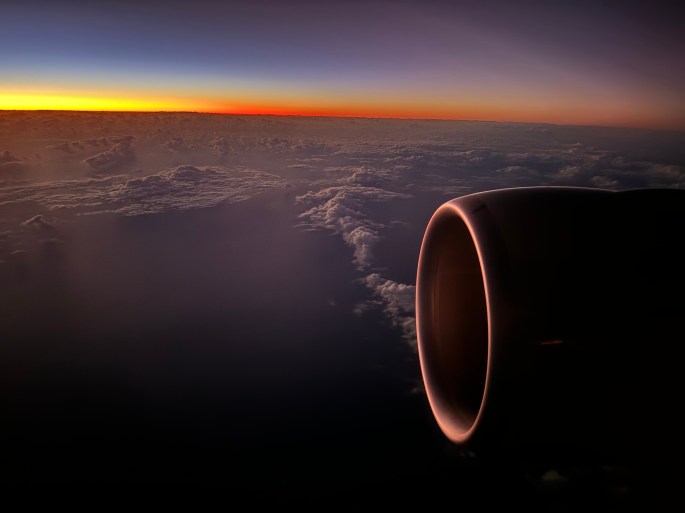
And now we return to Iceland, the last destination on our around-the-world journey. We will not see Northern Lights this time either….. still a bit early in the season ….. but our Iceland Air jet is fortunately equipped with a substitute.
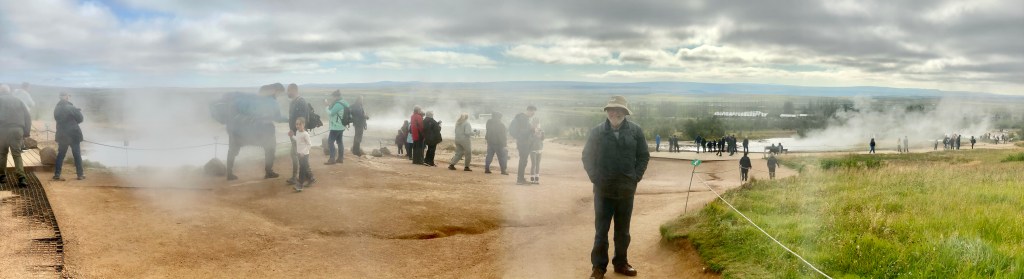
Having just been here a couple of months ago, the sights were familiar….. including geothermal springs and a geyser.
Also waterfalls (this one is the Gullfoss), with Henry and his new friend Louis looking on.
Between geothermal and hydro-electric power generation, Iceland has all the energy it needs, and then some.
Another obvious marker of geothermal activity is a volcano. Do not think that I have forgotten about Iain’s challenge… or my promise to attempt to pronounce the name of the famous volcano that erupted in 2010, whose ash output shut down air traffic across Europe for more than a week, disrupting the plans of millions of travelers.
Iain, hope you have your beverage in hand, because here it goes…….
Easy peasy!
In an environment hostile to traditional agriculture, Iceland is actively developing local food sources to reduce its dependency on imports. This greenhouse not far from Reykjavik produces just over a ton of tomatoes PER DAY year-round, using hot water from geothermal springs to keep things warm and bees from Holland for the most efficient pollination.
They have also developed a thriving tourist trade, serving lunch to hundreds of people alongside the vines….. and it was fabulous! But only if you like tomatoes.
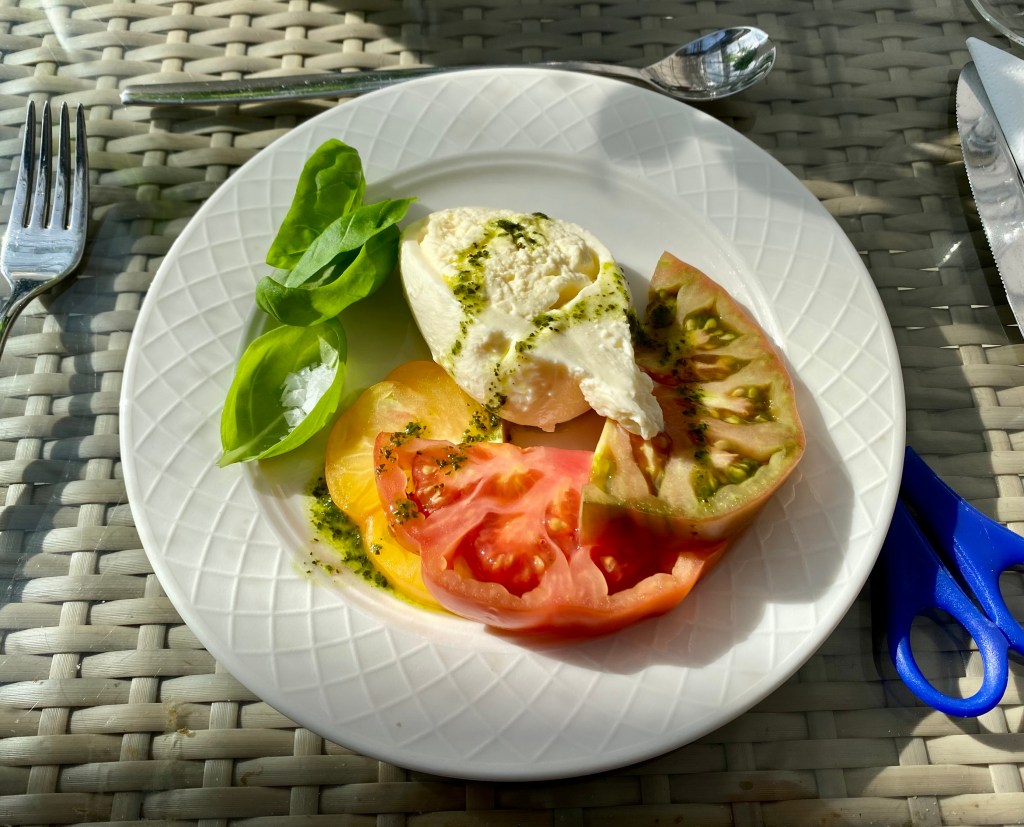
Tomatoes with burrata (here)…. Also tomato soup, cheesecake with tomato jam and even tomato beer and tomato lattes.
And as Henry points out, the people eating lunch in the greenhouse provide the plants with something they need just by breathing out – carbon dioxide, an element that is crucial to the photosynthesis process!
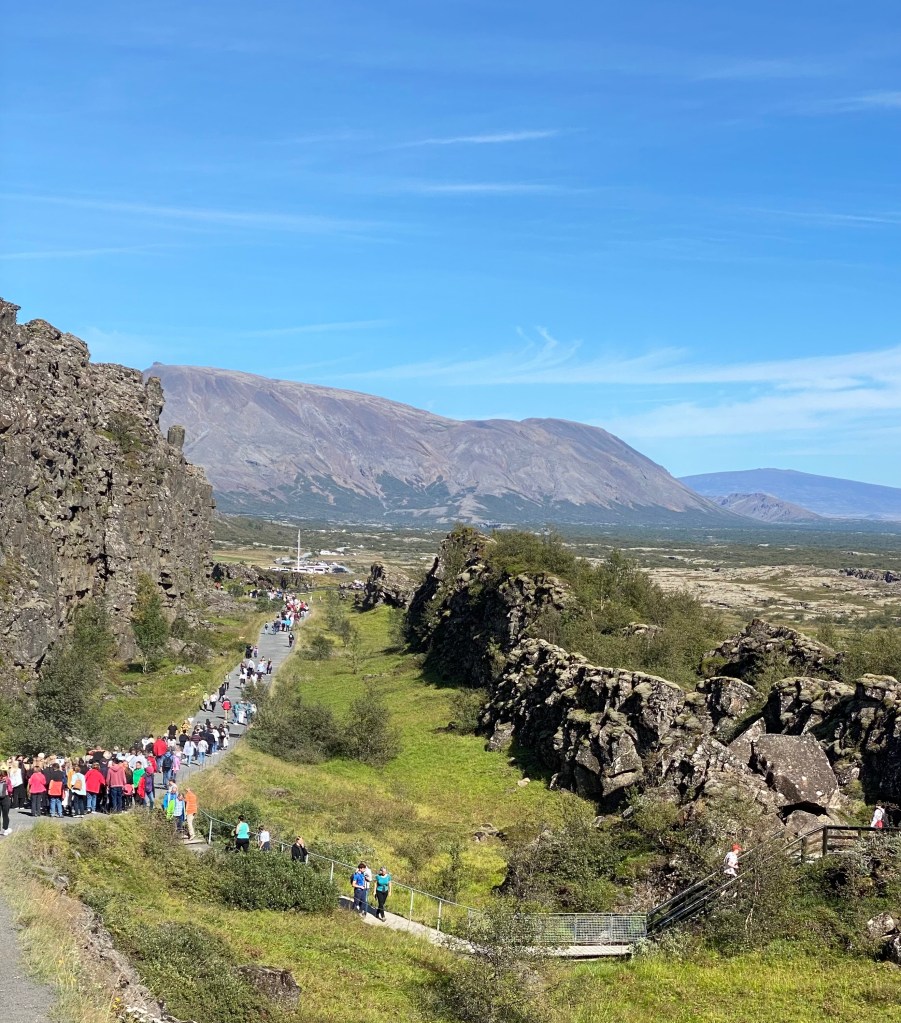
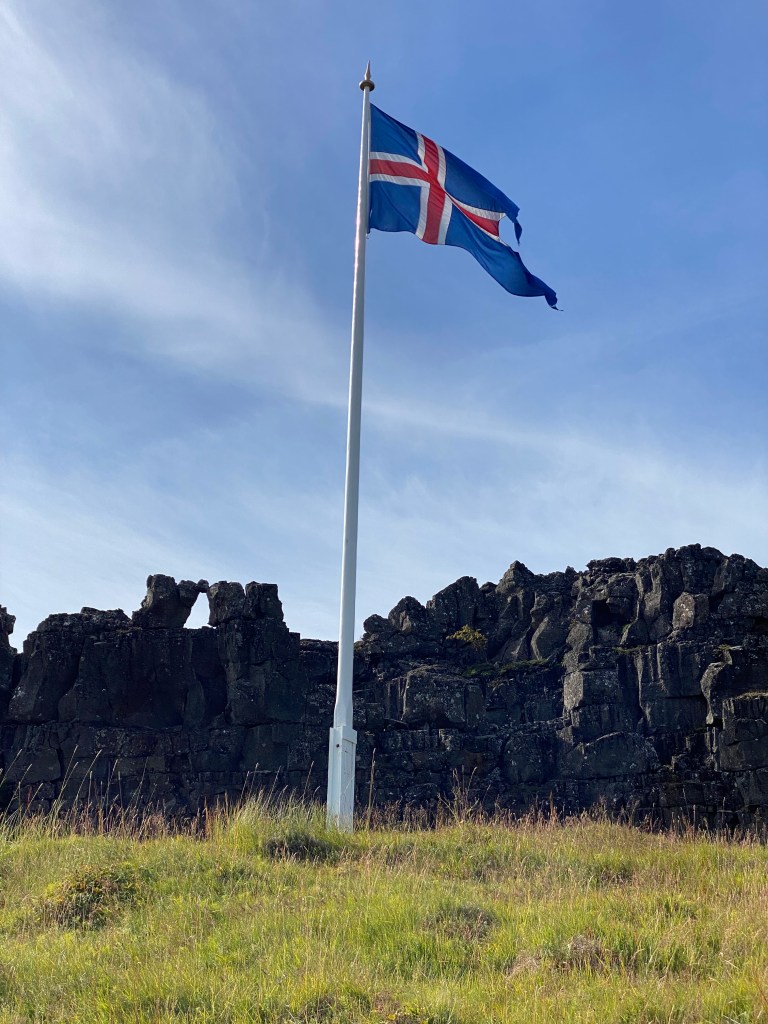
Þingvellir National Park is significant for reasons both geological and historical. First of all, it is a place where the tectonic plates that define the edges of the North American and European continents are pulling apart, creating a gorge….
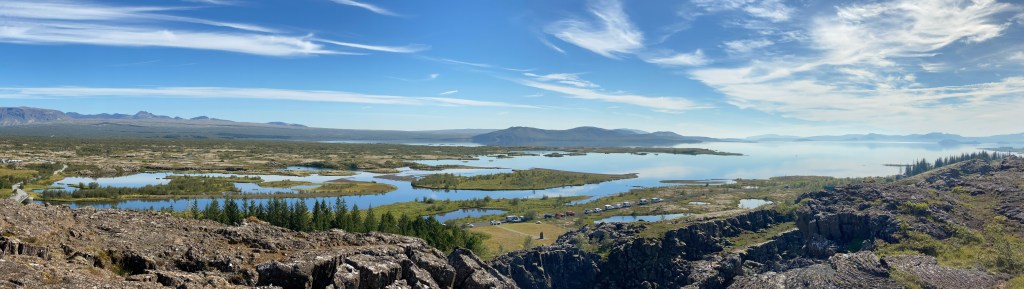
and a dramatic, rugged landscape of lava fields and a crystal-clear lake.
Considered the oldest national parliament in the world, the Alþingi (anglicised as Althing) was founded here in 930 AD. Chieftains from all over Iceland traveled to this spot each year for two weeks to collectively make laws and settle disputes. The procedural official was called the Lawspeaker; he recited the laws from memory from a promontory called the Law Rock.
All free men could attend the assemblies, which were the commercial and social events of the year. Women came as well, but were tending children and cooking food, while daughters were evaluated on their suitability for matrimony and childbearing.
Today Iceland is still governed by a parliament called the Alþingi, and the early site is a gathering place of national importance.
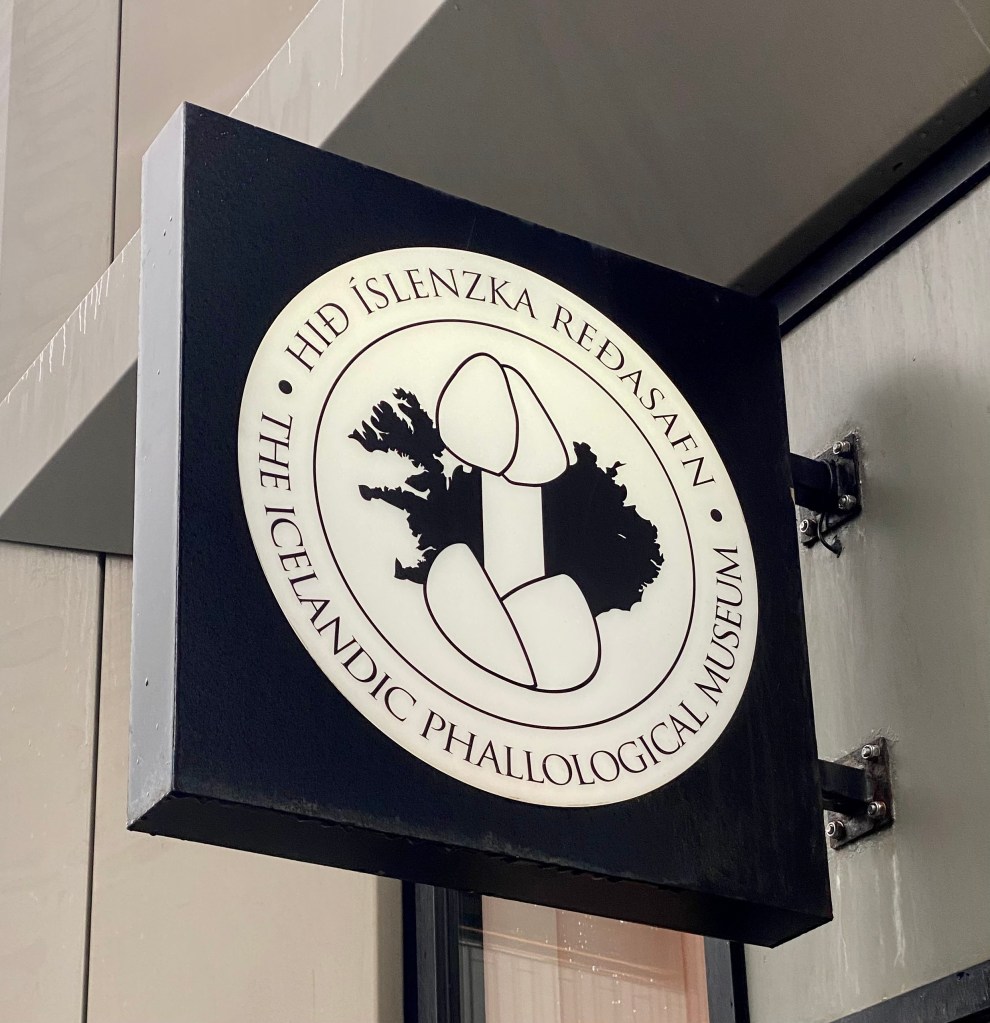
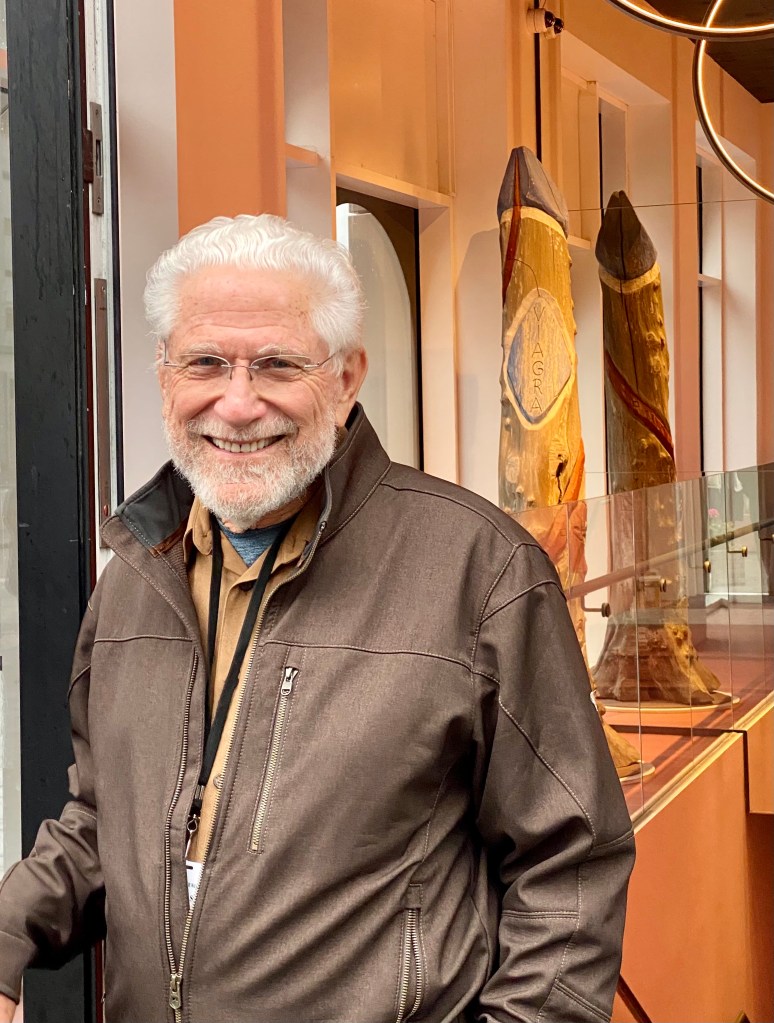
An educational establishment of note in Reykjavik is the Phallological Museum, which we glanced into briefly ….
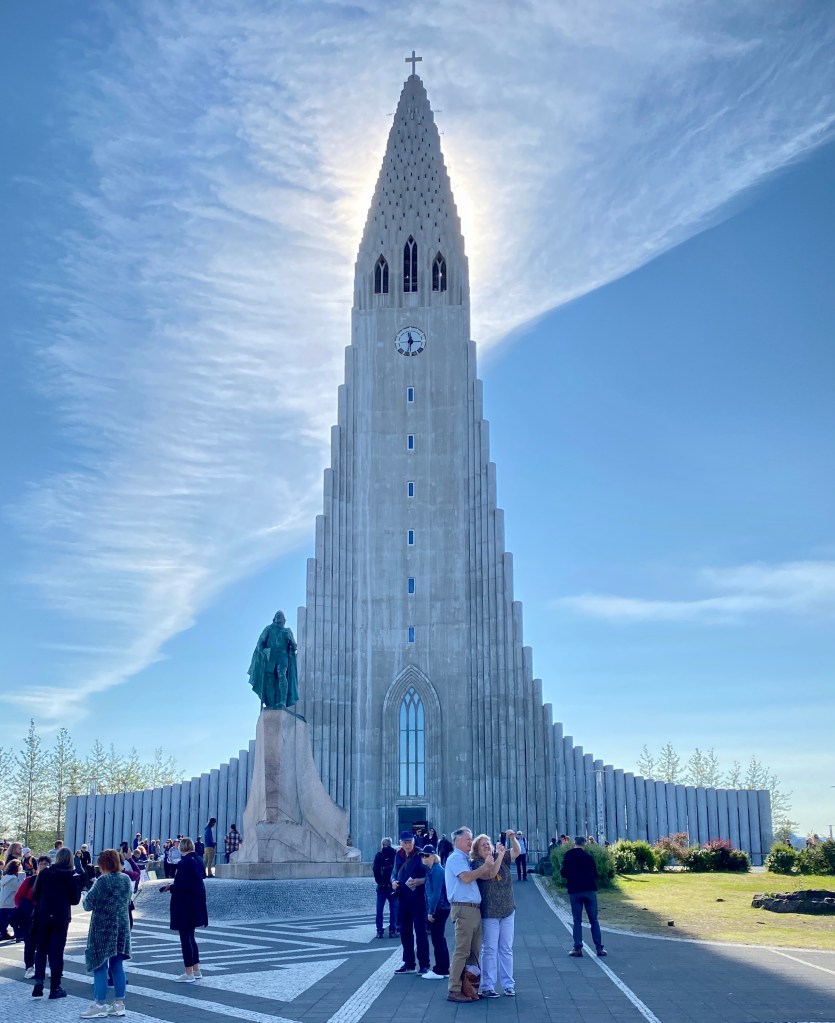
Hallgrimskirkja, a church that is an iconic part of Reykjavik’s skyline…..
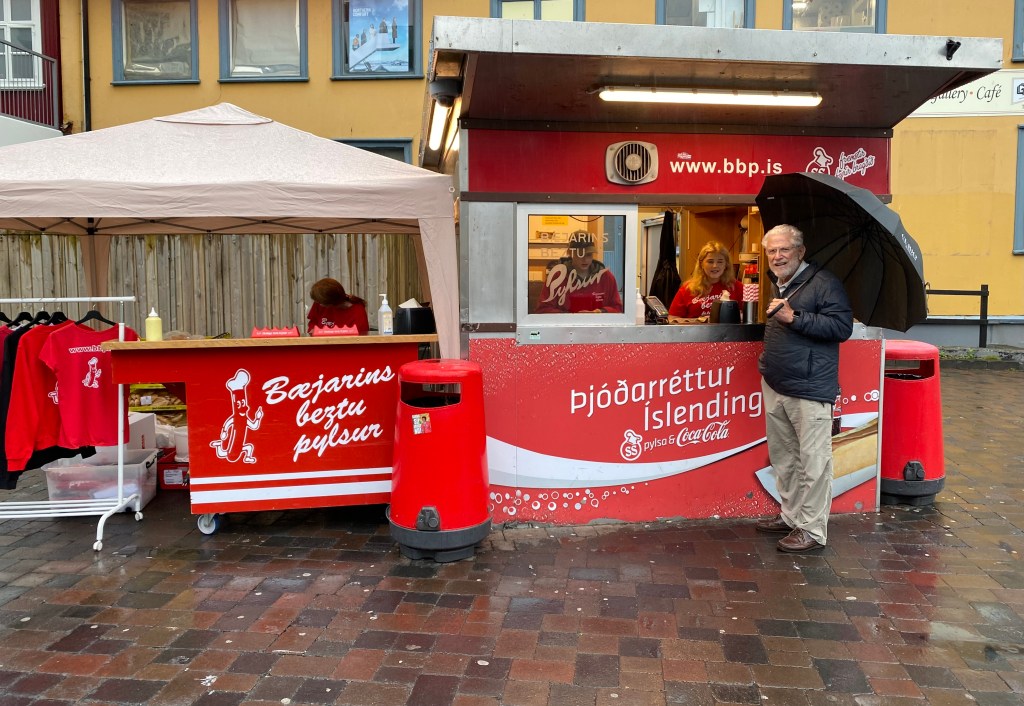
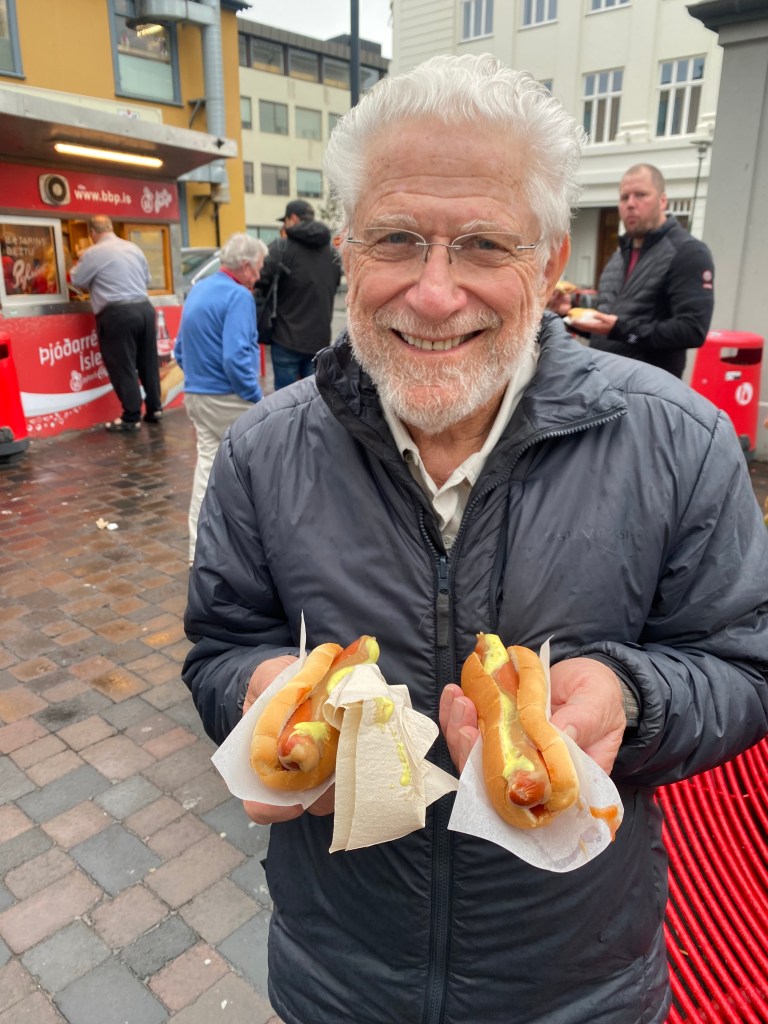
We broke away from the group for a quick lunch at this very popular hot dog stand in downtown Reykjavik, which has been in place since 1937…
There is often a very long wait, but we beat the crowds early on a rainy day.These dogs are made primarily of lamb, served with crunchy onions, ketchup made with apples and a creamy mustard. They were…. Okay!
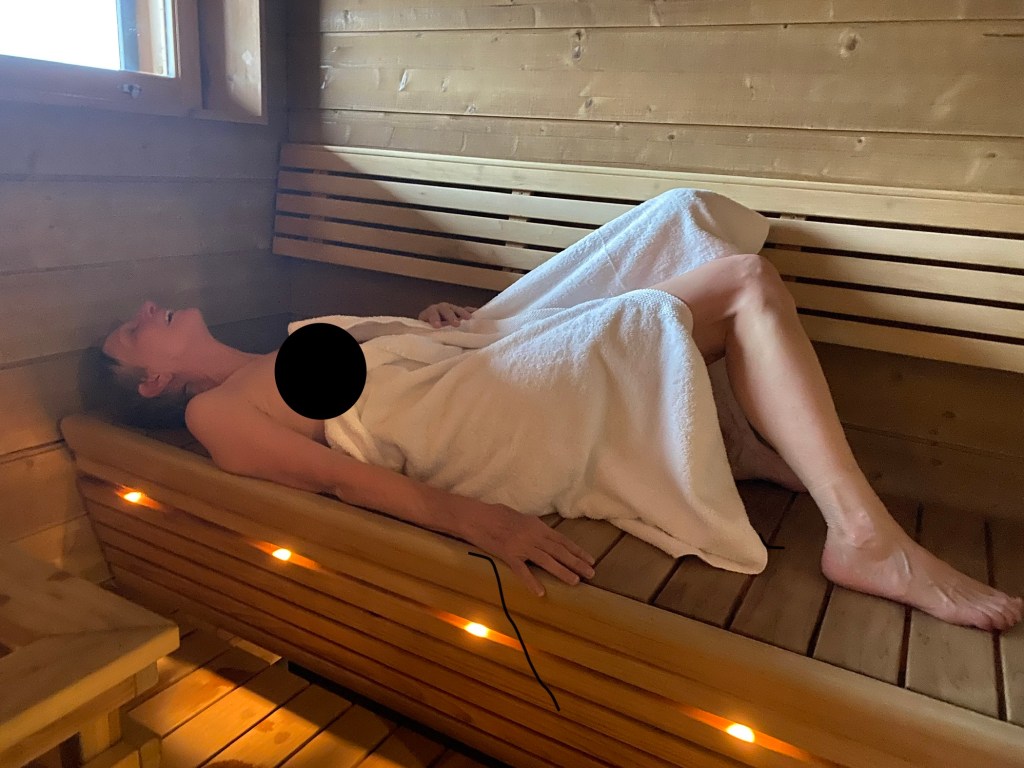
A mark of a truly advanced society is a tradition of communal bathing… the onsen in Japan, the scrub in Korea, the hamam in Turkey, the banya in Russia and the sauna or hot pot in Nordic countries. These practices are lacking in America and many Western European countries… which managed to thrive in spite of the stench of their citizens in earlier times.
There is bliss in a Finnish sauna….
Stunning beauty in the dry sauna at the Sky Lagoon in Reykjavik (with the largest single pane of glass in all Iceland)…..
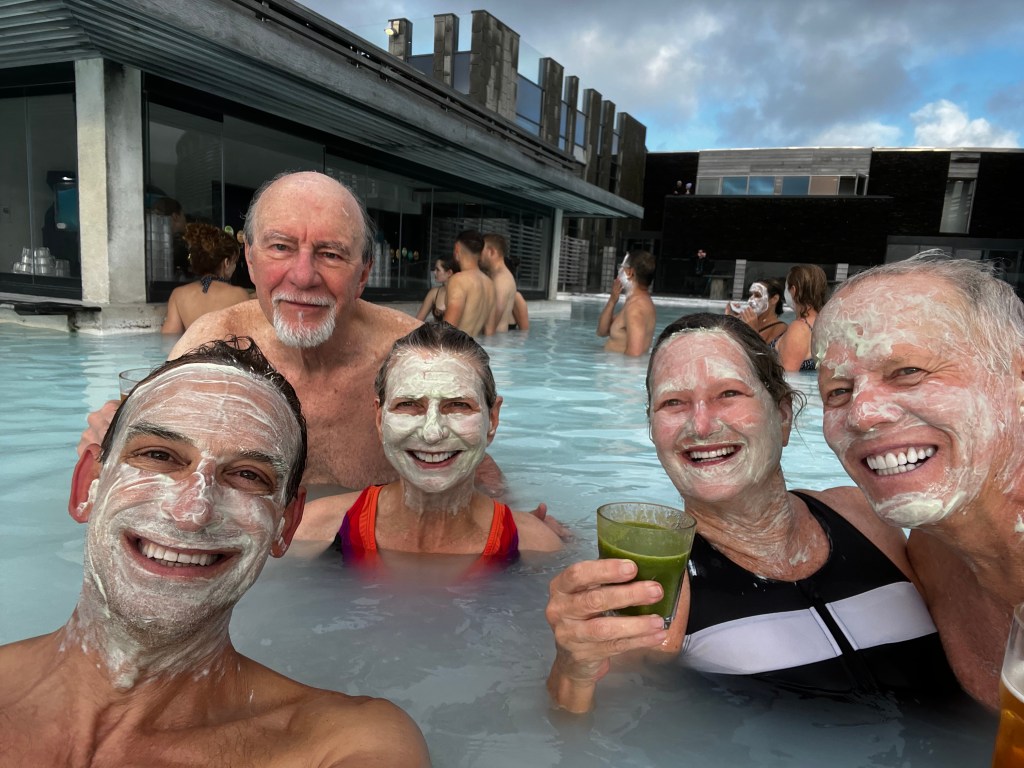
and a shared sense of well-being in the thermal waters of the famous Blue Lagoon….. (as mineral masks take years off mature faces).
How very civilized!
Soon we return to our native land, flying to our nation’s capitol, then driving back to East Texas and home. Final post to follow!
Back to the US after a fast-paced tour through an amazing variety of places.
How rewarding the trip was….. the appeal of this kind of travel is waking up every day knowing that you will see or learn something you have never seen or maybe even thought of before. We met a lot of fascinating people….. and were reassured that there are still many thoughtful, caring citizens in this increasingly-polarized world.
On the other hand, we got a little tired of trudging around in a group, off and on buses big and small for long trips and short trips. We were happier skipping some of the planned activities in favor of simply walking around. And nobody seemed surprised that most of the travelers came home with a small case of Covid… since recovered, in our case.
Accolades are due to National Geographic for putting together a broad array of experiences and seeing to a jillion details so that we could concentrate on developing more understanding and respect for cultures and histories so unlike our own.
We return to Washington, DC and from there take a road trip back to the desiccated husk that is East Texas after many weeks of oppressive heat and drought.
Until next time, please…. Go in peace. And you don’t have to “go” in a private jet…..
(Although it is very nice……..)
… You can go instead to the new Ethiopian restaurant across town, or go to a nearby archeological site (there are more than you think!) or go to the local library to learn something about a culture you have never heard of (ask a librarian!) or go to a music or dance performance for sounds and rhythms from another corner of the world. Take yourself away from the familiar with an open mind and be prepared to be deeply affected….. You may feel a little diminished in the process, but also more integrated with the richness, history and variety of the people who populate this precious, fragile planet.
This summer will be hot! Not particularly surprising, but the chart below provides another compelling reason not to be in this part of the world over the next few months:
So we are heading out in a few days for Iceland and beyond… will pick up a tiny motor home in Reykjavik so that we can circumnavigate the island over the next few weeks.
Iceland is called the Land of Fire and Ice – “fire” for the extensive geothermal activity there (we hope for a volcanic eruption!) and “ice” for the subarctic conditions that include glaciers and a permanent ice sheet that covers a portion of the island.
The term “Fire and Ice” always brings to mind a short poem that doesn’t have anything to do with this, but I happen to like it a lot.
Some say the world will end in fire,
Some say in ice.
From what I’ve tasted of desire
I hold with those who favor fire.
But if it had to perish twice,
I think I know enough of hate
To say that for destruction ice
Is also great
And would suffice.
Robert Frost
Love the meter and rhyming scheme. “They” just don’t write poetry like that any more!
But hopefully this blog will NOT be about the end, but about a new part of the world we have only dipped our toes into before – the Arctic.
The word Arctic is derived from the Greek word “arktos”, or bear – referring to the northern constellations known as Ursa Major (Big Bear) and Ursa Minor (Little Bear). These constellations incorporate the features known as the Big and Little Dippers. The North Star, or Polaris, is part of Ursa Minor and has been used for centuries in navigation to establish the direction of true north.
Perhaps only coincidentally, the Arctic is home to the polar bear, one of the largest land predators in the world.
The Antarctic, at the southern tip of the planet, was named to establish it as the opposite of the Arctic region. It’s also fitting since there are no bears there.
Hope you will follow us as we again seek cooler climes!
Earlier this year we ventured on a road trip west to Rock Hound Mecca – Quartzsite, Arizona. In January and February each year, the population goes from less than 2,000 souls to more than a hundred thousand, virtually all of whom are visiting in RVs and campers. These folks are by and large “mature” retirees – distinguished, however, by their vigor and energy, zooming around town and the nearby hills in ATVs and eating way too much junk food in the local eateries. (They generally will not become a burden on society and their families for another 10 or 20 years!)
They come for the swap meets and rock and mineral shows, as well as the camaraderie of their fellow oldsters! Here is a view of the town from our powered parachute, the big rock show in the foreground and camping areas spread out for miles around:
Henry was in hog heaven buying rocks, participating in auctions, visiting wholesalers, trading stuff and sharing stories and experiences with like-minded rock enthusiasts from around the world – Argentina, Germany, Afghanistan, Mexico and more.
Our camping space was far out of town, where we had space to launch the powered parachute. Raider was along for the ride!
Marfa, in far West Texas, had a fabulous rock shop that provided several days of browsing (and purchasing) for Henry’s rapidly growing collection.
Fascinating and friendly people along the way…..
Cousin Galen and his wife Mary were consummate hosts at their winter getaway in Green Valley, AZ – where we played golf (!) and helped prepare a meal for some homeless folks in Nogales near the Mexican border.
Of course, no road trip is complete without a breakdown of some sort – in this case, a flat tire near sunset along the border…..
Back on the East Texas home front, Henry processed some of his finds in his lapidary shop (wearing the very latest in protective gear):
His wares were displayed (and a few sold) at special Farmer’s Market events in Nacogdoches, here with daughter Ivy and grand Morgan helping out.
Visitors always receive geology lessons……grands Jake and Mallori here.
A long-postponed project realized – installation of heavy iron doors from an old kiln on the barn. Another heritage item preserved!
And that brings us more or less up to date since last year’s journey to South America and Africa. Looking forward to getting out and about again!
In Boston for a couple of days before our leap further north, we saw several historical sites, but one was particularly intriguing –
Victory gardens were established in the US shortly after it entered World War II as a way for private citizens to grow their own food, freeing up larger agricultural efforts to support the military. At their height, victory gardens supplied more than 40% of the fresh fruit and vegetables consumed in the US! Boston’s Fenway Victory Gardens is the only such garden that has remained in continuous operation at its location since its inception over 80 years ago. It is a lovely oasis of more than 500 small tenderly-cultivated plots in the heart of the city (now featuring flowers and ponds as often as comestibles…)
A local eatery reminded us of the theme of our ultimate destination.
And off we went, with an intriguing view of Greenland along the way.
The Icelandic language is closer to Old Norse than modern Norwegian is…. With some very difficult sounds for American English-speakers – including me, obviously. The name of the Land of Fire and Ice is….
We flew into the capitol city, site of the famous 1972 Cold War competition between American chess player Bobby Fischer and Russian Boris Spassky…. pronounced, more or less…..
The name of the international airport is roughly –
I intend to continue mangling the language as we go along, in a feeble effort to learn something new and exercise my remaining viable brain cells. Although it is almost totally unnecessary, as everybody here speaks near-flawless English.
Our primary residence for the next 25 days…..
Our first incident….. on Day 2! Stuck in the mud after a torrential rain!
Thank goodness for the kindness of strangers with a winch! A very nice couple from Switzerland pulled us out of the muck.
And one of Henry’s favorite activities in a new country – visiting the local thrift store!
(The lady on the left clearly knows exactly what to wear for such an activity – hot pink sheath and matching sling-backs with a faux-leather fringed jacket!)A one-of-a-kind memento that will also come in useful on the trip!
Preliminary activities taken care of, the next posting will include some fabulous photos of this beautiful country……
Weather being very changeable, we were extremely fortunate to have a clear and sunny day for our helicopter tour….. first, over the volcanic area near Reykjavik, where there was an active eruption as recently as a year ago!
From there, over some amazing inland water features…..
And across glaciers and over the Highlands in the central part of the country, which are accessible on the ground only by 4-wheel drive vehicles, and then only for a couple of months in the summer.
Looks like a Cézanne painting!
Iceland has innumerable waterfalls…. The pilot landed the helicopter so we could approach and admire this one, Haífoss, on foot.
Sightseeing from the air is such a treat….. this video illustrates the thrill of rising over a landscape that is breath-taking from any angle.
We moved on from the Reykjavik area north to a peninsula called……
Henry enjoyed walking along the beach; most of them here feature black sand derived from volcanic material…. Here he is with the “lava” his life:
And a pilgrimage to a Game of Thrones filming site, known in the show as Arrowhead Mountain, north of The Wall.
It was mostly covered in snow and ice in the film…… spectacular in any event!
From the Snæfellsnes Peninsula we took a ferry from Stykkishólmur to Brjánslækur in the Westfjords, a region with stunning scenery that is somewhat off the beaten track.….
Látrabjarg is the site of 14 kilometers of impressive cliffs that provide nesting places for approximately a zillion birds…. Gannets, guillemots, razorbills and puffins, among others. (We were there at the wrong time of day for puffins… apparently they spend their afternoons fishing in the ocean.)
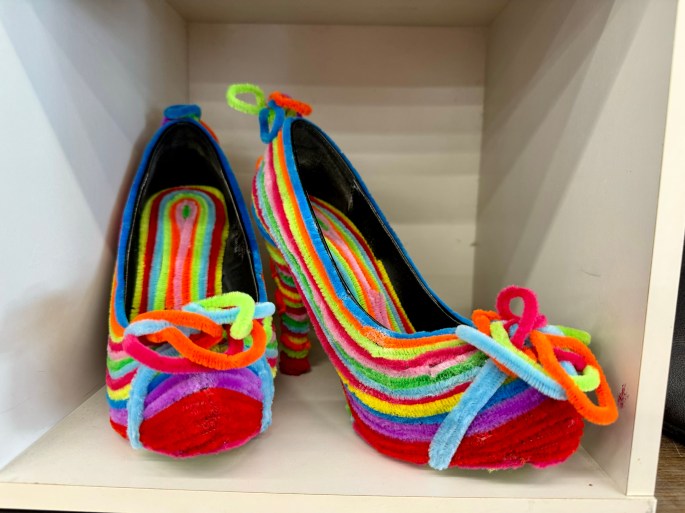
June is Pride Month…. And we noted that Icelanders are either very proud, or else fond of the rainbow!
Salt in the olden days was a precious commodity, traded all over the world. The industry was abandoned in Iceland at one point, but resuscitated in the Westfjords not so long ago. The processing facility was next to one of our campgrounds.
Five different types of salt to try – flaky, seaweed, licorice (!), birch-smoked and lava… all of them processed from Greenland Sea water in this remote facility and shipped around the globe!
We very much enjoyed visiting about world issues with the young Croatian salt maker.
And at last, Henry got a chance to acquire a vehicle license plate from Iceland, trading it for an old Texas plate…
A few words about our (mostly) trusty vehicle and the camping experience. We are generally required to overnight in established campgrounds. Reiner, the like-minded traveler we met in Namibia last year, has been to Iceland many times and gave us suggestions and directions to one or two “special” camping spots….. like this one….
This poor motor home (I’ve been calling her Bessie Mae) has been through many rodeos, and creaks and moans a lot as we take advantage of her features. After several days of intense searching, we finally found a can of WD-40, which Henry generously applied to some of Bessie Mae’s tender joints. She is very grateful.
Bessie Mae is bigger than what we expected, with a nice eating area….
A little kitchen space, teeny bath with toilet and shower, two bunk beds where we store our luggage, and a bed that descends from the ceiling for sleeping!
Although we generally prefer to find remote areas to spend the night, we have had great luck with beautiful campgrounds, in spite of having neighbors……
And remember – this far north at this time of year, the sun never fully sets. Here is midnight in another lovely place:
A view we are all rich enough to share!
(Lest you think I have turned coward, please know that I will in fact mangle some more place names in a future post or two! Stay tuned!)
Husavík, on the north coast, is the Whale-Watching Capital of Iceland…. Also the location for the film “Eurovision Song Contest – Fire Saga”, a cute comedy with Will Farrell and Amy McAdams that was largely filmed in this small town.
The movie is not great cinema (although its theme song was nominated for an Oscar!), but it is a charming travelogue for the area. Many scenes were shot in the harbor in front of the sailing schooner Opal, which was our home for 3 days, along with 10 other passengers and crew members.
The Opal is a sailing ship….. and when not under sail, it is powered silently by its hybrid electric motor, which makes for peaceful cruising that is far less likely to startle the surrounding marine life.
With teeny cabins….
Cosy dining room…
But lots of deck space and incredible weather….
There was even an onboard hot tub!
The first mate caught a fish!
The onboard marine biologist dredged the water from time to time, expecting to find lots of plastic and other pollutants, but it actually came up pretty clean (the pinkish material is a marine invertebrate, kind of like krill).
A major activity was looking for whales… blue whales and lots of humpbacks were spotted…
White-beaked dolphins and beautiful calm seas….
The itinerary included Grimsey Island, where a giant gray sphere denotes the location of the Arctic Circle.
Also onshore were semi-abandoned villages …. And a cunningly-designed knitted cover for the township trash container.
And puffins nesting among rocks on the shore!
A fellow passenger breaks out some hardfiskur, a traditional dried fish snack that is quite popular….. although some people like to play with their food before they eat it.
The sailing experience was a wonderful way to meet local people and see the island from a different perspective.
Here are some of the things you will notice on a road trip in Iceland.
Well, first and foremost …..
BREATH-TAKING SCENERY
Of course, more of this later..
You will also see…….
WATERFALLS
Mountainous terrain + glaciers + plenty of water = lots of waterfalls.
It’s a pity because after a while, you simply don’t notice any more just how spectacular they are.
Did I mention……
GLACIERS?
About 11 percent of Iceland’s land area is covered by glaciers. Lots of people like to hike or take a boat ride to see them up close.
One thing you will not see is…
TREES!
Iceland was first settled in about the 9th century by Norwegians….. and one of the first things they did was to clear those pesky trees to make way for raising livestock and planting crops. What they did not appreciate is that poor soil and a harsh climate would inhibit natural regrowth, and the island was stripped of trees in only about 3 centuries.
This is a treeless golf course…. !
To be fair, there are significant reforestation and soil conservation efforts under way, but they are up against so many years of neglect. It would be easy to become discouraged. As one Icelander pointed out to Henry, it can take 17 years for a seedling to grow to just shoulder height….. to which the wise forester replied, “The tree you don’t plant will never grow at all.”
And although not actual trees, you do see a lot of upside-down driftwood (most of which we are told comes from Russia) used as decoration or signposts…
And then there are the descendants of the livestock the Norwegians were so anxious to establish here….
SHEEP
Sheep are everywhere. There are more than twice as many sheep as people in Iceland.
At this time of year, the adult females always have two babies with them (don’t ask about other seasons….. lamb is a very popular dish here).
During the frequent rainy, cold and/or windy weather, they get a little shelter in hollows in the hillsides….
In addition to providing meat, the sheep produce wool which is most popularly used for knitting….
ICELANDIC SWEATERS or LOPAPEYSA
Knitting has always been a pastime in Iceland – a good way for both men and women and even children to spend the long winter nights. People have knitted here for hundreds of years, but the lopapeysa gained popularity in the mid-20th century, possibly as a symbol of Icelandic identity after it gained its independence from Denmark in 1944.
Even Jesus is depicted wearing one on an altarpiece in a Christian church on Flatey Island…
Getting back to the after-effects of deforestation, one bit of flora you see all over Iceland is …..
LUPINE (pronounced loop-en in English)
After World War II, Iceland decided to try to reinvigorate the vegetation which had been destroyed in the past by finding new plants and trees that could establish quickly and hold and nourish the soil. Its Forest Service director went to Alaska and brought back several species, most notably the Alaskan lupine, which was introduced in 1945.
A pretty flower – not unlike the Texas bluebonnet on steroids – it has spread all over the country. And although it has been wildly successful in enriching the soil, there are Icelanders who consider it an invasive species and are dedicated to eradicating it from many areas. Love it or hate it, lupine has become a distinctive part of the landscape.
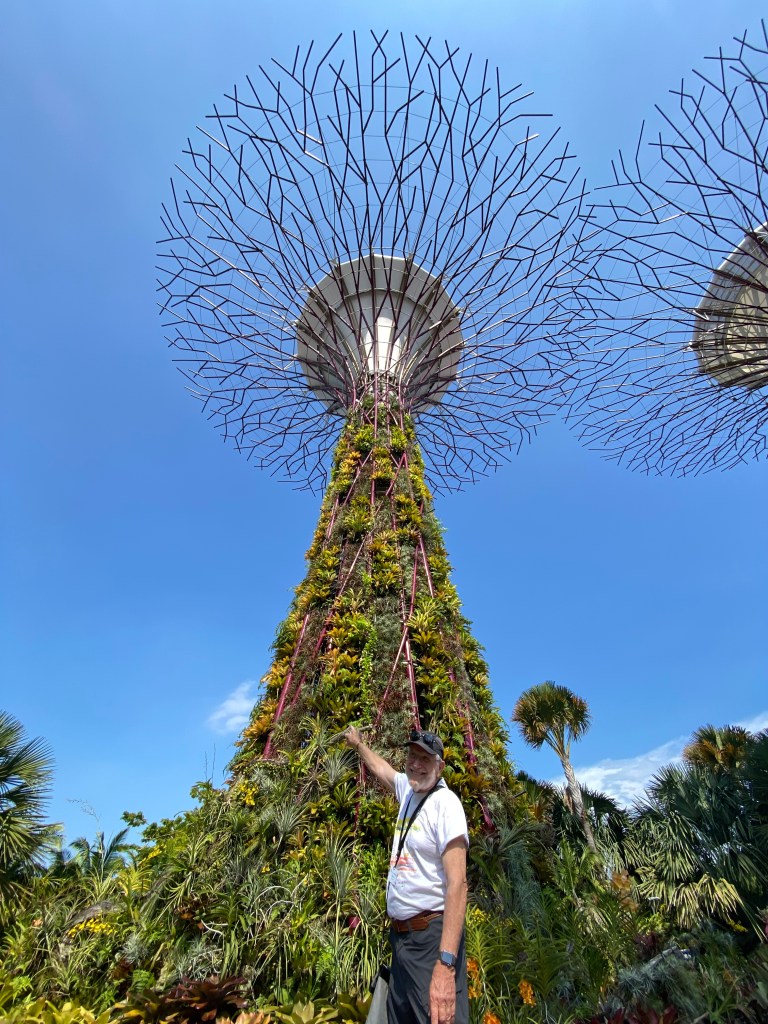
Another part of the scenery….
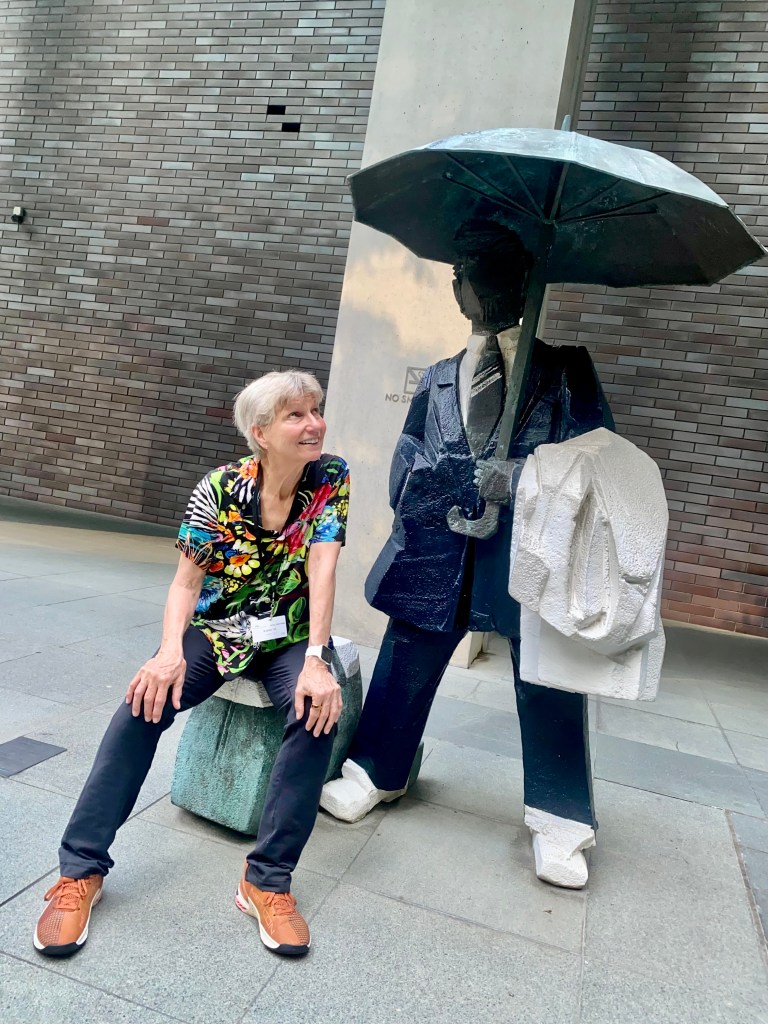
TURF HOUSES
With a lack of lumber following deforestation, Icelanders began using turf in building (the above dating to the 12th century). Turf provides good insulation in a cold environment, and was abundant in inhabited areas.
More from the road later!
(Just a reminder – if you receive the e-mail version of the blog, be sure to click on it to open it in your browser so you can see the videos!)